"Sweet April showers do spring May flowers" - Thomas Tusser
A bit late with April's report, mainly down to my tardiness but I'll use the excuse that May (when I prepare April's bulletin) is always the busiest of months in the kitchen and flower garden. I'm having trouble trying to recollect what sort of month April was as we approach the end of May. I hope my memory is not playing tricks but cool and cloudy is what I recall.
At the start of the month (Photo 1), it was cherry blossom time and the beginning of the tulip season:
Photo 1: Rear Garden View (April 2nd)
By the middle of April (Photo 2), the cherry blossom had gone and the tulips had taken over with their multi-coloured blooms. The red acer tree was just beginning to leaf up and the apple blossom was starting to burst.
Photo 2: Rear Garden View (April 16th)
Come to the end of April (Photo 3) and the apple blossom was in full flow. The red acer tree was providing a strong focal point while the tulips supplied the vibrant colours.
Photo 3: Rear Garden View (April 30th)
The daily photographs of the rear garden are collated in the timelapse video (Video 1) below:
Video 1: Daily Rear Garden Photos - April 2023
Summary of Weather Parameters for April 2023
Cooling and Heating Degree Days have been added to the list. Sunshine hours are estimated from average daily solar radiation values measured by the Davis weather station. A list of average and total weather parameters is given in Table 1.
Overall, April 2023 was a coolish, though not cold, month with average rain and below-average sunshine.
Table 1: Average/Total Weather Statistics for April 2023
April 2023
Weather Parameter
Value
Dates
Average Monthly Temperature
9 oC
Maximum Monthly Temperature
21 oC
29th
Minimum Monthly Temperature
-1 oC
3rd & 4th
Number of Air Frost Days
3
Number of Hot Days (> 25 oC)
0
Monthly Precipitation
43.0 mm
Greatest 24 h Precipitation
10.2 mm
11th - 12th
Number of Dry Days
14
Monthly Sunshine Hours (estimated)
142
Average Wind Speed
3 km/h
Highest Wind Speed
50 km/h
10th
Maximum Barometric Pressure (Sea Level)
1031.5 hPa
3rd
Minimum Barometric Pressure (Sea Level)
982.4 hPa
12th
Average Barometric Pressure (Sea Level)
1014.8 hPa
Heating Degree Days
269.7
Cooling Degree Days
0.6
Daily minimum and maximum temperatures are shown graphically in Figure 1. Fairly consistent, if cool, daytime (maximum) temperatures. Overnight temperatures were generally low with occasional excursions into zero/sub-zero temperatures which held back plant growth and bee swarms during April.
Figure 1: Daily Min/Max Temperatures for April 2023
Figure 2 presents the daily rainfall and sunshine hours (using solar radiation as a proxy). Regular periods of rain and generally overcast (low solar radiation) with relatively few bright sunny days.
Figure 2: Daily Rainfall and Solar Radiation (proxy for Sunshine) for April 2023
Comparing April temperature parameters for the last four years (Figure 3), the anomaly that was April 2020 is immediately clear. Subsequent Aprils have been cooler and much nearer the average April temperature (8.7 ℃) for the Central England Temperature (CET) dataset.
Figure 3: Temperature Data for the past four Aprils (2020 - 2023)
Figure 4 summarises the last four years of precipitation and sunshine data for the month of April. Following a couple of dry April months in 2021 and 2022, this year's April returned to more typical values. [Note: the extremely high rainfall in April 2020 (73 mm) was distorted by a single 24-hour downpour of 48.4 mm]. Sunshine hours were predictably also lower than expected due to higher rainfall and fewer dry days.
Figure 4: Rain, Sunshine, Wind Data for April 2020 -2023
A summary, by The UK Met Office, of the UK weather in April 2023 can be found here. Herefordshire (circled) had a very average month temperature-wise (Figure 5) ...
Figure 5: UK Average Temperatures (April 2023)
... with a distinctly below average in maximum daily temperatures (Figure 6):
Figure 6: Average Daily Maximum Temperatures for April 2023
On the other hand, rainfall (Figure 7) in Herefordshire (circled) was as typical as could be this month ...
Figure 7: UK Rainfall for April 2023
... whereas sunshine was a little under the weather in these parts ...
Figure 8: UK Sunshine Hours (April 2023)
Jobs in the Garden
trials and tribulations getting my additional hot composting bins going as the supply of garden waste from the neighbours went up two or three notches. See here, here, here, and here for the first four instalments - more to come
Sowing tomatoes, cucumbers, aubergines, chillies, courgettes and bell peppers in a heated propagator
As noted in a previous post, Greenhouse Sensation ceased trading sometime toward the end of 2022. As I mentioned in that post, I half-expected the company to reappear under new management and this now appears to have happened, albeit, it will be a few months before things get properly sorted. Previous customers of Greenhouse Sensation should have received an e-mail from the new owners promising a new website in the autumn of 2023. In the meantime, you can contact the new owners at info@greenhousesensation.co.uk.
Of immediate concern to current users of the Quadgrow system is the availability of the Nutrigrow nutrient packs. I have just heard back from the 'new' Greenhouse Sensation who have let mt know the Nutrigrow nutrient packs are availalble via their trade reseller Two Wests. When the Greenhouse Sensation website is up and running in the Autumn, you will be able to re-order directly from Greenhouse Sensation.
In the meantime you might want to consider using S-Chelate 12 Star as an alternative/option. Based on the elemental composition given for this product, I estimate it's N-P-K value to be 7-7-21 which is close enough to the 10-5-20 provided by the combined Nutrigrow A + B packs. S-Chelate 12 Star also provides a source of calcium (as Nutrigrow A does) plus the added benefit of sulfur (not provided by Nutrigrow nutrient packs).
Photo 1: S-Chelate 12 Star all-in-one nutrient for Quadgrows
I have not tried the S-Chelate 12 Star product yet as I am still working my way through my stock of Nutrigrow A + B. At some point I would like to give it a try, possibly comparing it with the original Nutrigrow nutrient mix. If you do find the S-Chelate 12 Star product is as good as or better than the Nutrigrow, then you should send a thank you to John Harrison at the Allotment Garden Diary who has done all the hard work finding this alternative. John reckons this is a superior product to the Nutrigrow due to its improved formulation, simpler one-pot use and no requirement for preparing stock solutions. Each 500g tub will make 400 litres of nutrient solution for adding to your Quadgrow reservoirs (i.e. the same as Nutrigrow). And the price for S-Chelate 12 Star is competitive with Nutrigrow especially with the free delivery available on orders over £20.
In my search for alternatives to Nutrigrow, I found two options:
The Chempak range from Thompson & Morgan includes a High Potash Feed (NPK 15-15-30) and a Calcium supplement which can be used in exactly the same way as Nutrigrow A (calcium) and B (high potash). Finding the Chempak Calcium product on the Thompson & Morgan website was challenging but it is also available from lots of resellers. This is a very cost-effective option as the 750 g packs cost the same as Nutrigrow and you get 3x the amount of soluble fertilizer (i.e. 1200 litres).
Agrigem, confusingly, also sell a Nutrigrow range of soluble fertilizers. Unfortunately for the home grower, they are only available in 25 kg bags. The Calcium Nitrate and Revive and products are good substitutes for Nutrigrow A and B respectively; use the same amounts (250 g dissolved in 2.5 litres) and dilutions (6 ml of each in 1 litre) as you would for the Greenhouse Sensation products. Note the Revive product also includes sulfur like the S-Chelate 12 Star.
If we ompare the relative costs of all four options (Nurigrow A+B, S-Chelate 12 Star, Chempak and Agrigem's Nutrigrow) then the cheapest option (per 500 g soluble fertilizer) is Agrichem's Nutrigrow at £1.35, followed by Chempak at about £4 and, finally, S-Chelate 12 Star and the original Nutrigrow A+B at £7.50.
If I've made any mistakes with my calculations, please let me know.
For pedantics, I have used the spelling of sulfur approved by the Royal Society of Chemistry (RSC) and the International Union of Pure and Applied Chemistry (IUPAC). The older spelling, sulphur, is still widely used however.
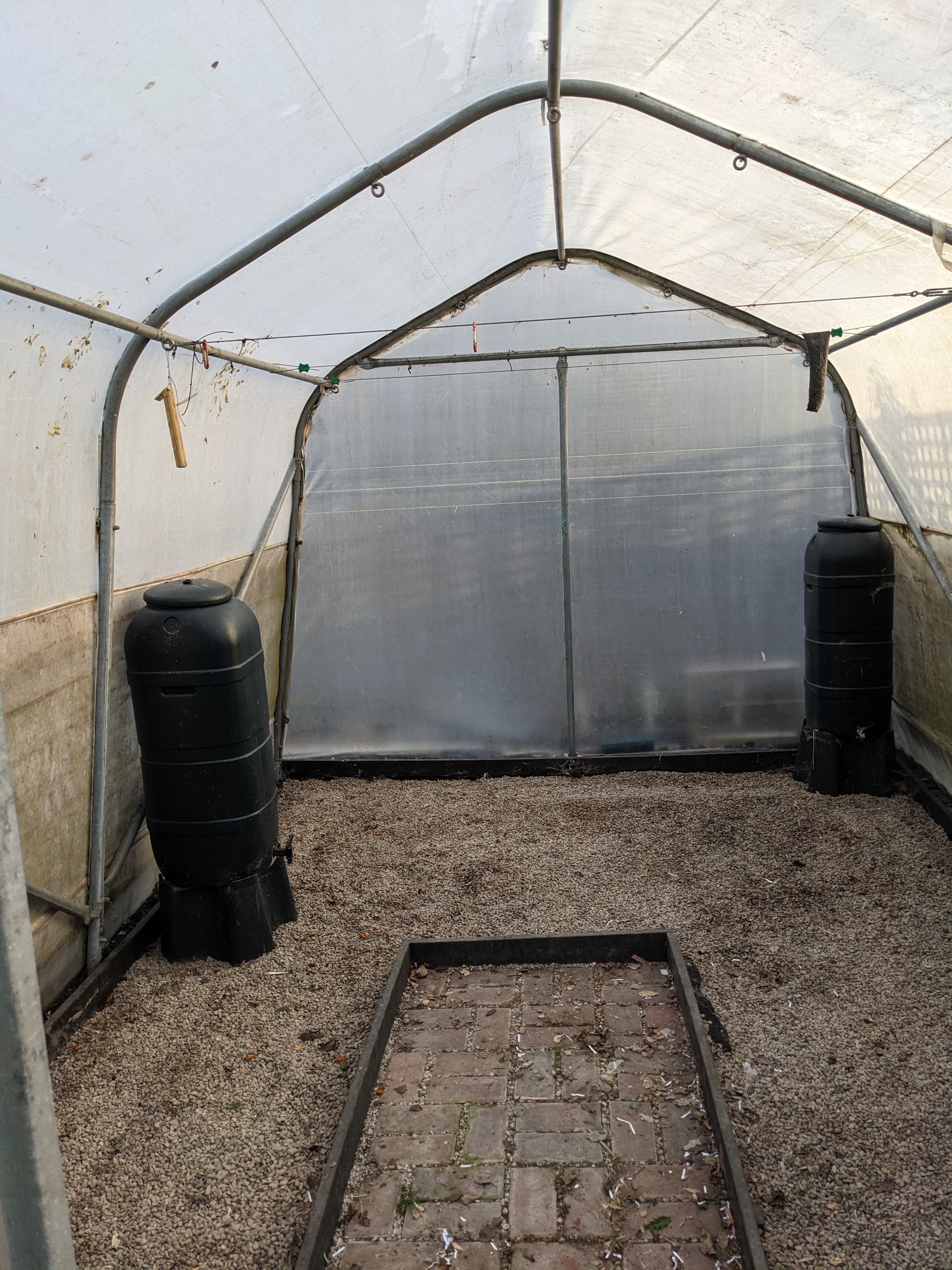
This was the state of the polytunnel on the 14th of March (Photo 1):
Photo 1: Polytunnel (14/3/23)
Essentially a storage/work space! The Quadgrows and Veg/Salad Planters had been emptied, washed, and left to dry. I had some bare-root raspberry plants soaking in one of the Quadgrow reservoirs (left-hand side) ready for planting out. In addition to tidying everything up, I needed to wash down the polythene cover - inside and out - and 'sterilize' the growing space.
About 6 weeks later, I finally got around to doing it. The first job was to empty the polytunnel ready for washing down with a pressure washer ...
... doesn't see a whole lot of action - washing the car (1 or 2 times a year), cleaning the patio/driveway (once every couple of years), and washing down the polytunnel cover inside and out (once every couple of years). But it is very good at what it does and saves a whole lot of time! I feel certain the plants growing in the polytunnel appreciate the improved light levels. Photos 5 & 6 show the improvement.
Photo 5: After pressure wash
Photo 6: After pressure wash
Time to put back everything that needs to go back - I plan to have a less cluttered polytunnel this year!!
Photo 7: Overcrowded Polytunnel (August 2021)
The Quadgrows are the first to return. These will be planted with cucumbers, tomatoes and squash this year. If you have the 'holiday watering kit' option, now is a good time to check that the water level controller (or ballcock) is free of debris and working as it should.
Photo 8: Making sure the Quadgrows are level
If you need to replace this item, just search for 'water float shut off valve' - here is an example I found on Amazon - just remember to check it fits your set-up.
My water level controller had only a small amount of root debris (Photo 9) that did not affect its operation - but was still worth removing. I have seen worse cases, especially during the growing season when the tomato and cucumber roots are extensive!
Photo 9: Root Debris on the Water Level Controller
The valve is easy to disassemble by removing the snap lock pin with a pair of pliers though, normally, this is not necessary for cleaning.
Photo 10: Disassembled Valve
The only other part that needs regular maintenance is the filter (Photo 12) in the reservoir tap (Photo 11). I have two barrel reservoirs (Photo 5) - one with a cone filter (Photo 12) and one with a disc filter (not shown). These can become blocked by solids in the nutrient solution - including precipitates formed from the Nutrigrow A & B mixtures.
Photo 11: Tap Assembly on Water/Nutrient Reservoir
Photo 12: Witches' Hat Filter in Tap Assembly
To clean, remove the filter holder (the lower black section in Photo 11) and flush both ways with running hot water. Generally, I check the Quadgrow reservoirs every other day to ensure the water levels are as expected. If I am going to be away for more than 3 days, I will also check the filter and give it a clean for good measure.
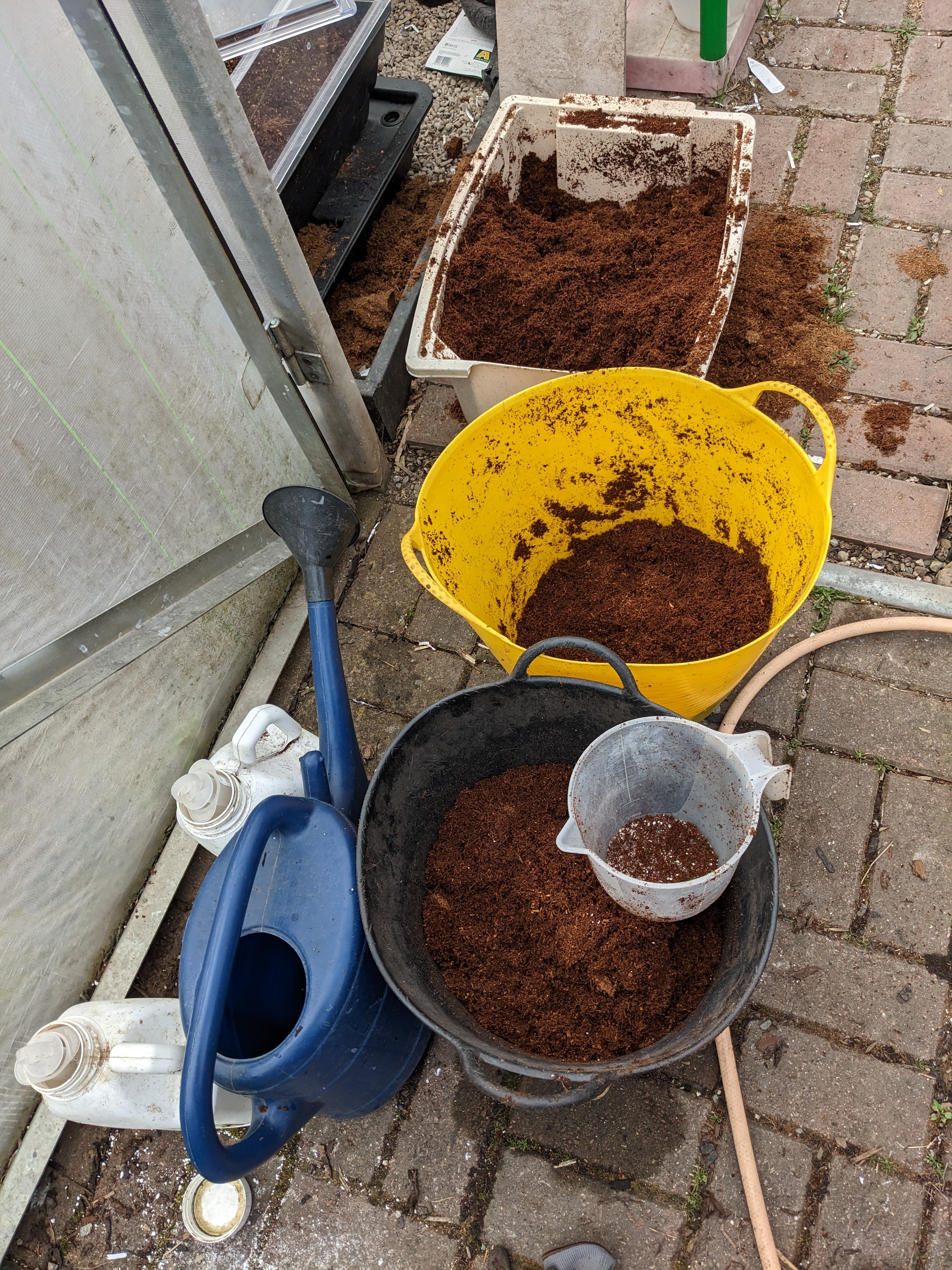
The next job was to prepare the growing medium for the Quadgrow Planters and Veg/salad Planters. Fuller details on how I do it can be found here. Everything you need is shown in Photo 13: large containers/trugs, 2-litre measuring jug, coir block (5 kg), Nutrigrow A & B nutrient stock solutions, water source (hose pipe) and watering can (10-litre).
Photo 13: Preparing Growing Medium for Quadgrow Planters
I made a small change this year - instead of adding 20 litres of tap water to the 5 kg coir block, I used a half-strength solution of Nutrigrow A+B. Using just water is fine but due to the late start to the growing season, I wanted to give the young plants an early boost. To prepare the final growing medium, I add 2 litres of perlite to 8 litres of expanded coir and mix by hand (Video 1)
Video 1: Mixing Coir and Perlite
The Veg/Salad Planters were assembled as per instructions, placed in position, checked for levelness (?) and the capillary matting wicks added.
Photo 14: Salad/Veg Planters ready for filling with the growing medium
The easiest and quickest way to prewet the wicks and fill the bottom reservoir with nutrient solution is to add it before filling with the growing medium (Video 2):
Video 2: Filling the Salad/Veg Planters with Nutrient Solution
There is not much to go wrong with the Salad/Veg Planters. I have lost a few of the stoppers used to plug the reservoir filler hole (Photo 15) ...
Photo 15: Reservoir Filler Hole on Salad/Veg Planter
... but these rubber bungs work well and are more difficult to lose.
So, finally, everything is in its place ready for the plants:
Photo 16: Polytunnel, clean and tidy and ready to go!
This year we did not have any frogspawn in our small garden pond. Mary did find a dead frog in late winter and we weren't sure whether there were any frogs left. Using the water sampler I bought for river testing ...
Photo 1: Water Sampler/Pond Emptier
... Mary carefully emptied the pond one litre at a time ...
Photo 2: Pond emptying completed
We weren't sure whether there was any amphibian life present so were pleasantly surprised when a small frog was found lurking in the sediment at the bottom of the pond (Photo 3)
Photo 3: Resident Amphibian
The pond was refilled with rainwater from our water butts and we made sure he had an escape route should he* wish to leave ...
Photo 4: Checking the coast is clear
* Mary thought it was a 'he' due to his/her diminutive size
Photo 5: Deciding to stay awhile
And why would you want to leave such an idyllic garden? Can you spot the flying blackbird?
The growing season is off to a slow start this year. It is May 20th and, already, we seem to be several weeks behind where I would expect to be. This is a picture (Photo 1) of our comfrey plant taken today (20th) ...
Photo 1: Comfrey (20th May 2023)
... and this is a photo (Photo 2) of the same plant taken three years ago on a slightly earlier date (16th May 2020) ...
Photo 2: Comfrey (16th May 2020)
... when the comfrey was flowering and one to two feet taller; in fact, enough growth to prepare my first batch of comfrey tea.
I am still awaiting some sign of life from the beetroot, carrots and parsnips I sowed directly in the ground on the 8th April - to be fair there is one beetroot plant that has dared to show its head. The weather has been dry but I've watered the seeds regularly using rainwater from our water butts. I have now resorted to using one of my Greenhouse Sensation Veg/Salad Planters as a seedbed (Photos 3 & 4):
Photo 3: Veg/Salad Planter Seedbed
Photo 4: Seedbed with Lid
The semi-automatic watering system of the Veg/Salad Planter should provide the right amount of water for the seeds to germinate and thrive. The mini-greenhouse will help provide extra warmth - the lid is removed during the day and replaced overnight.
I'm still waiting for my sweetcorn to germinate - in previous years I've planted out the young plants in mid to late May! The asparagus season started more or less on time.
I've spoken to a few gardeners and they also report slow germination and growth this year. Whether it is chilly nights, lack of rain or a bit of both, I'm not sure. Maybe this year's seed is a little old. Maybe I have just been unlucky. In any case, it's fine to start a little late - let's hope the growing season extends well into autumn.
.JPG)
.JPG)
.JPG)


.png)







.JPG)




 Posts
Posts

