Flowering Asparagus

The cropping season for asparagus has finished and the bed is in its resting stage throwing up its ferns to replenish the crowns. Later, in autumn, the ferns will turn golden yellow before they are cut back.

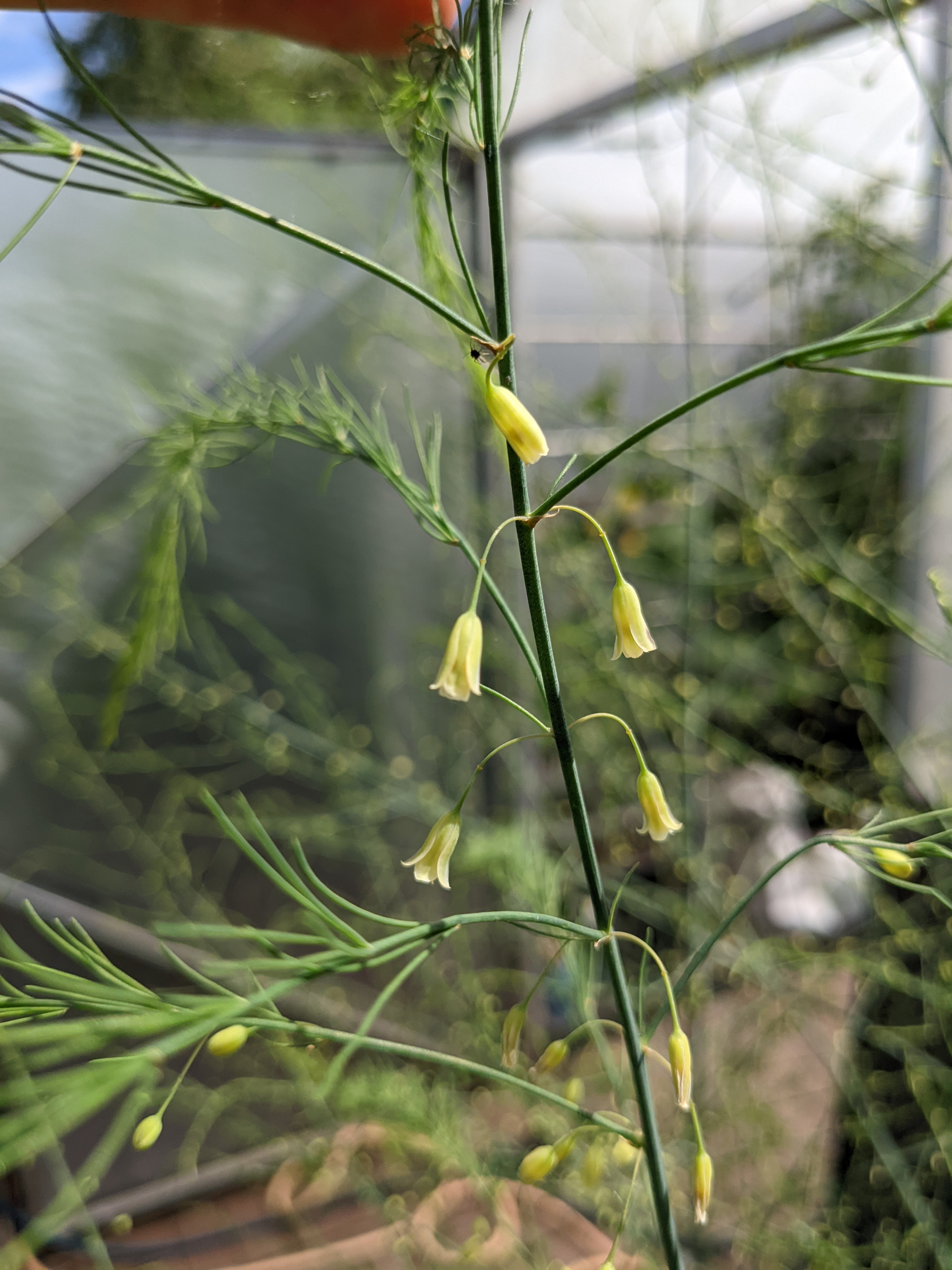
Tying my shoelace next to the asparagus beds, I started to look around to see if there was anything else I could do while I was down there. There was a strong buzzing sound in my ear and my attention was drawn to several bees navigating the asparagus forest adjacent to my head.  The bees were collecting nectar from the tiny asparagus flowers; I cannot recall having noticed the flowers before. Here is the video I recorded on my Pixel 4a phone in slow-mo... 


Here is a close-up of the delicate lemon-green flowers...


Asparagus flowers
...and seen from a different point of view...

Asparagus flowers

That's what I love about Nature and Gardening - always something new, always something to learn.

Heatwave & Extreme Temperature Alert

Belle

We are on dog-sitting duty near Reading (16th July) in the middle of a heatwave. The Met Office has issued a Red (Extreme Heat) warning for this coming Monday and Tuesday (18-19th July). Today at 3 pm, it is a balmy 28 ℃ in Oxfordshire with a predicted 39 ℃ for Monday! There is a good chance the UK maximium temperature record (38.7 ℃) will be broken in the next few days

Gardenning-wise, not the best time to be away. Fortunately, we have someone staying who can do some watering but the plants in the garden, polytunnel and greenhouse will be experiencing some degree of stress back in Hereford.

The UK Met Office define a heatwave as an extended period of hot weather relative to the expected local conditions at that time of the year. For the UK, a period of 3 consecutive days when the daily maximum temperature exceeds a set threshold for that location is deemed a heatwave. Threshold temperatures are set for individual counties and vary from 25 ℃ to 28 ℃. As a result of global warming, threshold temperatures are increasing especially in the South-East of England.

The UK Met Office has set a 2022 heatwave threshold temperature for Hereford at 26 ℃ though much of the UK (Wales, Scotland, Northern Ireland, the South-West and North England) retain a heatwave threshold of 25 ℃.

The plot below shows the minimum and maximum temperatures for July (up to 16th) as measured by my Davis Weather Station back home in Hereford. Based on the Met Office's current heatwave threshold of 26 ℃, the 7th - 13th July (inclusive, 7 days) was a heatwave and a new heatwave commenced on 15th July and will likely end on the 19th (inclusive, 5 days).

My definition of a 'hot' day is a daily maximum of 25 ℃ or higher and hence, by my 'reckoning', the current heatwave started on the 6th July and will not end until the 19th July at the earliest.


A key factor in being able to 'weather' heatwaves is the night time temperature - anything above 18 ℃ is likely to be uncomfortable. The chart below shows the high and low internal temperatures measured using the Davis WeatherLink Live internal module. Min/Max temperature variation is much smaller indoors than outdoors. The main point, however, is that internal temperatures have not dropped below 20 ℃ during the whole of July. A comfortable night's sleep indoors has only been possible through the use of fans.


The Fruity Thief

This is one of our friendly blackbirds often seen singing from nearby rooftops and chimneys or scurrying around in the undergrowth looking for worms & grubs. This morning he is perched on the fence in our kitchen garden...

Blackbird at his all-you-can-eat buffet

 The strawberries, just below his perch, are ripe and the redcurrants on the adjacent bush are almost ready for picking. Somewhere in the proximity of the pear tree, there is a rustling sound. In a flash, the male adult blackbird dives into the redcurrant bush and emerges with a slightly underripe redcurrant before disappearing into the pear tree. And the rustling sound seems to go up a notch!

Young Blackbird in Pear Tree

Then I spotted the young blackbird in the pear tree (Concorde). I have this youngster, or one very like it, around the garden for a few days now. We are slightly concerned for its/their safety as there is a pair of magpies in the locality. Two years ago, we witnessed a young blackbird become a meal for the magpies, although that was likely a young fledgeling that had fallen from its nest.

A few minutes later, there was a plaintive cry from another corner of the kitchen garden. With phone in hand, I tracked down the source...

  • 14 seconds, the male adult appears and disappears
  • 34 seconds, first youngster appears and makes the short run to the potato patch and safety
  • 39 seconds, second youngster spotted - fairly well camouflaged so decides to stay put
  • 44 seconds, the first youngster now makes his/her final run for freedom - probably following Dad!
Although blackbirds have a taste for my red fruit (strawberries, raspberries, redcurrants and rowanberries), I do enjoy having them around. Their song is delightful and they will happily 'belt' it out from the rooftops for long periods.

PS It seemed appropriate the blackbirds were spotted near Mary's bird painting, featuring blackbirds! 


Garden Makeover - Part 2

Back in late April/early May, we visited our son & his girlfriend (now fiancee) to help out with a garden makeover at their newbuild house. The housing developers handed the garden over looking like this...

Original Garden Design

Three days later, the basics were in place and we left the garden looking like this...

Garden after Re-design (3 days later)

Two months later, after more work (and no help from us!), the garden is maturing nicely...

Garden in early July

A small garden, filling up with edibles and bee-friendly flowers, has turned a sterile environment into a wildlife haven attracting birds, bees, butterflies, and insects. The lawn is still an issue but is shrinking fast and will be further reduced when the patio is extended. We think a wildflower meadow with a path(s) mown through would be delightful and easy to maintain.

Onions, Leeks and Garlic

One of my four 'rotation' beds is given over to growing onions, leeks, and garlic (one of Simon & Garfunkel's less well-known songs?). The bed is surrounded with insect mesh for protection against onion and leek flies. The photo below shows the bed in mid-June with garlic at the top, onions in the middle, and leeks at the bottom. At this stage, the leeks are still in their 'seed bed'; i.e. the green trough. 
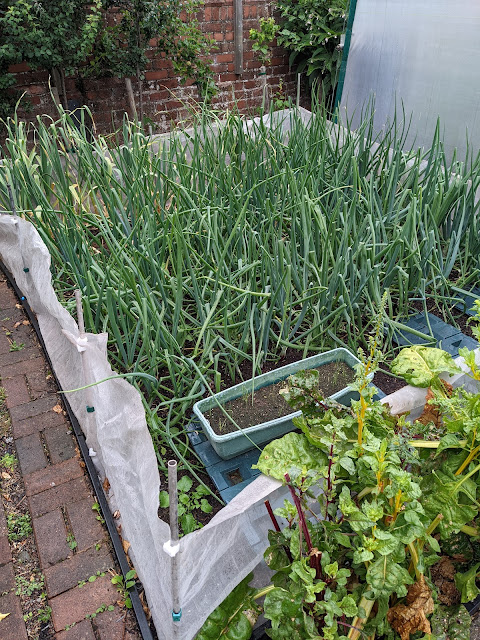
Onion, Leek, and Garlic Bed (June 18th 2022)


Garlic

Garlic comes in two varieties: softneck and hardneck. As a general rule, softneck varieties are milder in flavour, mature earlier, have a longer shelflife, and are less hardy than the hardneck varieties. Supermarket-bought garlic is usually of the softneck-type.
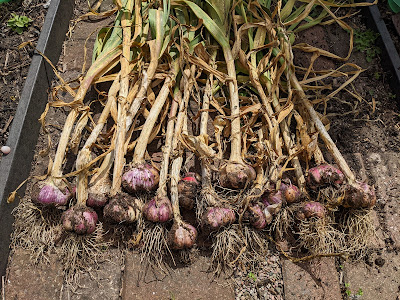
 
We bought a softneck garlic variety (Early Purple Wight) in late November at a reduced price from the Best Garden Centre in the UK (2021). The separated cloves were planted in coir seed compost in early December and left to sprout in an unheated greenhouse before planting out on New Year's Day 2022.  Harvest day was six months later on the 4th July 2022. 

Harvesting Early Purple Wight (4/7/22)

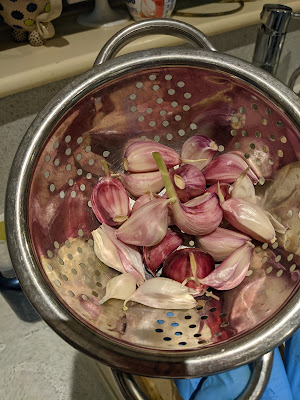
We think there were two smallish bulbs in the original pack; in any case, we harvested 18 bulbs - most of which were larger than the original 'seed' bulbs; each bulb contained about 12 cloves, on average, of varying size...

Harvested Bulbs

Harvested Cloves

Softneck varieties can be stored for up to 9 months once cured (dried). However, the Early Purple Wight is an exception and should be used within 5-6 months (even when cured). Garlic freezes well and, in the past, we have blended garlic (deskinned) with a little oil for freezing in an ice cube tray. This time we just removed the skins & diced the cloves...

Joie Garlic Dicer

before packing into shallow plastic boxes...

Ready for the freezer
... and freezing.

In addition to the Early Purple Wight, we also purchased a garlic bulb (softneck?) from Sainsbury's in February - the separated cloves were planted in coir seed compost, and left in an unheated greenhouse to sprout before planting outside on March 9th.  As of the 4th of July, these were still growing and will be harvested at a later date.
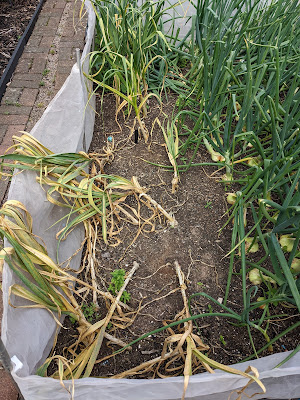
Sainsbury's Garlic (background); Early Purple Wight (foreground)


Onions

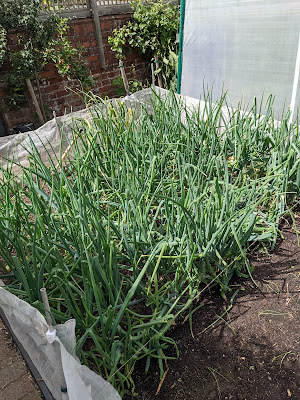
We still have a few onions left over from the 2021 season. Meanwhile, this season's onions are developing nicely. We are growing the same ones as last year, Cupido F1 and Red Baron, but in a different raised bed.

2022 Onion Bed (4/7/22)

Growing onions from sets are extremely easy: prepare the bed by digging in garden compost, plant onion sets in a line about 4 inches apart (six inches between rows), weed regularly, and water in dry weather. Last year we had a bumper crop so it will be interesting to see if this is repeated this year.

Leeks

We usually have problems with leek moth and/or allium leaf miner so growing leeks is a bit of a hit-and-miss operation. Using a protective insect mesh barrier helps while a detergent-based organic spray such as SB Invigorator offers some control if there is an infestation. I always expect to lose a few plants and I don't grow leeks every year. They are an extremely useful vegetable as they can stay in the ground over winter.

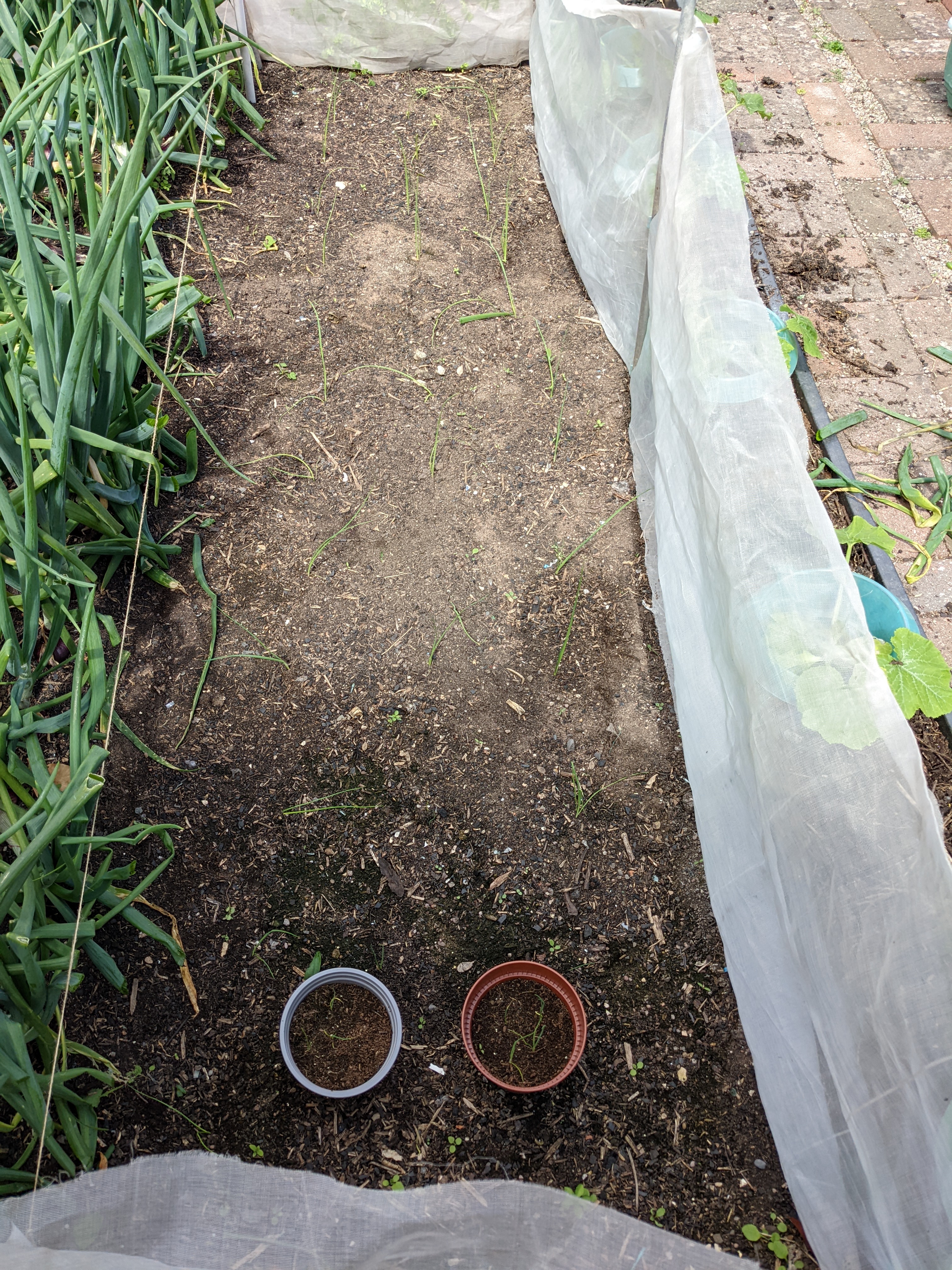
Someone suggested to me that growing leeks a little later in the year minimizes the pest problem. So this year I'm giving that a try. Leek seeds were sown in late May (instead of the normal February to April) in a window box filled with coir-based seed compost - see photo at top of the page. Seedlings were transplanted into their final position in the Allium bed 4-weeks later and kept well-watered to settle them in.

Leek Seedlings in the Allium Bed (4/7/22)

I'll report later on whether this experiment was successful.
Fruit-Picking Season Starts Now


Cherries, Blackcurrants and Gooseberries

The fruit-picking season in the kitchen garden has started in earnest. Yes, we have been enjoying some strawberries and raspberries up to now, but this is when it starts to get serious. 

Yesterday (26th June), I picked the Stella cherries (before the blackbirds and starlings got to them first) along Ebony blackcurrants and Whinham's Industry dessert gooseberries. The cherries were deliciously sweet with afternoon tea while the gooseberries were plenty sweet enough to eat raw with my muesli breakfast. Ebony blackcurrants are known for their sweetness and can also be eaten raw without that 'taking the roof off your mouth' sensation.

Today, I had a walk round the garden to see how the fruit trees and bushes were doing. The Concorde and Comice pears are swelling up nicely and should produce a reasonable crop - though possibly not as good as last year for the Concorde pears...

Concorde Pears

Comice Pears

Most of the apple trees are fairly new and still settling in; these are the Supercolumns bought from Chris Bowers a few years back. There will be few apples from the Red Windsor and Red Falstaff varieties...

Red Windsor Apples

Red Falstaff Apples

If you have to choose between growing pears or apples, then I would recommend pears because they are more productive, easier to grow and suffer far fewer pests and diseases. Should you decide you really do want to grow apples, then I strongly recommend Red Windsor - great taste and heavy crops. Modern varieties are usually more resistant to diseases so I would always plump for those if you can find one or more that you enjoy eating.

In a separate part of the garden, we also have Reverend W Wilks and Golden Delicious apple trees which are a 10-20 years old. The former only crops every other year (and this year is not that year!) while the latter had a bumper crop last year and seems to be in recovery mode this year with just a few fruits...

Golden Delicious Apple

Next to the Reverend W Wilks is our Nottingham Medlar tree showing a few fruits...

Nottingham Medlar Fruit

We used to have a couple of very productive redcurrant bushes but lost one to honey fungus in 2021. The remaining bush has flowered well and the currants are just starting to ripen...

Redcurrant fruit

 Our three Blueberry bushes are not great croppers, like the currants, though that may be down to my lack of proper care. I'm not a great fan, personally, as they are a bit lacking tastewise, but they are nutritious.

That just leaves the thornless blackberry and rhubarb growing along or next to a north-facing wall. The Livingstone rhubarb was only planted last autumn (2021), replacing a previously very productive but overlarge plant showing signs of rot, so we will not be harvesting any stalks this year. And I know, rhubarb is technically a vegetable, not a fruit!

Livingstone Rhubarb

Thornless Blackberry


The Underrated Radish

Harvesting radishes from my Salad/Veg Planter, I came across this whopper weighing 133 g...

Scarlet Globe Radish - Size XL


...the empty 1 lb (450g) peanut butter jar gives a visual indication of size.

The radish is probably the easiest vegetable to grow - the seeds are easy to handle and the plant grows quickly. It is widely used as a catch crop maturing quickly between slower-growing vegetables. Seed packets contain hundreds, if not thousands, of seeds and remain viable for many years. They are ideal for successional sowing for a long harvesting season.

High in vitamins and essential minerals & a good source of fibre, they can be eaten raw or cooked and will spice up any dish. There is a wide choice of radish-types so just find one you like and sow little and often. Scarlet Globe and French Breakfast are both excellent. 


Popular Posts

Blog Archive