National Grid's Demand Flexibility Service - First Experiences


Photo 1: Rainbow over Hereford (8th December 2023)

The Demand Flexibility Service (DFS) operated by National Grid allows residential and commercial customers to earn cash rewards by reducing their electricity usage during peak demand; usually, in the early evening period (16:00 to 19:00 hours). By reducing electricity demand during this period, expensive and polluting standby fossil fuel generators (especially oil and coal) are not required to fire up their turbines. This makes the UK electricity supply not only less carbon-intensive but also cheaper for all consumers. Started in the 2022/23, this winter will be the second trial period for this service and there will be 12 tests between November 2023 and March 2024.

To take part, you will need to have a smart meter capable of half-hourly metering (Photo 2). This is 

Photo 2: Our Smart Meter
because the test periods are multiples of 30 minutes (e.g. between 16:30 and 18:00 hours) and your electricity supplier needs to be able to measure your test period usage relative to your normal usage. In practice, householders are asked not to use high-powered appliances - such as kettles, ovens, washing machines, tumble dryers and dishwashers - during the test period. 

We are on a 100% renewable energy tariff with Good Energy and received our first invitation to participate on November 29th after first signing up to the scheme in mid-November. You have to opt in so Good Energy can set up the necessary half-hourly monitoring.

Figure 1: Invitation to Opt In to DFS Test

As noted above, the advice is to avoid using any appliances that consume lots of kWhs, charge up all your battery-operated devices (laptop, phone) beforehand and don't worry about turning off stuff on standby (e.g. TV) as this will make little or no difference. 

Figure 2: Suggestions for Reducing Power Consumption

So far, we have had three Power Pauses (as Good Energy calls them): November 29th, December 1st and December 5th). Two of the pauses were for 1½ hours and one for 1 hour between 16:30 and 18:30. Today, I received feedback on how much energy we had saved and how much money we had 'earned'

  • For the Power Pause on November 29th (17:00 to 18:30), energy saved = 0.407 kWh, and money earned = £1.63 (rebate is £4 per kWh)
  • For the Power Pause on December 1st (16:30 to 18:00), energy saved = 0.000 kWh, and money earned = £0.00
  • For the Power Pause on December 5th (17:30 to 18:30), energy saved = 0.000 kWh, and money earned = £0.00

Why did I save energy on the first Power Pause on November 29th (17:00 to 18:30) and not on the second and third Power Pauses on December 1st (16:30 to 18:00) and December 5th (17:30 to 18:30)? The reason, possibly, is down to my Air Source Heat Pump (ASHP) water and space heating system.

  • On the 29th November, indoor and outdoor temperatures were 20 ℃ and 3 ℃ respectively during the Power Pause.
  • On the 1st December, indoor and outdoor temperatures were 20 ℃ and -1/-2 ℃ respectively during the Power Pause.
  • On the 5th December, indoor and outdoor temperatures were 22 ℃ and 6 ℃ respectively during the Power Pause.
On the two December dates, the ASHP was working harder (using more electricity) due to lower outdoor temperatures (December 1st) or higher indoor temperatures (December 5th). Note: indoor and outdoor temperatures recorded on the Davis Weather Station. In future Power Pauses, I may try decreasing the room temperature setting on the ASHP system for an hour before and an hour after the set period provided it is not really cold.

It does raise some questions though. For example, when large numbers of people have converted to some form of heat pump (mainly ASHP, I suspect), will it still be possible to reduce electricity demand during peak periods? Most households currently use gas for space and water heating, making it easier to save electricity by not using energy-hungry electrical household appliances.

Is it possible to 'game the system' by maximising electrical energy usage between, say, 16:30 and 18:30 (4.30 pm to 6.30 pm) in order to set a high baseline for 'normal' usage and thus enabling larger rewards during Power Pauses? Provided daily electricity use does not increase and lead to higher electricity bills, then the energy savings (rebated at £4.00 per kWh) would greatly exceed the unit cost of electricity (£0.28 per kWh).

Does DFS make home storage batteries more cost-effective? Simply by meeting the household electricity demand from the battery only, could generate rebates of £10-20 per DFS event. Obviously, with only 12 planned events per winter in these trials, this will not pay for the battery over a reasonable time period. However, there are additional benefits to having a battery, especially if you generate your own electricity, and the number of DFS events per year may increase. Furthermore, your storage battery may be in the electric vehicle parked on your drive or in your garage using a Vehicle to Home (V2H) system.

We will be participating in future Power Pauses so I will how we get on. Expect some tinkering with the ASHP!


Uffington White Horse & a Friendly Robin

Returning from a family visit and baptism, we stopped off at the Uffington White Horse for a picnic. There was a convenient National Trust car park with picnic benches and panoramic views.

Photo 1: Looking North from the Uffington White Horse

We didn't have the energy to walk all the way to this ancient hill figure so contented ourselves with a gentle walk in its direction, disturbing a good number of skylarks in the process.
 
Photo 2: Uffington White Horse & Grazing Sheep

Great views especially northwards.

Photo 3: Looking North

The silence was occasionally broken by a passing plane from one of the nearby RAF bases (Brize Norton, Fairford, Lyneham) ...

Photo 4: Passing Military

Back at the car park, we were entertained by a friendly and inquisitive robin, the UK's favourite bird.

Video 1: Inquisitive Robin at Uffington White Horse Car Park

These birds are now so use to the presence of humans they will approach very close with little fear.


Vale of Rheidol Railway

We spent an excellent day walking some of the trails on Gilfach Nature Reserve in gloriously sunny weather. The forecast for the following day was cool and cloudy; we decided this might be the opportunity to ride the Vale of Rheidol Railway from Devil's Bridge to Aberystwyth, a distance of about 12 miles.

Video 1: Steam Locomotive - Vale of Rheidol Railway

A few years earlier, we had booked the same trip but it was cancelled at the last minute due to a fire on the track. That disappointment did not last long as it allowed us to spend more time in Devil's Bridge itself, including a visit to the Falls.

However, we are getting a bit ahead of ourselves. First, there was the trip from Rhayader to Devil's Bridge to enjoy. This mountain drive along the B4518 has been described by the AA as one of the 10 best scenic drives in the world. That is quite a claim! Here are a few photographs taken en route to help you make up your own mind. 

Photo 1: Waterfalls on the Mountain Scenic Route

Photo 2: Hills in the Distance

Photo 3: Top of the Elan Valley

Photo 4: Top of the Elan Valley 2

Photo 5: Scenic Mountain Views

Photo 6: The Road to Devil's Bridge

Photo 7: Cwmystwyth Lead Mine Workings

Having arrived at Devil's Bridge, time for a cuppa at the Two Hoots cafe before boarding the train and setting off for Aberystwyth. The train hugs the side of the valley so the extensive views are all on one side of the track. These waterfalls looked far more impressive than the Rheidol Falls - a series of cascades on the river itself.

Photo 8: Distant Waterfalls

Photo 9: Cwm Rheidol Reservoir

Photo 10: Distant Views Looking Seaward

It was a quick 30 minute turnaround at Aberystwyth. Just time for hot chocolate drinks to ward off the chilly weather and a long friendly chat with one of the guards from whom we learned little nuggets of information. For example, all the staff are paid and the trains always run even if empty. Apparently, many of the heritage railways in Wales only run above a certain capacity and require pre-booking. On the way back to Devil's Bridge we noticed a lot of dead trees - possibly larch infected by Phytophthora Ramorum.

Photo 11: Dead Larch Trees on the Horizon

Video 2: View of Steam Locomotive from Carriage (Rheidol Railway)

All in all, a very enjoyable way to spend an afternoon on a cold grey day in Wales. On a better day, we would have stayed awhile in Aberystwyth to enjoy the fresh sea air.


Rhayader & Gilfach Nature Reserve

Two family weddings in August and September meant we missed out on camping trips over the summer. We did manage the final Llanwddyn Folk Weekend at the beginning of September but, before we knew it, October had arrived and it was getting a little chilly/damp for camping. We managed to squeeze in an overnight stay and a visit to Kelmscott Manor on the way to a family gathering in early October. And, of course, there was the eventful trip to the Isle of Wight towards the end of the month. Inbetween these two trips, we did manage to get away for a few days in glorious Mid-Wales.

We booked a two-night stay in the Bear Apartments, Rhayader - self-catering accommodation comprising large bedroom, spacious bathroom, and well-appointed kitchen/dining room/lounge (Photo 1). Good price and location and our host, Julie, was charming (5 ✩ rating from us).

Photo 1: Kitchen/Dining Room/Lounge - Bear Apartments, Rhayader

We arrived in Rhayader just after midday on a warm (for October) sunny day and headed straight for the Gilfach Nature Reserve just outside Rhayader. We spent an enjoyable 3 hours, including lunch, there.

Photo 2: Lunch Spot Overlooking the Information Hut adjacent to the Car Park

Photo 3: Art Work near the Information Hut

Photo 4: Art Work near the Information Hut

Photo 5: Blue Skies and Orange Bracken - Gilfach, October 2023

Photo 6: Mary Forging Ahead

Photo 7: View from the Trail - Gilfach Nature Reserve
The Marteg River flows through the valley - a great spectacle after rain:

Photo 8: Magical Marteg River

Video 1: Marteg River (Gilfach Nature Reserve) in Full Flow

In mid-November, you can view leaping salmon from the platform as they head for their spawning grounds. Alas, we were too early for the show!

Photo 9: Salmon Viewing Platform
We made it as far as the Byre visitor centre (toilet, help yourself refreshments in high season, and lots of information) before returning to the car and heading back to Rhayader.

Photo 10: Byre Visitor Centre

A bit of shopping in Rhayader followed by an early tea before heading off to the Lost Arc ...

Photo 11: The Lost Arc Venue

... for a concert by Hands of the Heron - a trio of singer/songwriters from Bristol playing dreamfolk choral alt-pop. No, I'm not sure what that is but it was an excellent evening nevertheless.

A trip on the Vale of Rheidol Railway was planned for tomorrow.


Freezing Hot Chillies - Neither Tautology nor Oxymoron?

 There are two definitions of Tautology: verbal tautology and logical tautology. Verbal tautology refers to a phrase or sentence that includes two or more words with the same meaning. For example:

  • close proximity
  • new innovation
  • very unique
  • a necessary requirement
  • a short summary
As a general rule, the overuse of verbal tautology equates to a poor writing style because the unnecessary repetitive words add nothing to the understanding of the phrase or sentence (see verbosity). There are times when verbal tautology may be used to emphasize a point or add clarity. For example, I interviewed the candidate personally. Technically, the use of the personal pronoun, 'I', makes the adverb, 'personally', redundant. However, if interviews were sometimes perfomed by telephone or online, then the addition of 'personally' would indicate that this particular interview was face-to-face. Verbal tautologies may also be used for comic effect. Three of my favourites are:

  • It's like deja vu all over again - Yogi Berra
  • It's difficult to make predictions, especially about the future - Various including Neils Bohr and Yogi Berra, of course
  • You can observe a lot by watching - that's Yogi Berra again.
Logical tautologies are statements or formulae that are always true. Some examples are:

  • all batchelors are unmarried men
  • all humans are mammals
  • it is raining or it is not raining
  • A = A
  • X ≄ Y
An oxymoron is a combination of contradictory words such as deafening silence or less is more. Although oxymorons may seem incongruous, they often make perfect sense in the right context. Some examples:

  • organized chaos
  • awfully good
  • working vacation
  • old news
  • pretty ugly
  • seriously funny
  • the budget was unlimited, but I exceeded it - Donald Trump
  • I can resist everything but temptation - Oscar Wilde
  • We must believe in free wiil. We have no choice - Isaac B Singer
  • Of course I can keep secrets. It's the people I tell them to that can't keep them - Anthony Haden-Guest
  • I never said most of the things I said - Yogi Berra

The title of this post might be considered to be a verbal tautology (freezing hot chillies) and/or an oxymoron (freezing hot or hot chillies) but is neither. It is simply a descriptive title on how we prepare and store our Jalapeno chilli crop.

This is my preferred method. Beware that dissecting and chopping chilli peppers can get right up your nose. Mary always wears nitrile gloves for this job but I don't find it necessary using this method.

First, rinse the chilli under the cold tap and dry with a tea towel. Place on the chopping board (Photo 1):

Photo 1: Washed & dried chilli awaiting its fate

Top and tail (Photo 2):

Photo 2: Topped & tailed chilli

Slice in half (Photo 3) and check for any signs of decay - typically green/black fungal growth and dark/black seeds - discarding all but the best.

Photo 3: Halved Chilli

I remove the seeds and most of the pith which are the 'hottest' parts. There is still plenty of 'heat' left in the fleshy part and it is easier to estimate quantites when adding to curries, soups, chilli dishes, etc after discarding the variable and unpredictable seeds and pith. The easiest way to do this, I find, is the slice the chilli into quarters (Photo 4):

Photo 4: Quartered Chilli

And use the tip of a sharp knife to scoop out the pith and seeds starting from the pointy end and working your way to the stem end (Photo 5):

Photo 5: Prepared Chilli Quarters

Slice the prepared quarters to your preferred size and lay out on a freezer tray. Place in freezer (Photo 6) at -18 ℃ or below for 24 hours before transferring the contents to a suitable container (box or plastic bag).

Photo 6: Open Tray Freezing of Prepared Chillies

Typically, I would use a whole chilli in a curry (4 persons) and half a chilli in spicy parsnip soup (2 litres).

View from the Rear Window - September 2023

 "September days remind me of summer while September nights anticipate the winter days to come" - craftycabbage.com

The glorious weather of early September served as a poignant reminder of the summer we never had in July and August. There were 8 consecutive days (4th - 11th September inclusive) when the mean daily temperature recorded by my Davis weather station did not drop below 20 ℃. There were 10 consecutive days (2nd - 11th) when the maximum daily temperature was 25 ℃ or more, and 6 consecutive days (4th - 9th) when the daily maximum was 30 ℃ and above. The last two weeks of the month were noticeably cooler though still above the long-term average.

Three photos of the back garden this month. Can you spot the differences between Photo 1 and Photo 2?

Photo 1: Rear Garden on the 8th September

Early September was apple picking time, especially from the Rev W Wilks apple tree behind Mary. This tree fruits biennially and there was a good crop this year. Everything still looking green with plenty of flowering plants including cosmos, fuchsia, dahlias, osteospermum, rudbeckia, pansies, sunflowers and more.

Photo 2: Rear Garden on the 9th September

By the end of September, many flowers had peaked apart from the fuchsias which were still growing strong. The rose bed (to the right of the bird feeder) was having its third flush of the year.

Photo 3: Rear Garden on the 30th September

A time-lapse video of September's daily garden photos can be found in Video 1.

Video 1: Daily Garden Photos (September 2023)

Summary of Weather Parameters for September 2023

Overall, a warm month with the beginning of September very warm and dry.

Table 1: Weather Statistics for September 2023

September 2023

Weather Parameter

Value

Dates

Average Monthly Temperature 

17 oC


Maximum Monthly Temperature

33 oC

8th & 9th

Minimum Monthly Temperature

5 oC

23rd

Number of Air Frost Days

0


Number of Hot Days (> 25 oC)

11


Monthly Precipitation

27.4 mm


Greatest 24 h Precipitation

5.0 mm

19th - 20th

Number of Dry Days

15


Monthly Sunshine Hours (estimated)

123


Average Wind Speed

2 km/h


Highest Wind Speed

40 km/h

20th

Maximum Barometric Pressure (Sea Level)

1027.2 hPa

3rd

Minimum Barometric Pressure (Sea Level)

992.2 hPa

20th

Average Barometric Pressure (Sea Level)

1013.6 hPa


Heating Degree Days

79.0


Cooling Degree Days

45.4


Figures 1 & 2 are graphical representations of daily minimum and maximum temperatures, rainfall and sunshine hours. The steady hot, dry conditions of early September contrasting with the cooler, wetter and more variable weather conditions in the final two-thirds of the month.

Figure 1: Min/Max Daily Temperatures (September 2023)


Figure 2: Rainfall & Sunshine - September 2023


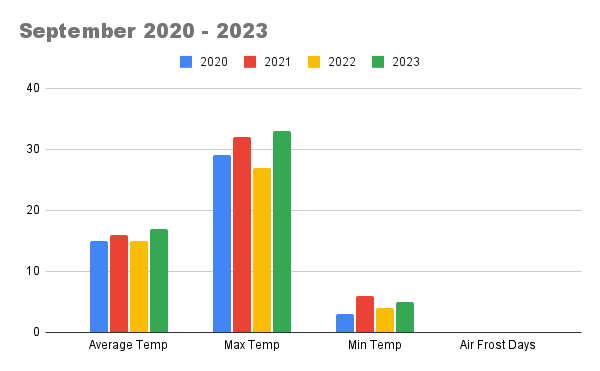
In Figures 3 & 4, I compare the September temperature, rainfall, and sunshine data for the last four years. September 2023 was not only the warmest, on average, in the 2020 - 2023 period but also registered the highest daily temperature (33 ℃). Rainfall was in the middle of the range for 2020 - 2023 with sunshine hours typical for this month.

Figure 3: September Temperature Data for the 2020 - 2023 Period

Figure 4: Rainfall & Sunshine Data (September 2020 - 2023)

The UK Met Office's Weather Report for September can be found here. The Met Office summarized September 2023 as follows:

"High pressure influenced the UK's weather for the first half of September, bringing fine, sunny, dry conditions and the most significant spell of warmth since June. From 4th to 10th, the UK experienced a significant heatwave with temperatures exceeding 30°C somewhere in the UK for seven consecutive days: a September record."

The same summary works well for our Hereford garden!

Figures 5, 6, & 7 show, respectively, the mean temperature anomaly, and relative rainfall and sunshine data for the UK courtesy of the UK Met Office. The location of Herefordshire is clearly indicated in all three maps.

September 2023 was the equal-warmest (shared with 2006) September in the UK based on records going back to 1884. For England and Wales, it was the warmest September ever recorded. Both the Met Office data (Figure 5) and my local weather station (Figure 3) agree that Herefordshire was exceedingly warm in September.

Figure 5: UK Mean Temperature Anomalies, September 2023

Rainfall for the UK was slightly above the long-term average but  near normal for Herefordshire (Figure 6).

Figure 6: UK Rainfall (% Typical) for September 2023

Scotland and Eastern England had above-average sunshine hours but Herefordshire was close to the average (Figure 7).

Figure 7: UK Sunshine Hours (% Typical) for September 2023

Jobs in the Garden
  • Dig up potatoes with granddaughter
  • Harvesting French Beans, Carrots, Raspberries, Apples, Celery, Sweet Peppers, Beetroot, Sweetcorn, Pears, Cucumbers, Tomatoes, Parsnip, Squashes, Marrows, Chard, Spinach
  • Plenty of shredding and composting
Flora & Fauna
  • 2 x Blackbirds
  • 2 x Blue Tits
  • 2 x Collared Doves
  • 1 x Crow
  • 1 x Dunnock
  • 1 x Great Tit
  • 20 x Sparrows
  • 7 x Long-tailed Tits
  • 1 x Robin
Video 2: Robin Alarm Cal
  • 8 x Starlings
  • 2 x Wood Pigeons
  • Common Frog
Photo 4: Common Frog in Garden Pond


And, finally, some pictures from the garden:

Photo 5: Fuchsia

Photo 6: Osteospermum

Photo 7: Dahlia

Photo 8: Dahlia

Photo 9: Salvia 'Hot Lips'

Photo 10: Pansy

Photo 11: Raindrops on Nasturtium Leaves

Photo 12: Nasturtium

Photo 13: Cyclamen under Acer

Photo 14: Tomatoberry Cherry Tomatoes


Popular Posts

Blog Archive