We grow a variety of bush fruits in the kitchen garden - redcurrants, blackcurrants, gooseberries, and blueberries - in addition to apples, pears, grapes, rhubarb, blackberries, strawberries and raspberries. July is a busy month harvesting and preserving bush fruit.
Blackcurrants
Blackcurrants
We have six blackcurrant bushes: three old ones (at least 10 years old) of uncertain heritage (though I think they include Ben Lomond and Ben Sarek) and three new bushes (Ben Connan & Ebony x 2) planted in 2019. I actually bought one Ebony bush but managed to get two plants out of it! Because of the different varieties, the fruit ripens over about a one month period so picking and preserving can be spread out to fit in with other jobs in the garden.
Blackcurrants fruit on previous year's wood - most productively on one-year old branches, less so on two-year old wood and hardly at all on three-year old branches. So, once the bush is established, expect to be removing about one third of the bush each year as you cut out the oldest branches. Unlike other currant bushes, blackcurrants can be pruned in summer while you are harvesting the berries. It can be a back-breaking job picking the currants so take this opportunity to prune out the oldest wood and then go and find a nice place to sit down and strip the fruit off the branches in comfort. To harvest the remaining berries, use a small stool so you don't strain your back. You may need to do a small amount of additional pruning in Winter to tidy the bush up (e.g. removing weak and/or low-growing stems) but that will now be a very quick job.
The two photographs below show before and after pruning/fruitpicking. The picture shows an older bush at the rear and a more recent planting in the foreground. The older bush was smothering its younger version and also reducing the amount of sunshine reaching the pear tree behind. Consequently, I have pruned the older bush a little more drastically than I normally would (and because I have 5 other blackcurrant bushes!).
Before
After
Maintainance and care of blackcurrants is very simple. Feed, water, pick & prune. I use wood ash from my wood burning stove to dress the bushes in winter followed by a Spring dressing of home-made compost. Summer watering after fruit set is only required during dry periods (e.g. I've watered only twice during the current drought, typically about 10 litres per bush).
Most blackcurrant varieties are cooked or made into jams/jellies but Ebony is delicious eaten raw. The 2022 blackcurrant harvest yielded 4.75 kg, enough for about 18 x 1lb jars of blackcurrant jam or 150 servings of apple and blackcurrant crumble or 3 litres of blackcurrant cordial. To freeze, for later use in any of the above recipes, simply wash, drain and spread on a tray or fill plastic boxes/bags (note the weight of fruit) and put in the freezer.
Redcurrants
Redcurrants
We only have a single redcurrant bush after losing its partner to honey fungus in 2021. Unlike blackcurrants, redcurrants should only be hard-pruned in winter though some light pruning of new wood can be done in summer. I find it easier to just prune in winter when the leaves have dropped and you can see what you are doing. While you can train the redcurrant bush into various shapes to keep it compact, just remember that the bigger the bush the bigger the harvest. An advantage of redcurrants is that they are shade-tolerant; one of my currant bushes, albeit the one eventually infected with honey fungus, was grown next to a north-facing wall. It still managed over 10 years productive growth though.
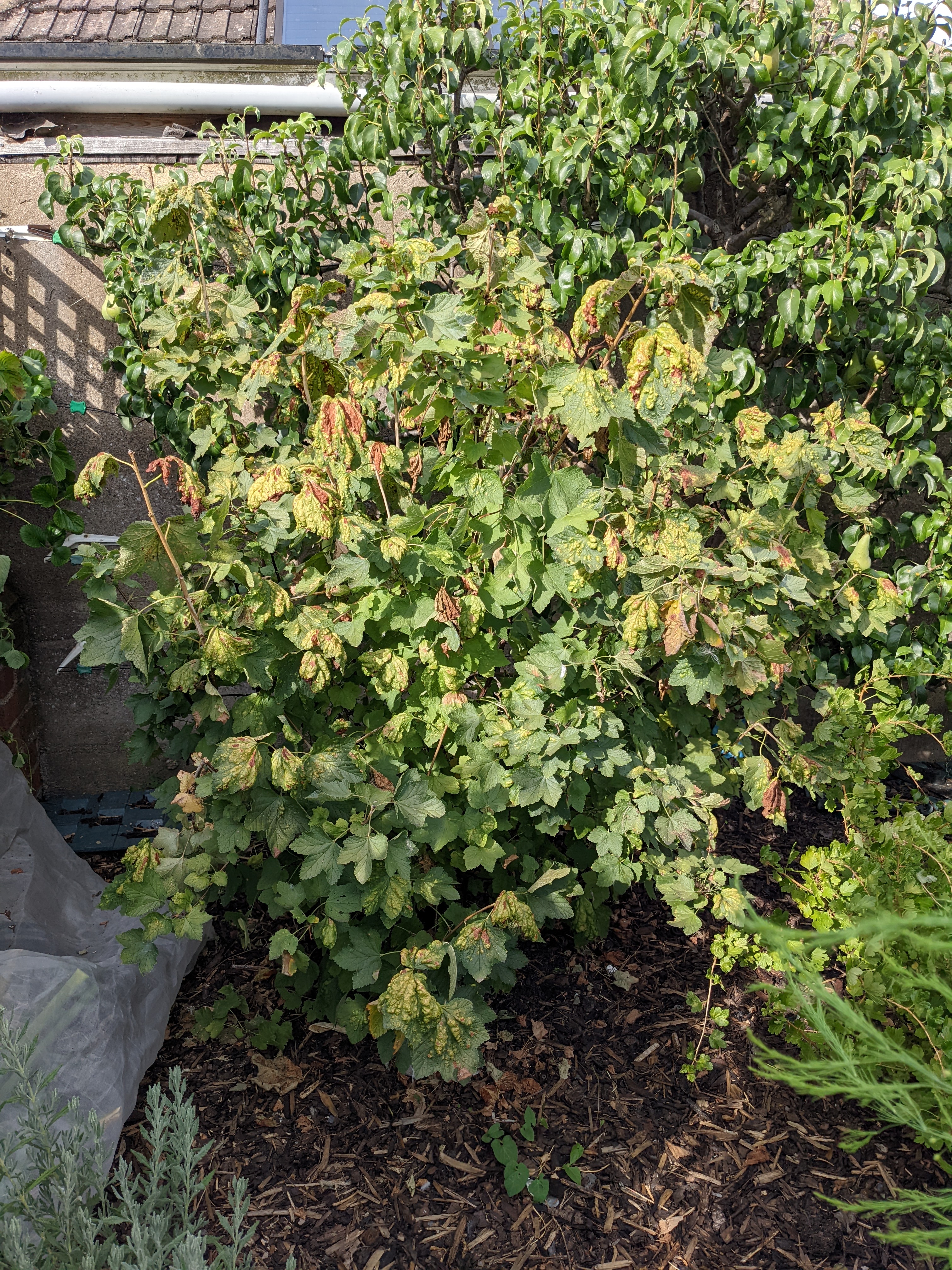
A photograph of the redcurrant bush after fruit-picking is shown below. The leaves often look a little sad, mainly due to the presence of the currant blister aphid, but this does not seem to affect the fruit yield. I feed redcurrant bushes in exactly the same way as the blackcurrant bushes - with wood ash and home-made compost. [Note: wood ash is a good source of potash (potassium) required by all currants but its alkalinity means you shouldn't overdo its use]. Applying wood ash in winter finds an immediate outlet during its primary production period and also allows the wet weather, often associated with the English winter, to dissipate the alkalinity.
Redcurrant Bush in front of Concorde Pear Tree
Redcurrants are easy to pick; simply detach/pull each string of fruits from the stems/branches. The bright red colour makes it easier to spot the berries and strip the bush completely; however, you might want to leave a few currants for the birds.
This year, the redcurrant bush yielded 1.5 kg of fruit, enough to make 3x 1lb jars of redcurrant jelly. We pre-prepared the redcurrants, for jelly-making at a later date, by first stripping the berries from their strings using a fork.
Preparing redcurrants
Hold the base (thicker end) of the stalk and pull through the tines of a fork to remove all the green bits...
Before stripping
After stripping
Add 500 ml water to each kilogram of fruit and bring to the boil before simmering for 20 minutes while, intermittently, breaking up the fruit with a potato masher or wooden spoon...
Allow to cool slightly and sieve through a jellybag/muslin...
Jellybag and stand
Note: if you are sieving the fruit then you can omit the destalking process though I still prefer to do it. Don't squeeze the bag to extract more juice if you want the finally redcurrant jelly to be clear/translucent though it will not affect the flavour should you decide to squeeze!
Freeze the sieved juice until required and put the fruit residue in your compost bin.
Gooseberries
My two dessert gooseberry bushes...
Whinham's Industry (WI)
...and...
Langley Gage (LG)
...yielded 2.3 kg in total; 1.5 kg from the more mature WI and 0.8 kg from the recently (2019) planted LG. The first pickings were eaten raw with my breakfast muesli but then it was time to harvest the whole bush (early July) and preserve the crop. I recommend thick/safety gloves to solve the thorny problem of gooseberry bushes when picking the fruit. I use these cut-resistant gloves, originally bought to wear for pruning and shredding garden waste. They resist thorns but are flexible enough for picking fruit.
To prepare the gooseberries for freezing, I top and tail using a small pair of scissors, wash in cold water...
Gooseberries - Topped, Tailed & Rinsed
...followed by a quick rinse with boiling water (from my Quooker tap), 2 minutes in the microwave and pack into freezer boxes...
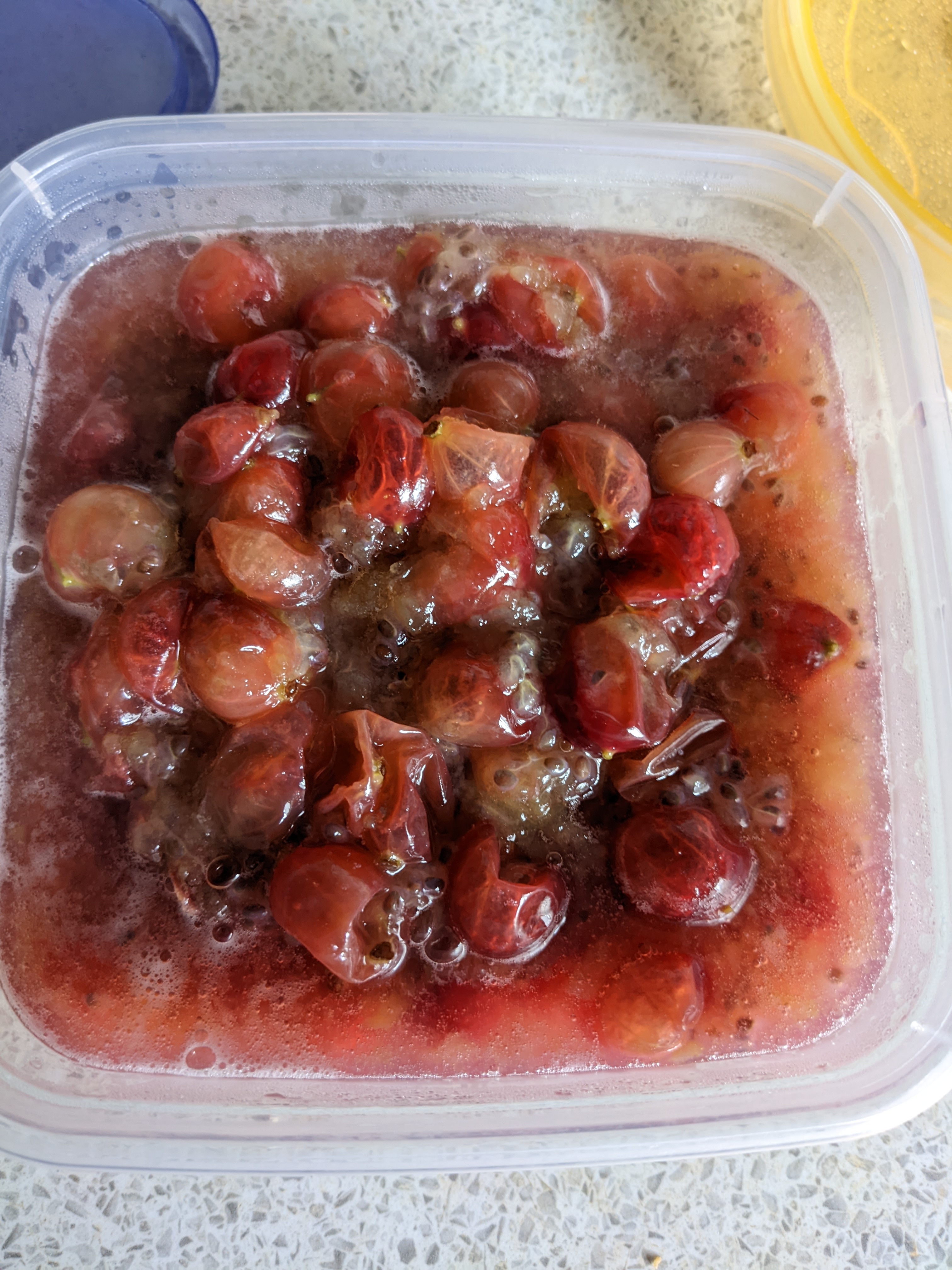
Gooseberries - microwaved & ready for freezing
Defrost as required and use in Gooseberry Crumble or add to breakfast cereal. Personally, I find dessert gooseberries sweet enough but add honey to taste if they are still too tart. If you like lemon curd, I think you'll find gooseberry curd even nicer!
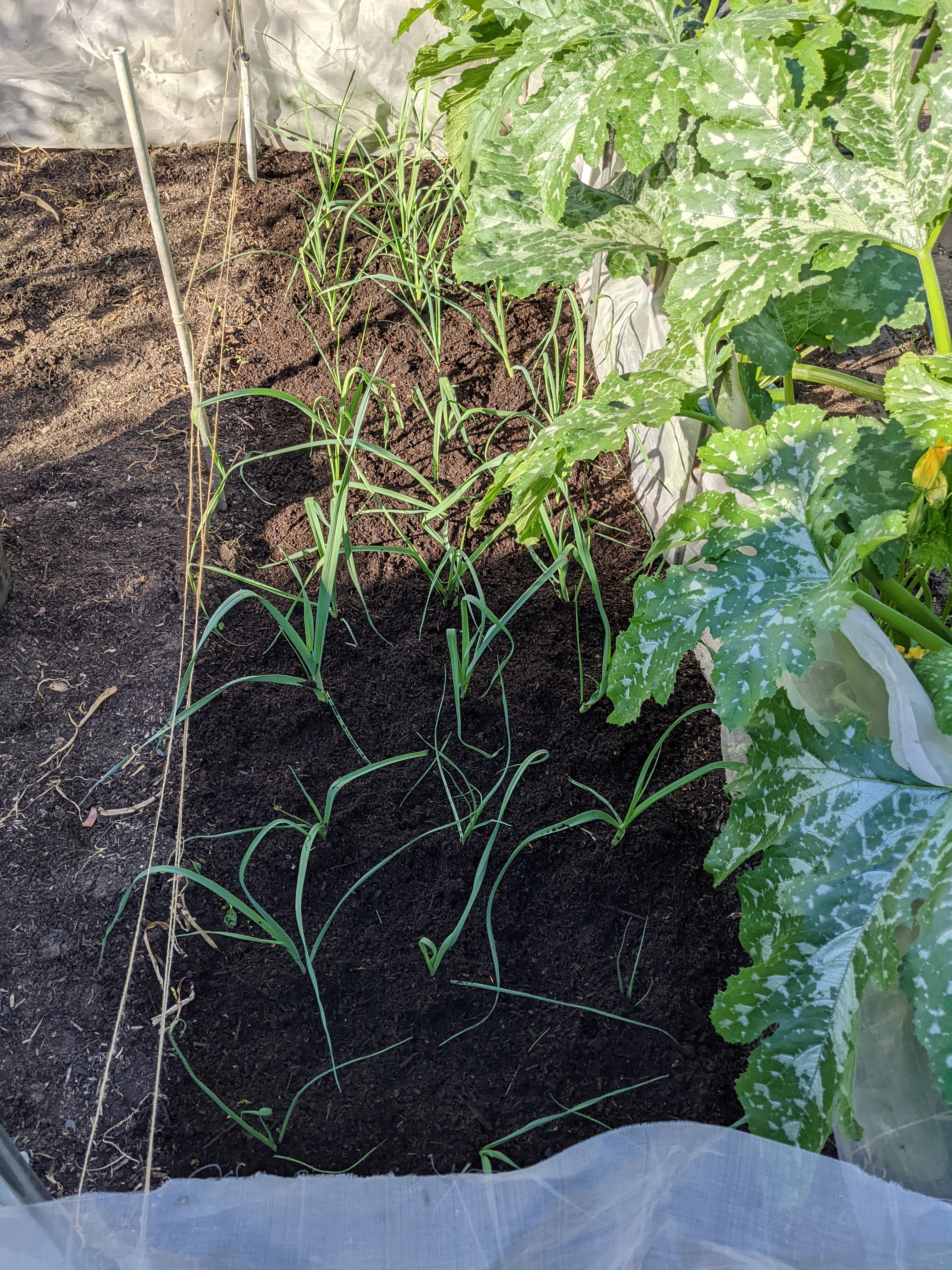
This year's onion sets (Cupido F1 and Red Baron) were planted out on March 19th and harvested on August 5th. The photograph below was taken 10 days before harvesting...
Onion Patch on 26th July 2022
For comparison, last year's onion crop (also Cupido F1 and Red Baron) was also planted out on 19th March but harvested nearly 3 weeks later on 24th August.
A somewhat earlier harvest was to be expected due to the recent hot weather/heatwave. With the fair weather forecast to continue for the next ten days, including another heatwave with temperatures above 30 ℃, I have laid out the onions, on wire racks, to dry in the sunshine before putting them undercover to finish the curing process.
Onions laid out on wire racks to dry in the sun
I will calculate this year's crop yield once the curing process has finished. Qualitatively, the Cupido F1 yield looks to be down while the Red Baron yield is up relative to last year. The main reason seems to be this year's 250g pack of Cupido F1 onion sets contained fewer than last year's pack. Conversely, this year's 250g pack of Red Baron onion sets contained more than last year's. Harvesting this year's crop, I counted 54 white onions and 84 red onions. Overall, crop yield might be similar to last year though bulb size might be down a little due to the drier weather conditions in 2022.
Finally, an update on the leek experiment that involved planting later to avoid pests such as leek moth and allium leaf miner. The photograph below was taken on 5th August, approximately 10 weeks after seed sowing.
Leek Patch (August 5th)
One or two seedlings didn't make it but I had a few spares to fill in the gaps. The patch has been watered twice a week during the long dry spell we are currently experiencing. This photo was taken after giving the leeks a thorough soaking followed by feeding/mulching with sieved compost. Further updates to come.
If you look carefully then you will spot a blackbird - either female or young - in our Mountain Ash (Rowanberry) tree. These orange-red berries are an autumn treat for the birds but this blackbird seems to be starting a little early. Possibly, the recent hot weather has brought forward the ripening of the rowanberries though it may also be down to the last of the redcurrants being picked along with a sparsity of strawberries - our blackbird's favourite fruits.
In case you didn't spot the blackbird in the above photo here is a short video (9 seconds) - taken on my Pixel 4a phone - of her/him enjoying the rowanberries. The rowanberry crop looks smaller this year but, hopefully, there will be enough to attract other birds into the garden in autumn.
We have just had the driest July in England since 1935. For some parts of the country (East Anglia, South and South-East) it has been the driest July on record. Hosepipe bans are in force, or about to come into force, in the south and south east.
The lack of rainfall has not been uniform throughout the United Kingdom as this map produced by the UK Met Office shows:
July Rainfall 2022 as percentage of 1991-2020 Average
If you draw a line from the Bristol Channel to the Wash then, below this line, rainfall was about ⅕ its typical value. Above this line, but below a line between the Ribble and Tees estuaries, rainfall was around 50 % the expected value based on the 1991-2020 average. Scotland had the highest rainfall at around 80 % its average for July.
We had very little rainfall in Herefordshire; my Davis Weather Station recorded just 7.6 mm in July. My rainwater butts (capacity about 2500 litres) have all but run dry and I am having to use potable (tap) water in the kitchen garden.
The current conditions in my garden can certainly be classified as a meteorological drought and, possibly, an agricultural drought. This situation has been exacerbated by an unusually dry 2022 so far, as the plot below demonstrates (data from my Weather Station). Furthermore, precipitation in November and December last year (2021) was only about a third the amount of rain seen during these months in 2019 and 2020.
Monthly Rainfall (Hereford) for January - July (2020 - 2022)
To summarise, rainfall during the last 8 months (November 2021 to July 2022, inclusive) has halved compared to the same period in 2019-2020 and 2020-2021.
A few days ago, we paid a visit to the Red Kite Feeding Station at Grigrin Farm; I'll post a few photos at a later date. On the way back, we stopped off at Warren Woods, near New Radnor, to see the waterfall: Water-breaks-its-Neck. We've visited this spot many times for picnics or just to break up a longer journey. This photo is from the notice board in the nearby car park...
Water-break-its-neck Waterfall
...and this is what it looked like on our visit (4th August 2022)...
Water-Break-its-Neck Waterfall (4/8/22)
Confirmation, if confirmation were needed, that drought conditions are prevailing. With no rain forecast for the next fortnight, and temperatures once again expected to reach 30 ℃ and above, the situation can only worsen.
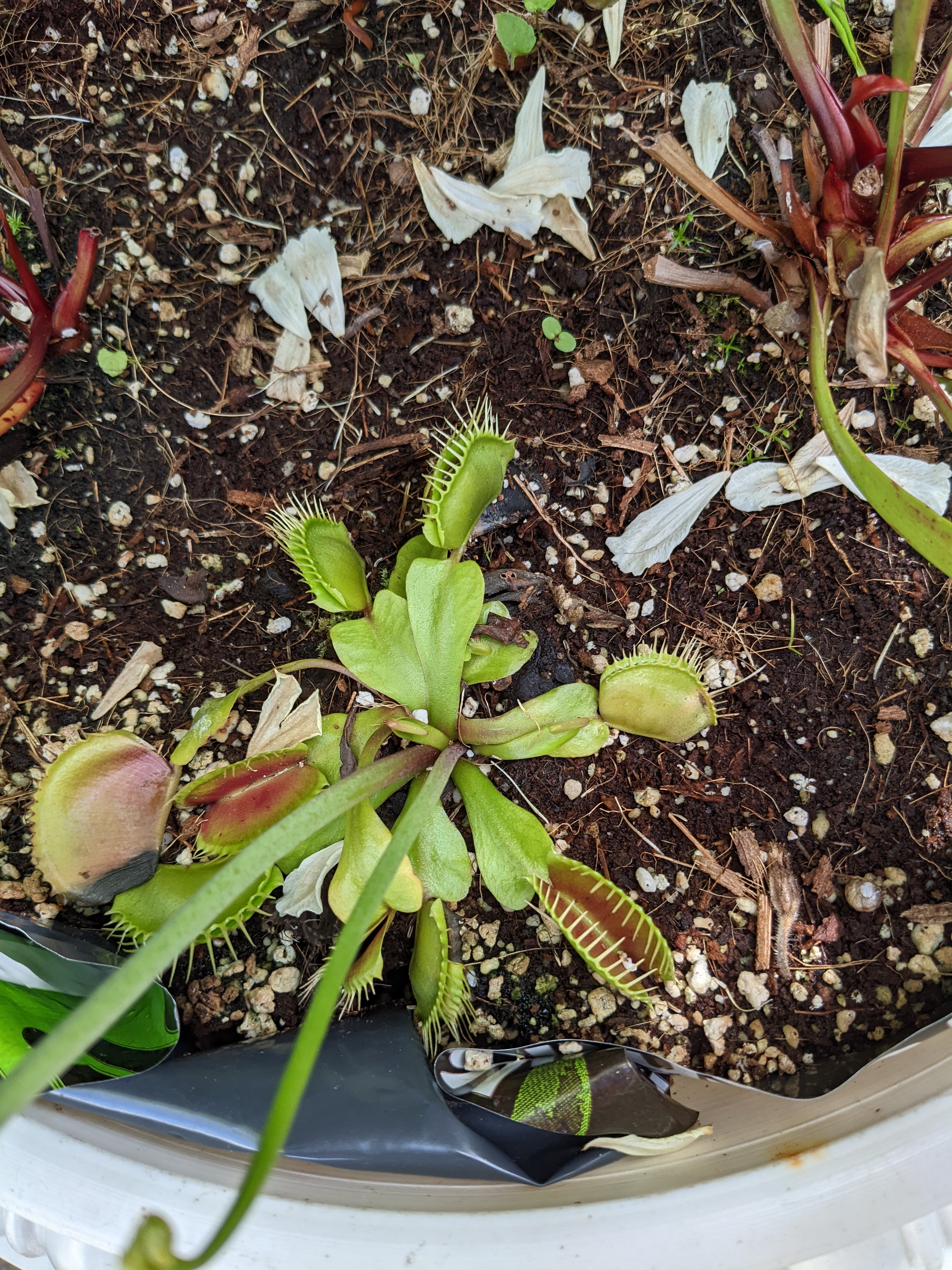
I last reported on the Carnivorous plant garden at the end of May. A couple of months later and everything seems to be fine. The pitcher plants and venus fly trap have survived drought conditions and a heat wave and are thriving...
Pitcher Plant - July 2022
Venus Fly Trap - July 2022
The Venus Fly Trap (VFT) has thrown up a flower stalk just like the pitcher plant did last year. Most VFT growers recommend removing the flower stalk as early as possible because it weakens the plant: see here and here. By contrast, allowing pitcher plants to flower seems to be no big deal.
Venus Fly Trap Flower Stalk
Experienced growers, looking to maximise the number of plants produced (and sold), will be happy to allow the plant to flower and collect the seed (20-30 per flower). Amateur growers might remove the stalks in order to maintain an already established VFT plant collection.
With our single VFT plant, the stakes are not so high and the flowers look to be close to opening. It might be a little too late to 'save' the plant since it has already expended a lot of energy producing the flower stalk. In which case, I think we'll leave the VFT to flower to see if we can collect some seeds. In the worst-case scenario, we will have to buy a new plant (about £5).
We will update as and when the experiment finishes.
Herefordshire is a landlocked county with the seaside between one and two hours away by car. We do, however, have a watery connection to the sea via the River Wye which runs into the larger River Severn near Chepstow. Hereford does have its own 'beach' near the Victoria Bridge where locals can often be found enjoying safe and easy access to the river...
Swan and Cygnets on Hereford 'beach'
For this reason, we are blessed/plagued (delete as appropriate) with seagulls that have taken up residence in Hereford and the rest of the county by following the River Wye and its tributaries. Being excellent scavengers, the gulls find plenty of food morsels and scraps discarded by the human population - you do wonder whether the Hereford-born gulls still know how to catch fish?
This recording was taken from our back garden on 21 July...
... you can hear the bleating of the youngsters and the cajoling of the parents as they offer encouragement and protection.
The gulls nest on the rooves/chimneys nearby and July is a particularly noisy time of the year. The young gulls have fledged and are developing their flying skills under the watchful (and very protective) eye of their parents...
...which seems to bring all the other gulls out...
It is not uncommon to see young gulls on the ground ...
Young gull in a neighbour's front garden
...unfortunately, this one appears to have a damaged wing and, a few moments later, came to a sticky end...
Another road casualty?
...possibly when our neighbour reversed their car into their garden/parking space without seeing the bird. However, when I looked 10 minutes later the cadaver had disappeared. A few days later, I heard of another neighbour who had 'adopted' a young gull with a damaged wing and was feeding it on sardines. So maybe the cadaver was only stunned?
In a few weeks, the gulls will move out into the countryside and we will have peace and quiet once more.