Storing Onions

Back in August 2021, I harvested our maincrop of red (Red Baron) and white (Cupido) onions. The onions were 'cured' on wire racks in an outhouse. In November, before any frosts, the onions were transferred to the house cellar (temperature range 10-15 ℃) to store over winter. I tied bunches of four to six onions together and hung the bunches over a wooden batten slung between two shelves. This ensured a good airflow around the onions for long-term storage.

Nine months later, on the first of June 2022, I still had these onions left...
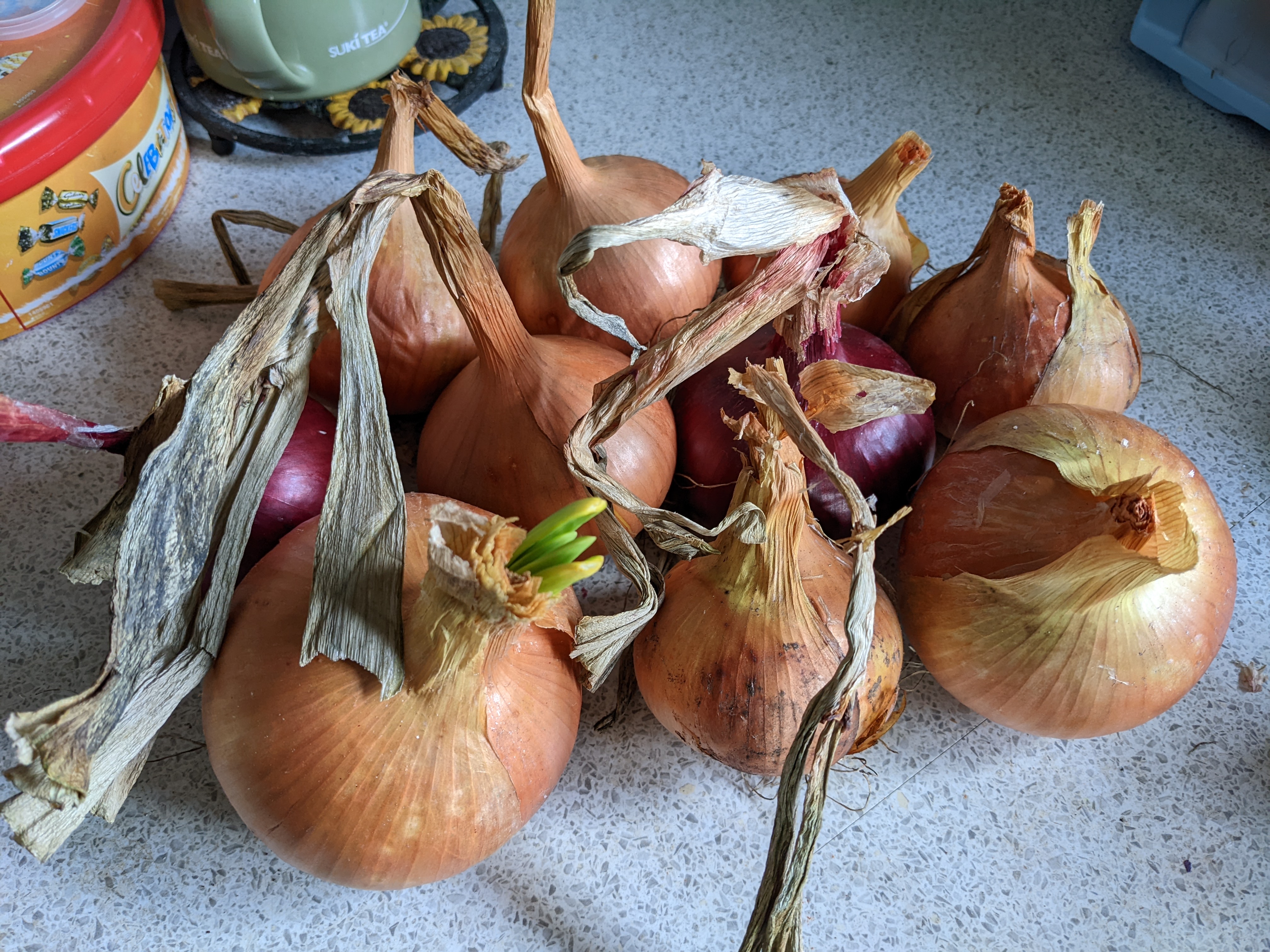
Onions after 9 Months of Storage

One or two onions had gone off (predominantly the red-type) and a few had sprouted but, overall, >95%  had stored well. Some onions were processed (peeled & chopped) and frozen for future use, while these remaining bulbs will see us through to the end of June at least. That means the onion crop from a 6 ㎡ plot (2 m by 3 m) provided nearly a full year's supply of these versatile vegetables.

This year's (2022) crop is coming along nicely...

2022 Onion Patch (Garlic in the background)

...such that, we may never have to buy an onion from the supermarket again!


A Slow Burner or Fiery End?

Queen Elizabeth II is celebrating her platinum jubilee this year - 70 years on the throne and Britain's longest-reigning monarch. All over the UK and in many Commonwealth countries, fire beacons were lit on the 2nd June 2022 in a time-honoured fashion.

Hereford lit their beacon at 7.30 pm on one of the highest points in the city - Churchill Gardens. There is a choice of two videos. The first video is nearly 4 minutes long for those with a little time on their hands! The second video is for those with less patience who just want to see the final outcome.


Enjoy!


European Garden Spiderlings

 Filling my watering can from a water butt next to a sarcococca bush, a movement caught my eye. Due to my slight longsightedness and the closeness of the perceived movement to my head, the video below is a pretty accurate view of what I saw. And it has nothing to do with the fact that my video-making skills need improving!


I did manage to get a slightly better-focussed picture though, admittedly, not that much better...

In any case, the picture was clear enough to identify European garden spiderlings (Araneus diadematus) just beginning to disperse from the cluster. The female lays 100-800 eggs (then dies) - after hatching, the spiderlings remain as a cluster for a day or so before dispersing to build their own small orb-shaped webs.

Wikipedia has a good page on these European garden spiders including a video of the female eating the male after mating. Spiders are fascinating creatures but they do tend to get a bad press. They work incredibly fast building their webs. In the mornings, I have to remember to wave a stick (or my arms) in front of me as I walk down the garden paths if I want to avoid a faceful of web and, sometimes, a persistent sense of crawling on my head for the next hour or so!

Here is a rather fine example of an orb web in the back garden on a sunny day in September 2021...

Orb web - Back garden, Autumn 2021


How Much Rubbish does Herefordshire Council send to Landfill

 A few weeks ago, I posted about a pet hate of mine often found across all media forms (social, mainstream, TV, radio, internet blogs, etc); i.e. data presented without context. As a result of that article, I sent in two Freedom of Information (FoI) requests to Herefordshire Council. I received answers to both requests fairly quickly.

The first FoI request asked for more up-to-date information on the rates of recycling. Not only did I get a reply to my question but my FoI request also triggered an update of the Council's website so everyone benefited.

The second FoI request concerned a statement that 3000 tonnes of stuff rejected in the recycling process, operated by Envirosort, was sent to landfill. I have visited this facility and it is an impressive, if somewhat smelly, operation that still requires significant human interaction in the sorting process.

I asked Herefordshire Council why the rejected recyclables were sent to landfill rather than the Energy from Waste (EfW) Incinerator built by Herefordshire and Worcestershire and in operation since 2017. I'm not a fan of incinerators but they are probably better than landfill for materials that cannot be reused or recycled. It would be better if the energy generated was used in a carbon capture process to reduce the environmental impact of the incinerator but that might destroy the economic feasibility of the incinerator.

The Council's response stated that in 2020-2021, 17.05% of the total waste went to landfill, 43.76% went to the incinerator and the remaining 39.19% was recycled. From April 2022, it is planned to send no more than 1% to landfill - this will be achieved by (i) re-routing the rejected recyclables away from landfill and towards the EfW facility, (ii) improving recycling rates, and (ii) sending more general waste to the incinerator.

For Herefordshire residents, just over 8% of council tax (ca £10 million) is spent on waste management. We can help reduce these costs by ensuring we recycle more and create less waste. I'll have more to say on this in another post.


Bog Garden Revisited and New Carnivorous Plant Garden

 Back in 2020, we made our very own bog garden from a discarded water closet following a bathroom upgrade. The pitcher plants thrived and produced several flowers...

The original and genuine bog garden


As chance would have it, another lavatory became available when we had our guest bathroom refurbished. Mary thought my wee idea of twin bog gardens was just potty so that suggestion went down the pan - does she think toilet humour is beneath her?

Long story short - Mary decided the original and genuine bog garden had to go. And when something has got to go, it has to go. The replacement looks a bit temporary but, on the plus side, now includes a Venus Fly Trap...

New Carnivorous Plant Garden


...and has become the new Carnivorous Plant Garden!

Of course, this meant we now needed a replacement Bog Garden - although the original Bog Garden was really a Carnivorous Plant Garden as it contained only pitcher plants. Since carnivorous plants get all their nutrients from their captives, they must be grown in a nutrient-deficient medium. Many bog plants, however, need to source their nutrients from the growing medium. So by keeping the carnivorous plants separate, we can grow a wider variety of plants in our new & improved Bog Garden II.

In order to maintain the moist soil conditions for a bog garden, we used a medium Salad/Veg Planter from Greenhouse Sensation. This comprises a 20 litre reservoir - holding water or a dilute nutrient solution - topped by a tray of growing medium. Strips of capillary matting draw water/nutrients from the reservoir into the growing medium. This watering system ensures water and nutrients are consistently and constantly available to the plants without the 'soil' medium becoming waterlogged and thereby inhibiting root development. I would expect the reservoir to need topping up about once a month - but I will monitor this. The reservoir will be topped up with water (rain or tap) most of the time with the occasional dilute nutrient solution when the plants are flowering. The Bog Garden II will also benefit from natural rainfall which may reduce watering frequency even more. 

I used a 50:50 mixture of home-made compost (sieved) and coir/perlite (4:1 by volume) recovered from a Salad/Veg Planter used the previous year to grow celery. The planter is situated with a South/Southwest aspect to benefit from long sunny days. This was Bog Garden II after planting up on 16th May 2022...

The Beginnings of Bog Garden II

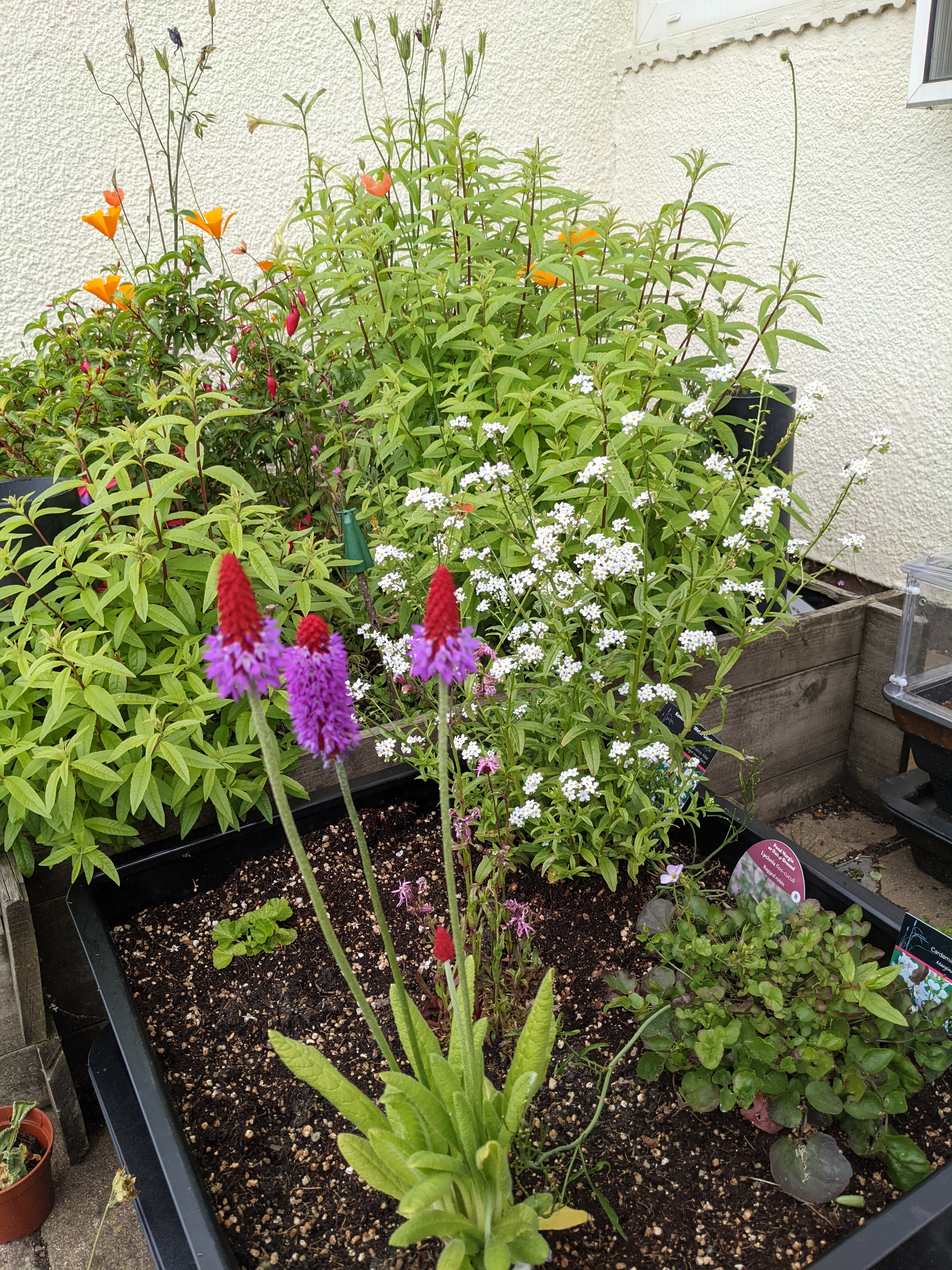
... with Water Forget-Me-Not, Ragged Robin, Lady's Smock, Primula vialii (all from Kenchester Water Gardensand a Geum bought at the Broxwood Court Plant Fair. Nearly two weeks later, the plants have settled in and the Primula vialii certainly seems to be appreciating its new environs...

Bog Garden II (12 days later)

This is an experiment so we will see how it develops; hopefully, adding more plants when/where possible. One advantage of the Salad/Veg Planter system is that it can be converted into a small greenhouse which could offer extra winter/frost protection.


First Garden Strawberries (2022)

 First strawberries from the garden in 2022 and a full month before the Wimbledon Championships. Mind you, the weather is cool wet and windy at the moment and not suitable for tennis or butterflies.   

First Strawberry Crop (2022)

I find strawberries easy to grow but we never seem to get a bumper harvest because we have to share them with the birds, slugs/snails, woodlice, etc. At the moment I'm growing them using Wonderwall planters to (i) maximise space usage in the kitchen garden, and (ii) make the fruits less accessible to slugs and snails, even though the climbing abilities of these gastropods are legendary.

Strawberries in Wonderwall Planters (25/5/22)

I still have a problem with birds, mainly blackbirds to be fair, who enjoy the ripe fruit. So I will probably have to net the plants at some point. In the meantime, I'll continue to pick the fruits before they are fully ripe and finish the job on a sunny windowsill.


More Rubbish and a Response to a Freedom of Information (FoI) Request

Last month, I wrote a post on one of my pet hates - lack of context when quoting numerical data. When, for example, mainstream media (MSM) and politicians give you the 'facts', they often leave out the necessary context required to decide whether the information is important or relevant. For example, how often do you see claims that eating/drinking something doubles your chances of getting cancer - yet, when you look at the raw absolute data, this translates from a 1-in-100 chance to a 2-in-100 chance of getting cancer - probably not enough to warrant changing your lifestyle.

In the case of Herefordshire Council, just saying that 3000 tonnes of stuff put out for recycling had to go to landfill, because it was contaminated, does not paint a complete picture. We need to know whether 3000 tonnes is a big number or a small number (h/t More or Less). In practice, the 3000 tonnes of recyclables redirected to landfill represents less than 10% of the total recyclable material collected. We should still do everything we can to reduce the amount sent to landfill but a <10% wastage does not seem that great, considering Herefordshire operates a one-bin recycling scheme for glass, plastic, paper/cardboard, tins/cans.

I submitted a FoI request to Herefordshire Council on April 27th asking for more up-to-date data on waste/recycling tonnages because their website only reported upto 2018-19. I received a reply on 4th May containing the information I requested and a note to say the Council's website had been updated - I'm going to take credit for that update!

As can be seen from the bar chart above, in the first year of the pandemic (April 2020 to April 2021) there was a small increase in non-recycled household waste and slight decrease in recycled household waste. Could this be attributed to a move away from independent food shops (e.g. greengrocers, butchers) towards on-line supermarket orders (more packaging) and less eating-out and more home cooking during various lockdowns? 

Finally, Herefordshire Council provided a breakdown of the types and amounts of material that went through the recycling system. It is interesting to look at changes during the first year of the pandemic (2020-2021).

  • decrease in paper and card recycling - surprising considering increase in Amazon deliveries but, perhaps, fewer newspapers and magazines bought
  • increase in glass recycling (wine, beer and cider bottles?)
  • increase in plastic recycling - more supermarket shopping?
  • decrease in metal recycling - people drinking wine and spirits instead of tinned lager, coke?
  • drop in green waste recycling - a bit of a surprise that one as you might expect an uptake in gardening activities during lockdowns. Maybe more people composted at home though I wouldn't bet on that!


Popular Posts

Blog Archive