Slugfest: Nematodes vs Limax Maximus


vs


For more than half the year (Autumn, Winter and early Spring), we allow garden slugs (e.g. Limax Maximus or Leopard Slug) pretty free range to enjoy the garden and its produce. They are particularly good at hoovering up plant debris and decaying matter; although any especially voracious slugs, with a liking for plants we are fond of, are despatched to one of the hot composting bins to become next year's garden compost!

Unfortunately for the slug, we do not find their eating habits conducive to Spring/Summer sowings of our vegetables and flowers. So as April comes around, it is time to do BATTLE.

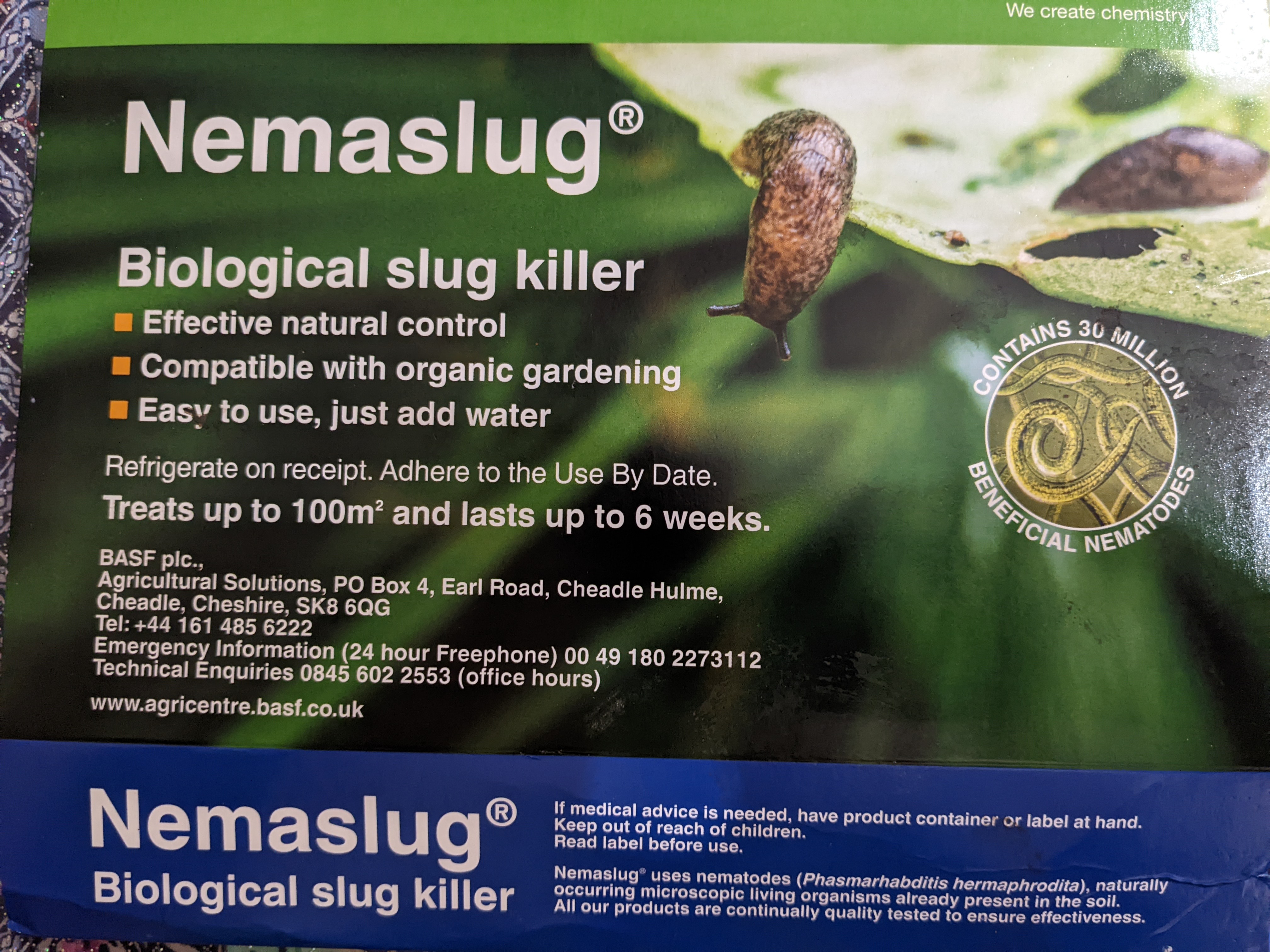
I have discussed various means of slug control in a previous post and we still use a variety of methods. However, the first line of attack is always Nemaslug, the biological slug slayer. One of the reasons I like Nemaslug, apart from the fact it works, is that it functions via a short-term increase in natural slug predators and is entirely reversible.

It is a time-consuming manual operation although there are ways to do it quicker if you have large areas to treat. To treat 100 ㎡ (i.e. an area measuring 10 m x 10 m or 5 m x 20 m), I usually set aside between half and a full day depending on how much preparation is needed (e.g. whether I need to clear the ground first). You can save time and effort by applying the nematodes to the soil immediately after rain or, even, while it is raining. The nematodes are easiest to apply to bare soil and, of course, the soil temperature needs to be above 5 ℃ which is why April is typically when the first application is made. I find two applications are sufficient with the second application approximately 6 weeks after the first.

I operate a 4-bed rotation system in the kitchen garden. The onion/garlic/leek bed is already active with the garlic planted out on 1st January (softneck) and 9th March (hardneck) and the onion sets planted out on the 19th March.

Onion/Garlic/Leek Bed (25/4/22)

Seed potatoes were planted out on the 11th April with space left for sweet corn in May/June depending on the weather.

Potato/Sweetcorn Bed (21/4/22)

That left the last year's potato/sweetcorn bed (already cleared) and the brassica bed (below) which I needed to clear first before starting the nematode treatment.

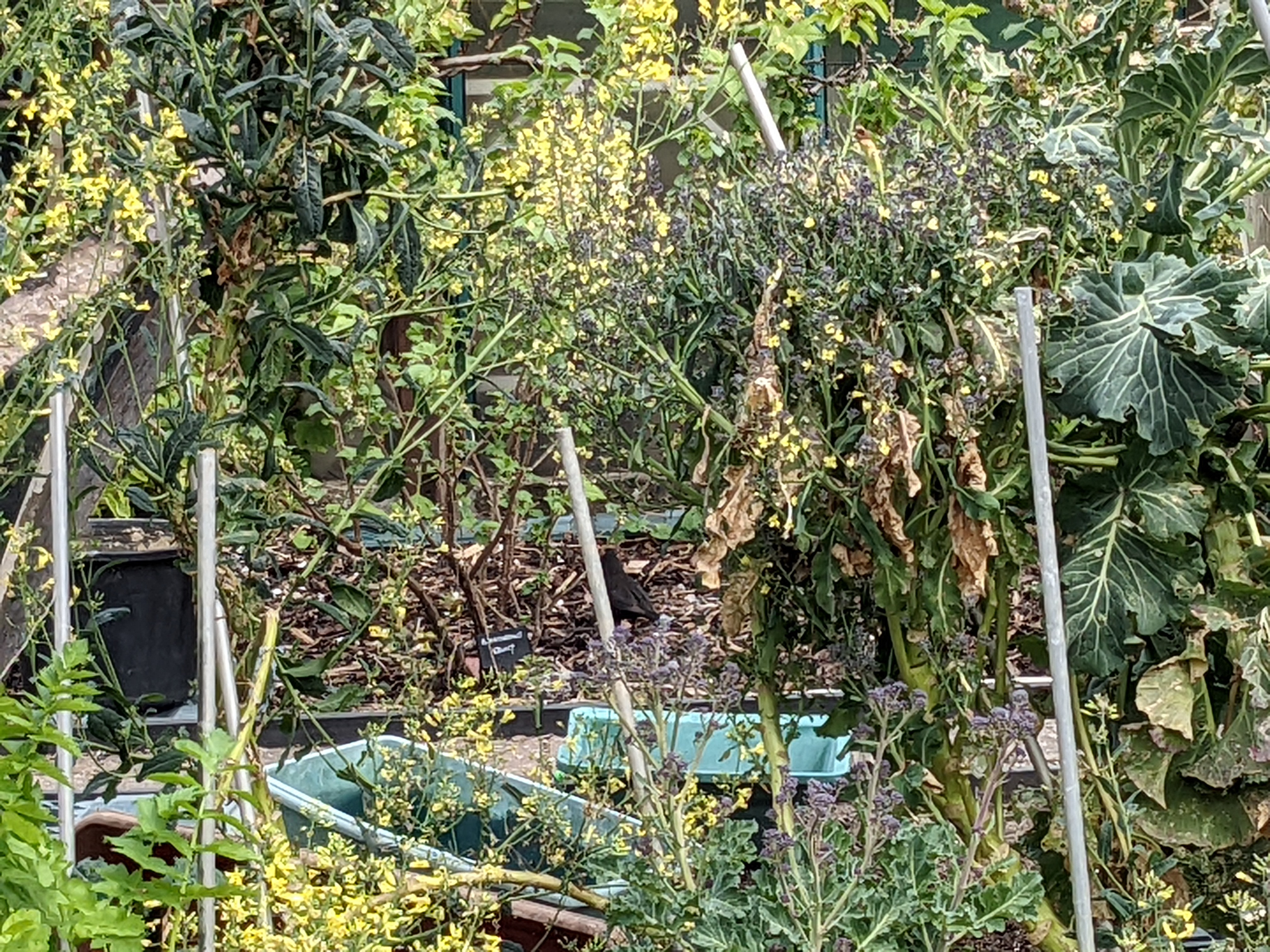
Brassica bed (21/4/22)

It has been a dry Spring overall and April (up to 25th) has been very dry; 10 mm rainfall for the month and no rain for the last 12 days. So I had to prewet the soil, apply nematodes with a watering can (coarse rose) and, then, water in the nematodes. Bare soil was covered with black plastic to reduce weed growth, retain moisture and stop the local cat population from using it as their toilet area.

Black plastic as weed & cat control

Another advantage of using black plastic is that slugs will gather underneath and they can easily be picked off and sent to a warmer place (hot compost bins). The plastic will only be down for a month or so until other veggie stuff is planted out.

Any leftover nematode suspension is applied to the fruit beds surrounding the vegetable plots and as many flower beds as possible. All-in-all, a good day's work and another 10,000 steps added to the exercise plan!


Frogspawn Update

 This year (2022), frogspawn appeared in our small garden pond on or about the 23rd March. Generally, froggie parents disappear once the eggs have been laid though they may hang around in smaller bodies of water - where else would they go? There was evidence (a splash as you approached the pond) of a frog but we did not get a good look until the 16th April when a common frog was seen sitting close to/on the remaining frogspawn. As they are not known as caring parents, he/she may just have been enjoying the warm sunshine (temperatures of 22/23 ℃ that afternoon).

Parent frog guarding its eggs (16/4/22)?

There is plenty of tadpole activity so, hopefully, a successful breeding season!?


Start of the 2022 Asparagus Season...

First asparagus spear of 2022 (April 14th)

April 14th and the first out-of-focus spear was spotted in our small asparagus bed of 5 Eclipse plants. Over the next two days, it grew and became more focussed...

First asparagus spear of 2022 (two days later on April 16th)

The year's crop is about two weeks behind the 2021 crop (when the first spear surfaced on March 31 and the first cut was on 9th April).

We shall be enjoying this little beauty in the next day or so...


Daffodil Season at the Weir Garden!?

 Our last visit to the Weir Garden, a National Trust garden in Herefordshire, was on the 29th January and we were treated to a lovely display of snowdrops.

Snowdrops at the Weir Garden

We had missed a few opportunities to return to see the daffodils including, earlier in the week, when we turned up to find the garden closed for safety reasons. On 9th April we finally made it but unfortunately...

Daffodils past their best at the Weir Garden


...we were too late to see what must have been a glorious display of daffodils.

Never mind, the wild garlic was worth a visit...

Wild garlic at the Weir Garden

...along with other delights.

Scilla italica at the Weir Garden

Primroses at the Weir Garden

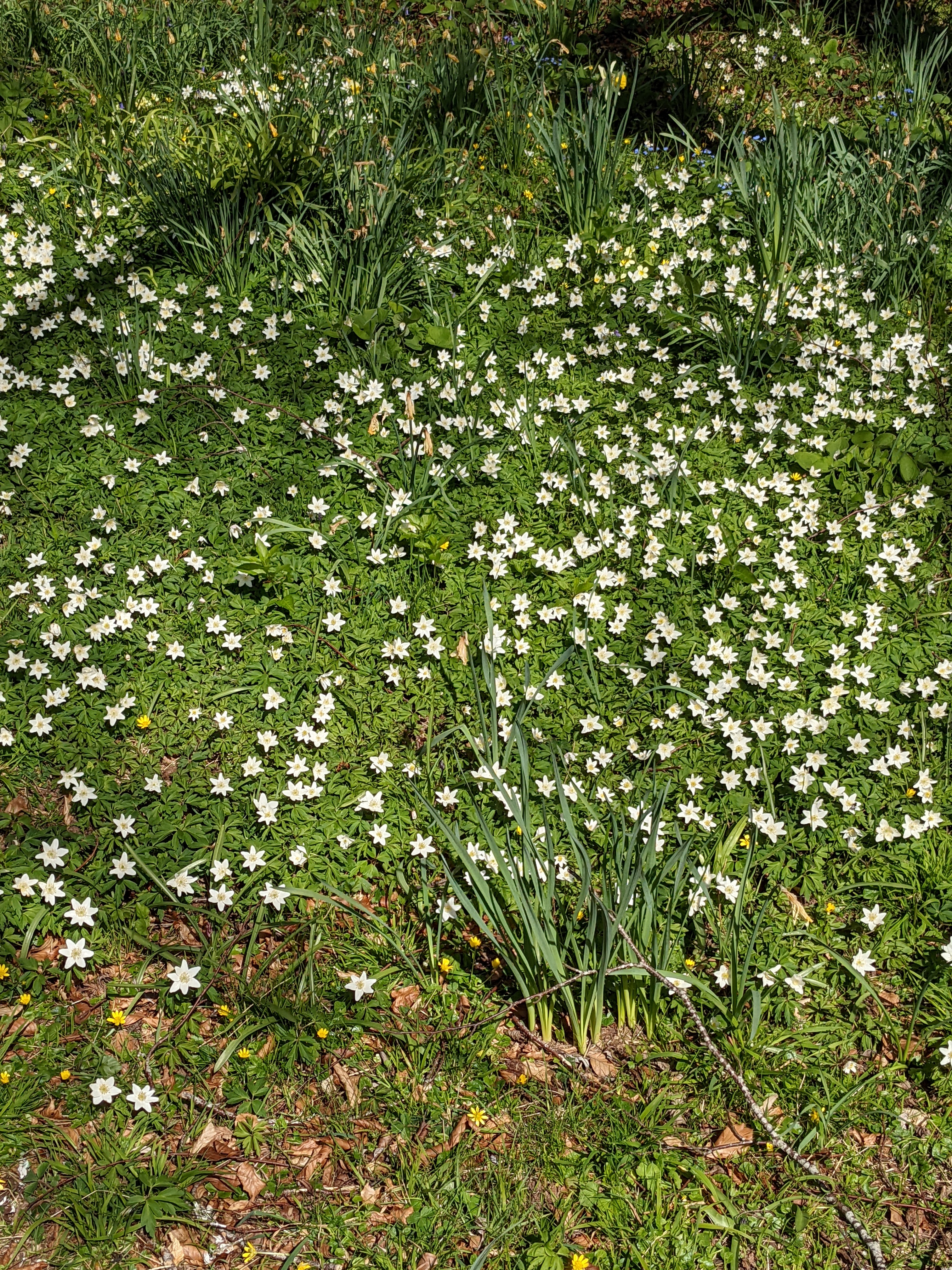
Wood anemones at the Weir Garden

Brunnera at the Weir Garden

Clove-smelling currant bush at the Weir Garden


The Weir Garden is adjacent to the River Wye and the waters were clear for a change. Some quite large fish could be clearly seen near the bank - I assume brown trout but then I'm no angler.

Brown Trout(?) in the River Wye

Somebody was flyfishing on the opposite bank but I didn't have the heart to tell him the brown trout were congregating on our side.

One final treat was spotting a Red Kite soaring above the trees near the rookery at the Weir Garden. Some agitated rooks drew my attention skywards where the Red Kite was circling just above the tree canopy. This is probably the closest I've seen a red kite to the city of Hereford. Red kites almost went extinct in the UK; down to just two breeding pairs in mid-Wales. In one of the best conservation stories ever, the kite population in Wales was nurtured and grew sufficiently to allow some birds to be caught and released in England (Chilterns) and Scotland (Black Isle). The red kites from the Chilterns have spread westwards into the Cotswolds while the Welsh kites have spread eastwards into England. I suspect the kites we see in Herefordshire are of the Welsh variety and hopefully they will meet up with their English cousins before too long.

Butterfly Hunt at Haugh Woods

Good Friday (15/4/22) and it is a lovely sunny day in Hereford. BBC reports it as the warmest day of the year so far with a temperature of 23.4 ℃ (74.1 ℉) in London. Our Davis Weather Station recorded a high temperature of 22 ℃ in the garden between 2pm and 5pm.

Sunny days without too much wind are good for butterfly spotting so we packed our lunch and headed for Haugh Woods. It is a great place for observing butterflies and even has a marked butterfly trail. Our first sighting was a Peacock butterfly perched on one of the many dandelions...

Peacock butterfly at Haugh Woods (15/4/22)

Then a Small Tortoiseshell fluttering along one of the many wide paths but refusing to land for a photo. Cuckooflower (or Lady's-smock) has been in flower for a while now so we were hoping to spot an Orange-tip butterfly on our walk as the cuckooflower is a major food plant for the caterpillar. If you look carefully you can sometimes find the mature yellow egg of the Orange-tip on cuckooflower.

The cuckooflower gets its name by association with the arrival of the first cuckoo. Its alternative name, lady's-smock, arises from the cupped-shape of the flowers or, more risque, it alluded to certain springtime activities in the meadows ('smock' was slang for 'an immoral woman').

Today we were lucky and saw one on the wing - fortunately, the male Orange-tip is easy to identify from its characteristic orange tip.

Finally, on our way back to the car park along a narrow woodland path, we came across a Speckled Wood flying close enough to identify. And this delicate wood sorrel with its shamrock-like leaves...

Wood Sorrel in Haugh Woods (15/4/22) 

In addition to looking for butterflies, we paid a visit to Joan's Hill Farm which is accessible from Haugh Wood. This nature reserve is owned and managed by Plantlife. Many of the fields were speckled with cowslips...

Cowslips at Joan's Hill Farm (15/4/22)


Cowslips at Joan's Hill Farm (15/4/22)

Later in the year, there will be lilac carpets of orchids so we must remember to return.


Big Garden Birdwatch 2022 - Results

Robin looking for worms in the garden

At the end of January, Mary spent an hour counting the birds in our garden as part of the Big Garden Birdwatch 2022. Her sightings were summarised here and the results were sent off to the RSPB. Over 11.5 million birds were counted by almost 700,000 people.

In our garden, the most populous birds were:

1    Wood Pigeon (4 of each)

2=    Blackbirds & Blue Tits (3 of each)

3=    Crows, House Sparrows, Starlings & Collared Doves (2 of each)

4=    Great Tit, Robin & Lesser Black-backed Gull (1 of each)

For the UK, the most common birds were:

1    House Sparrows

2    Blue Tit

3    Starling

4    Wood Pigeon

5    Blackbird

6    Robin

7    Goldfinch

8    Great Tit

9    Magpie

10    Chaffinch

So the top 6 birds in the UK also featured in our garden count. Three birds (Goldfinch, Magpie & Chaffinch) did not feature in our list; although Goldfinch and Magpie are fairly regular visitors (just not that particular weekend).

For a bit more information go here.


Good Spuds by Planting on Good Friday?

 I have always sown maincrop seed potatoes when the environmental conditions seemed right - generally, in mid-April when the ground has warmed, the probability of a late frost is low and the promise of April showers is in the air. Mary tells me they should be put in the ground on Good Friday to 'guarantee' a good crop. Since Good Friday can fall between March 20 and April 23, this makes absolutely no sense to me because there are so many other factors affecting crop yield (drought, flood, pests and diseases, nutrient availability, etc).

Chitted Sarpo Blue Danube Seed Potatoes

The origin of the 'Good Friday' link with potato planting is hazy. There may be a religious connection - allegedly, Protestants would not eat potatoes because they are not mentioned in the Bible but Catholics were OK with them if planted on Good Friday (with or without a sprinkling of holy water) to drive off the devil. A more pragmatic explanation is that Good Friday is the first holiday after Christmas and, therefore, the first opportunity (for working people) to get some serious work done in the kitchen garden. 

Yet another explanation relates this tradition to 'gardening by the moon'. I have seen this explained by the fact the moon is closer to the earth during full and new moons (higher gravitational effects) and this raises the water table in the soil and also influences water transport mechanisms in seeds and plants. Can the nearness of the moon have such an effect? Possibly, though I would expect the effect to be really small. I remain sceptical the small changes in the distance between the moon and earth around Eastertime have a big enough effect on the water table sufficient to affect crop health and yields. If there was an effect due the changes in the gravitational pull of the moon, then, at least for 2022, the data suggests planting a week before Good Friday would be optimum. Happy to be convinced otherwise but it would need some supporting evidence!

Yet another idea is that rain follows both full and new moons and all gardeners and farmers appreciate some rain after sowing. The effect, if indeed it is an effect, seems small and probably overwhelmed by other factors. No plausible mechanism has been suggested for the link between moon phases and precipitation.

So, back in the real world, on the 11th April, I decided it was time to plant the seed potatoes. I had considered putting the seed potatoes in the ground at the beginning of April as the weather had been reasonably warm. However, frost was forecast for the first weekend of April and then the second weekend; so I decided to wait until the outlook was frost-free. For those of a curious and scientific bent, the weather forecast was correctand there were frosts on both weekends.

I operate a 4-bed crop rotation system so I knew exactly where I was going to put the potatoes (blue area); the other half of the bed would be used for sweetcorn later in the year.


First of all, I needed to clear the green manure planted at the start of October 2021. Normally, this would be dug into the ground and left for 2-4 weeks before planting as some green manures (e.g. rye grass) contain a chemical that inhibits seed germination though this is not an issue for seed potatoes. As my hot composting bins were also in need of some soft green vegetation to give them a temperature boost, I decided to pull out the green manure, shred it and add to my Hotbin. Having cleared the plot...


...time to plant the seed potatoes. I am planting Sarpo Blue Danube again this year. We are still eating last year's crop so I know they keep well. Last season, I did not irrigate the crop: this year I will operate a moderate degree of watering and compare yields. There are many ways to grow potatoes; traditionally, in the ground but also above ground under straw or black plastic and in containers. There are pros and cons to all of these methods so choose the one that suits you. I favour the traditional method of planting the potato about 15 centimetres below ground and then earthing up. Potatoes are a good crop for improving the tilth of the soil and preparing it for next season's crop - which should not be more potatoes!

I received my seed potatoes on the 29th January and, about a week later, placed them on trays filled with shredded cardboard (an eggbox is an excellent alternative but we don't eat eggs). The trays were placed in a light airy room (16-18 ℃) to chit. Commercial growers do not chit potatoes (too time-consuming) and chitting is mainly beneficial to give a kickstart to first and second earlies and early maincrop varieties. Blue Danube is an early maincrop so does benefit from chitting.

 Chitted Blue Danube Seed Potato ready for planting out

My 1.5 kg pack of Blue Danube seed potatoes contained 18 tubers and cost £6.45 from D.T. Brown. I will, therefore, have three 2.4 metre (8 foot) rows with six seed potatoes in each row. The spacing within each row is about right for early maincrop potatoes though the rows are closer together than is generally recommended  - an advantage of a raised bed system where cropping can be more intensive.

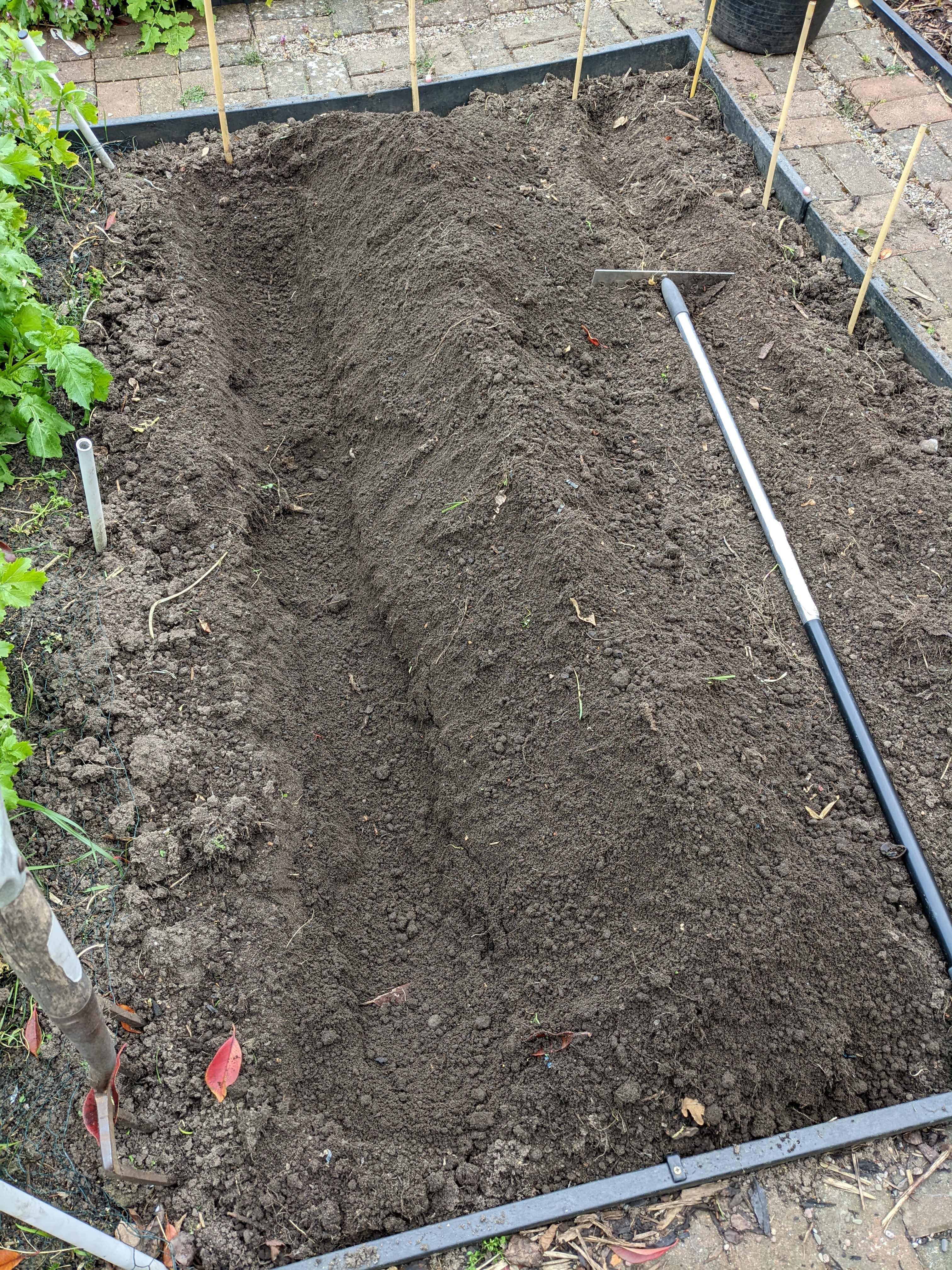
First, I mark out with canes the three rows and approximate positions for each seed potato. Then I create a trench about 5-6 inches deep using a rake - this avoids standing on the soil and compacting it - before using the short edge of the rake to loosen the soil in the bottom of the trench...

Preparing the first trench
...seed potatoes are pushed into bottom of the trench, chitted end upwards...

Seed potatoes placed in the trench

...and then covered with compost (unsieved)...


...before raking the soil back over the trench to form a ridge along the row...


Repeat twice more and then stand back and admire your handiwork!

Job done!


Popular Posts

Blog Archive