Daffodil Season at the Weir Garden!?

 Our last visit to the Weir Garden, a National Trust garden in Herefordshire, was on the 29th January and we were treated to a lovely display of snowdrops.

Snowdrops at the Weir Garden

We had missed a few opportunities to return to see the daffodils including, earlier in the week, when we turned up to find the garden closed for safety reasons. On 9th April we finally made it but unfortunately...

Daffodils past their best at the Weir Garden


...we were too late to see what must have been a glorious display of daffodils.

Never mind, the wild garlic was worth a visit...

Wild garlic at the Weir Garden

...along with other delights.

Scilla italica at the Weir Garden

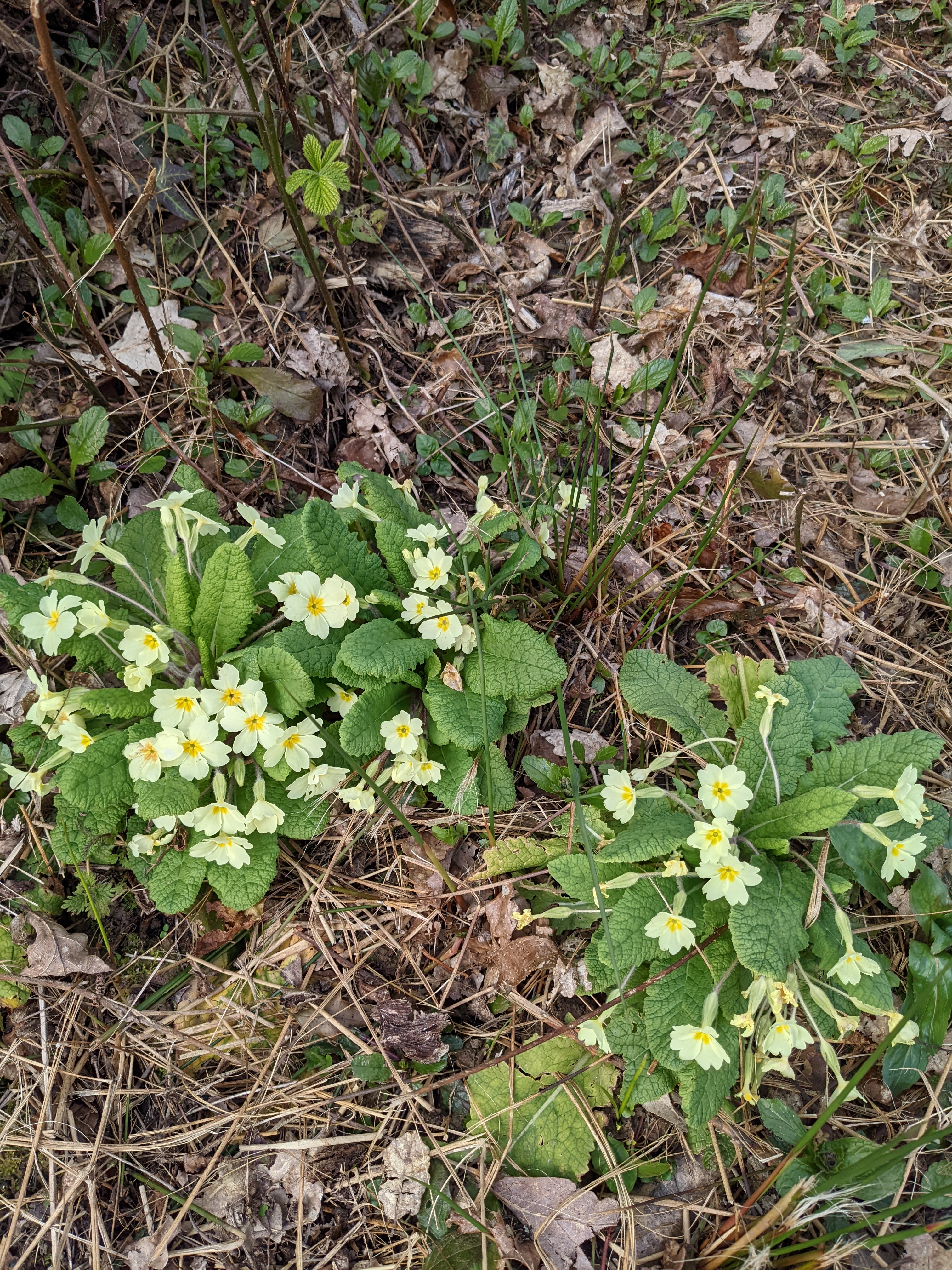
Primroses at the Weir Garden

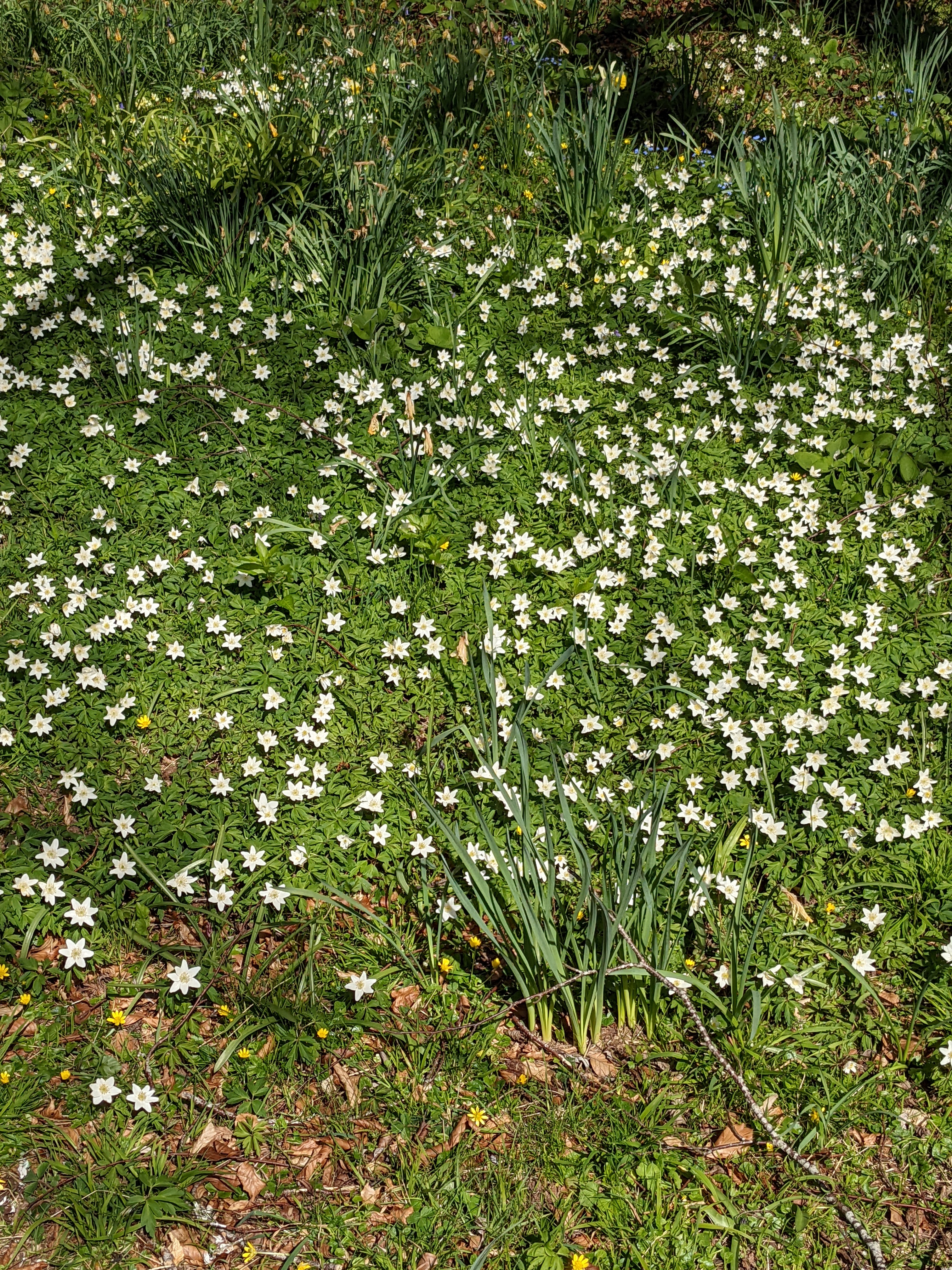
Wood anemones at the Weir Garden

Brunnera at the Weir Garden

Clove-smelling currant bush at the Weir Garden


The Weir Garden is adjacent to the River Wye and the waters were clear for a change. Some quite large fish could be clearly seen near the bank - I assume brown trout but then I'm no angler.

Brown Trout(?) in the River Wye

Somebody was flyfishing on the opposite bank but I didn't have the heart to tell him the brown trout were congregating on our side.

One final treat was spotting a Red Kite soaring above the trees near the rookery at the Weir Garden. Some agitated rooks drew my attention skywards where the Red Kite was circling just above the tree canopy. This is probably the closest I've seen a red kite to the city of Hereford. Red kites almost went extinct in the UK; down to just two breeding pairs in mid-Wales. In one of the best conservation stories ever, the kite population in Wales was nurtured and grew sufficiently to allow some birds to be caught and released in England (Chilterns) and Scotland (Black Isle). The red kites from the Chilterns have spread westwards into the Cotswolds while the Welsh kites have spread eastwards into England. I suspect the kites we see in Herefordshire are of the Welsh variety and hopefully they will meet up with their English cousins before too long.

Butterfly Hunt at Haugh Woods

Good Friday (15/4/22) and it is a lovely sunny day in Hereford. BBC reports it as the warmest day of the year so far with a temperature of 23.4 ℃ (74.1 ℉) in London. Our Davis Weather Station recorded a high temperature of 22 ℃ in the garden between 2pm and 5pm.

Sunny days without too much wind are good for butterfly spotting so we packed our lunch and headed for Haugh Woods. It is a great place for observing butterflies and even has a marked butterfly trail. Our first sighting was a Peacock butterfly perched on one of the many dandelions...

Peacock butterfly at Haugh Woods (15/4/22)

Then a Small Tortoiseshell fluttering along one of the many wide paths but refusing to land for a photo. Cuckooflower (or Lady's-smock) has been in flower for a while now so we were hoping to spot an Orange-tip butterfly on our walk as the cuckooflower is a major food plant for the caterpillar. If you look carefully you can sometimes find the mature yellow egg of the Orange-tip on cuckooflower.

The cuckooflower gets its name by association with the arrival of the first cuckoo. Its alternative name, lady's-smock, arises from the cupped-shape of the flowers or, more risque, it alluded to certain springtime activities in the meadows ('smock' was slang for 'an immoral woman').

Today we were lucky and saw one on the wing - fortunately, the male Orange-tip is easy to identify from its characteristic orange tip.

Finally, on our way back to the car park along a narrow woodland path, we came across a Speckled Wood flying close enough to identify. And this delicate wood sorrel with its shamrock-like leaves...

Wood Sorrel in Haugh Woods (15/4/22) 

In addition to looking for butterflies, we paid a visit to Joan's Hill Farm which is accessible from Haugh Wood. This nature reserve is owned and managed by Plantlife. Many of the fields were speckled with cowslips...

Cowslips at Joan's Hill Farm (15/4/22)


Cowslips at Joan's Hill Farm (15/4/22)

Later in the year, there will be lilac carpets of orchids so we must remember to return.


Big Garden Birdwatch 2022 - Results

Robin looking for worms in the garden

At the end of January, Mary spent an hour counting the birds in our garden as part of the Big Garden Birdwatch 2022. Her sightings were summarised here and the results were sent off to the RSPB. Over 11.5 million birds were counted by almost 700,000 people.

In our garden, the most populous birds were:

1    Wood Pigeon (4 of each)

2=    Blackbirds & Blue Tits (3 of each)

3=    Crows, House Sparrows, Starlings & Collared Doves (2 of each)

4=    Great Tit, Robin & Lesser Black-backed Gull (1 of each)

For the UK, the most common birds were:

1    House Sparrows

2    Blue Tit

3    Starling

4    Wood Pigeon

5    Blackbird

6    Robin

7    Goldfinch

8    Great Tit

9    Magpie

10    Chaffinch

So the top 6 birds in the UK also featured in our garden count. Three birds (Goldfinch, Magpie & Chaffinch) did not feature in our list; although Goldfinch and Magpie are fairly regular visitors (just not that particular weekend).

For a bit more information go here.


Good Spuds by Planting on Good Friday?

 I have always sown maincrop seed potatoes when the environmental conditions seemed right - generally, in mid-April when the ground has warmed, the probability of a late frost is low and the promise of April showers is in the air. Mary tells me they should be put in the ground on Good Friday to 'guarantee' a good crop. Since Good Friday can fall between March 20 and April 23, this makes absolutely no sense to me because there are so many other factors affecting crop yield (drought, flood, pests and diseases, nutrient availability, etc).

Chitted Sarpo Blue Danube Seed Potatoes

The origin of the 'Good Friday' link with potato planting is hazy. There may be a religious connection - allegedly, Protestants would not eat potatoes because they are not mentioned in the Bible but Catholics were OK with them if planted on Good Friday (with or without a sprinkling of holy water) to drive off the devil. A more pragmatic explanation is that Good Friday is the first holiday after Christmas and, therefore, the first opportunity (for working people) to get some serious work done in the kitchen garden. 

Yet another explanation relates this tradition to 'gardening by the moon'. I have seen this explained by the fact the moon is closer to the earth during full and new moons (higher gravitational effects) and this raises the water table in the soil and also influences water transport mechanisms in seeds and plants. Can the nearness of the moon have such an effect? Possibly, though I would expect the effect to be really small. I remain sceptical the small changes in the distance between the moon and earth around Eastertime have a big enough effect on the water table sufficient to affect crop health and yields. If there was an effect due the changes in the gravitational pull of the moon, then, at least for 2022, the data suggests planting a week before Good Friday would be optimum. Happy to be convinced otherwise but it would need some supporting evidence!

Yet another idea is that rain follows both full and new moons and all gardeners and farmers appreciate some rain after sowing. The effect, if indeed it is an effect, seems small and probably overwhelmed by other factors. No plausible mechanism has been suggested for the link between moon phases and precipitation.

So, back in the real world, on the 11th April, I decided it was time to plant the seed potatoes. I had considered putting the seed potatoes in the ground at the beginning of April as the weather had been reasonably warm. However, frost was forecast for the first weekend of April and then the second weekend; so I decided to wait until the outlook was frost-free. For those of a curious and scientific bent, the weather forecast was correctand there were frosts on both weekends.

I operate a 4-bed crop rotation system so I knew exactly where I was going to put the potatoes (blue area); the other half of the bed would be used for sweetcorn later in the year.


First of all, I needed to clear the green manure planted at the start of October 2021. Normally, this would be dug into the ground and left for 2-4 weeks before planting as some green manures (e.g. rye grass) contain a chemical that inhibits seed germination though this is not an issue for seed potatoes. As my hot composting bins were also in need of some soft green vegetation to give them a temperature boost, I decided to pull out the green manure, shred it and add to my Hotbin. Having cleared the plot...


...time to plant the seed potatoes. I am planting Sarpo Blue Danube again this year. We are still eating last year's crop so I know they keep well. Last season, I did not irrigate the crop: this year I will operate a moderate degree of watering and compare yields. There are many ways to grow potatoes; traditionally, in the ground but also above ground under straw or black plastic and in containers. There are pros and cons to all of these methods so choose the one that suits you. I favour the traditional method of planting the potato about 15 centimetres below ground and then earthing up. Potatoes are a good crop for improving the tilth of the soil and preparing it for next season's crop - which should not be more potatoes!

I received my seed potatoes on the 29th January and, about a week later, placed them on trays filled with shredded cardboard (an eggbox is an excellent alternative but we don't eat eggs). The trays were placed in a light airy room (16-18 ℃) to chit. Commercial growers do not chit potatoes (too time-consuming) and chitting is mainly beneficial to give a kickstart to first and second earlies and early maincrop varieties. Blue Danube is an early maincrop so does benefit from chitting.

 Chitted Blue Danube Seed Potato ready for planting out

My 1.5 kg pack of Blue Danube seed potatoes contained 18 tubers and cost £6.45 from D.T. Brown. I will, therefore, have three 2.4 metre (8 foot) rows with six seed potatoes in each row. The spacing within each row is about right for early maincrop potatoes though the rows are closer together than is generally recommended  - an advantage of a raised bed system where cropping can be more intensive.

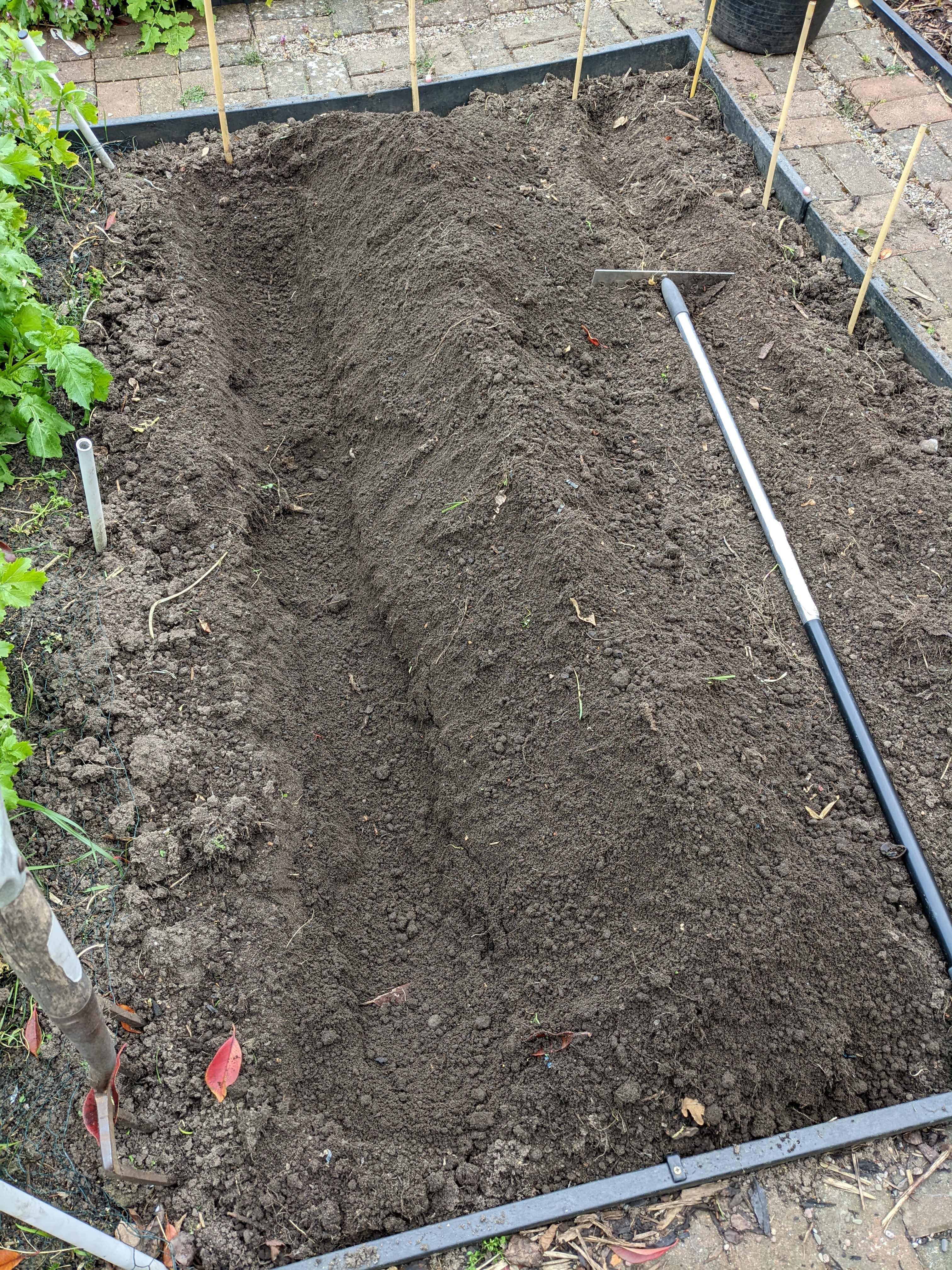
First, I mark out with canes the three rows and approximate positions for each seed potato. Then I create a trench about 5-6 inches deep using a rake - this avoids standing on the soil and compacting it - before using the short edge of the rake to loosen the soil in the bottom of the trench...

Preparing the first trench
...seed potatoes are pushed into bottom of the trench, chitted end upwards...

Seed potatoes placed in the trench

...and then covered with compost (unsieved)...


...before raking the soil back over the trench to form a ridge along the row...


Repeat twice more and then stand back and admire your handiwork!

Job done!


The Herefordshire Viking Hoard

In 2015, two metal detectorists uncovered a hoard of Viking artefacts near Leominster in Herefordshire. Instead of reporting this treasure find, as required by law, they sold most of the 300 pieces of jewellery and coins for personal profit. In 2019, both detectorists received long jail sentences (ten and eight & half years); two coin dealers were also convicted and given jail sentences. Out of the original hoard of 300+ pieces (worth up to £12 million), only 10 % was recovered including this 5th - 7th century crystal pendant.

The treasure find seems to go by various names. Wikipedia calls it The Leominster Hoard whereas Current Archaeology calls it The  Herefordshire Viking Hoard. At the moment, the British Museum is custodian of what remains of this Viking Hoard and it will cost Herefordshire Council about £1 million to buy it back and put it on display in the local museum.

Today (10/4/2022), Herefordshire Council and Hereford Museums organised a family day, including Viking re-enactment groups, at Hereford Rowing Club. We met up with two of our grandchildren and their dad to watch the re-enactments, make coins, try on helmets, etc. This bunch of Viking warriors looked pretty friendly though and were easily repelled by children throwing bean bags...

The day-out was free but there were several 'encouragements' to donate!

View from the Rear Window - March 2022

 March is the first month of meteorological Spring as we start to look forward to warmer days with less frequent frosts. The garden is really starting to green up and March is a great time for flowering bulbs. Our general impression was that March 2022 was a dry, sunny and fairly quiet month, but would the weather stats back that up? Previous months of 2022 can be found here and here. This photo of the back garden was taken on March 3rd 2022. For the most part, trees are still bare except for a few pink flowers on the wild cherry. Our neighbour's grass lawn is growing fast which is good for me as it supplies much-needed 'winter/spring' nitrogen for my hot composting system. The hellebores and viburnum provide some welcome contrast to the early Spring greening while daffodils and primulas provide a splash of yellow and the promise of warmer days (with occasional frosts!)... 


Garden and wild daffodils appear in February but will continue to flower throughout March as this garden photo from the 28th March shows...


...and the kerria japonica is not looking too bad.

By the end of March (30th) our wild cherry was looking its best with our neighbour's cherry tree a close second! Fortunately, we missed out on any really strong winds in March so the cherry blossom remained intact for longer...


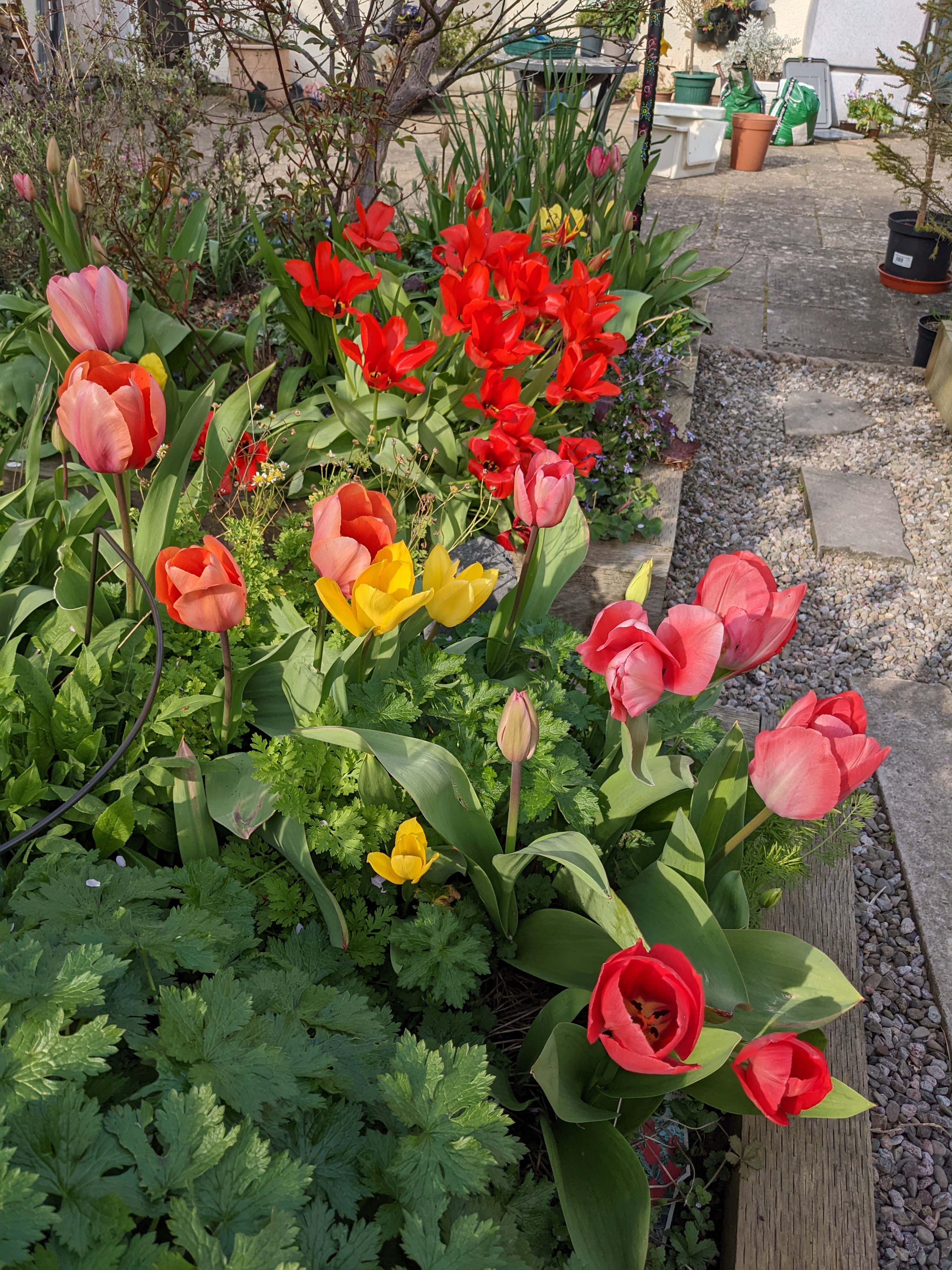
March is also a good month for tulips and they bring exciting colour to the garden...


Jobs in the Garden

  1. Seed sowing frenzy at the beginning of the month, especially tomatoes, sweet and chilli pepers, aubergines, courgettes, squashes and cucumber
  2. Following on from 1, transplanting mini-plants to bigger/individual pots
  3. Plant out sprouted garlic cloves (softneck, Sainsbury's) in the ground. These had been started off in the greenhouse (early February), hardened off in the polytunnel (late February) and planted outside on the 9th March
  4. Split off some comfrey root for my daughter's garden
  5. Onion sets arrive in the post on 19th March. Immediately plant outside next to garlic. Surround with insect-proof netting. Water every other day with rainwater from our waterbutts during dry periods
  6. Mulch/feed fruit trees and bushes with compost: apples, pears, plums, redcurrants, blackcurrants, gooseberries & raspberries
  7. Strawberry plants rooted in the Hydropod transplanted into 13 cm pots filled with recovered coir & placed in Wonderwall planters                                                                                                              
  8. Neverending compost-making, pruning, tidying up and adding new plants to the garden
  9. Last year's stored potato and onion harvest still being eaten! Along with regular pickings of sprouting brocolli, kale, spinach and chard sown last year  
  10. To be honest, not that busy a month - we had time to take a short break and visit family

March 2022 Weather

A summary of key weather parameter for March 2022 can be found in the table below. Not too windy (unlike February), generally dry with warm daytime and cool nighttime temperatures.

March 2022

Weather Parameter

Value

Dates

Average Monthly Temperature 

8 oC


Maximum Monthly Temperature

21 oC

24th

Minimum Monthly Temperature

-0 oC#

17th & 21st 

Number of Air Frost Days

2


Number of Hot Days (> 25 oC)

0


Monthly Precipitation

39.4 mm


Greatest 24 h Precipitation

11.4 mm

10th - 11th

Number of Dry Days

19


Monthly Sunshine Hours (estimated)

107


Average Wind Speed

4 km/h


Highest Wind Speed

37 km/h

13th & 31st

Maximum Barometric Pressure (Sea Level)

1043.6 hPa

18th

Minimum Barometric Pressure (Sea Level)

996.2 hPa

11th

Average Barometric Pressure (Sea Level)

1021.5 hPa


# minimum temperature below 0 ℃ but not as cold as -1 ℃ so also counts as an air frost day

Maximum and minimum temperatures throughout the month are shown in the bar graph below [click once on the plot for a larger, clearer image]. The second half of the month was characterised by warm, even hot, sunny days combined with cold nights (including a couple of air frosts).


The next bargraph summarises rainfall and solar radiation during March 2022 [click on plot for larger image].  Rainfall was low and occurred at the start, middle and end of the month. The second half of the month was notable for its sunny days.


The Met Office reported March 2022 as the the second sunniest in the UK since records began in 1919 (and the sunniest since 1929) as high pressure and clear skies were the order of the day (and night).  Northern Ireland (NI) and Scotland had an especially sunny March with NI having nearly twice the sunshine hours it normally receives.

Compared with the long-term average (1991-2020), the West Midlands, including Herefordshire, was a bit sunnier than normal with average rainfall and a mean temperature about 1 ℃ higher.

So, how does March 2022 in the back garden compare with 2020 and 2021? Temperature-wise, 2022 stands out because of its significantly higher maximum temperature (21 ℃) but is, otherwise, quite similar to 2020 and 2021.
Compared with 2020 & 2021, March 2022 had similar rainfall and sunshine but was a little less windy...
And finally, some pictures from the garden...


Queenswood Country Park and Arboretum

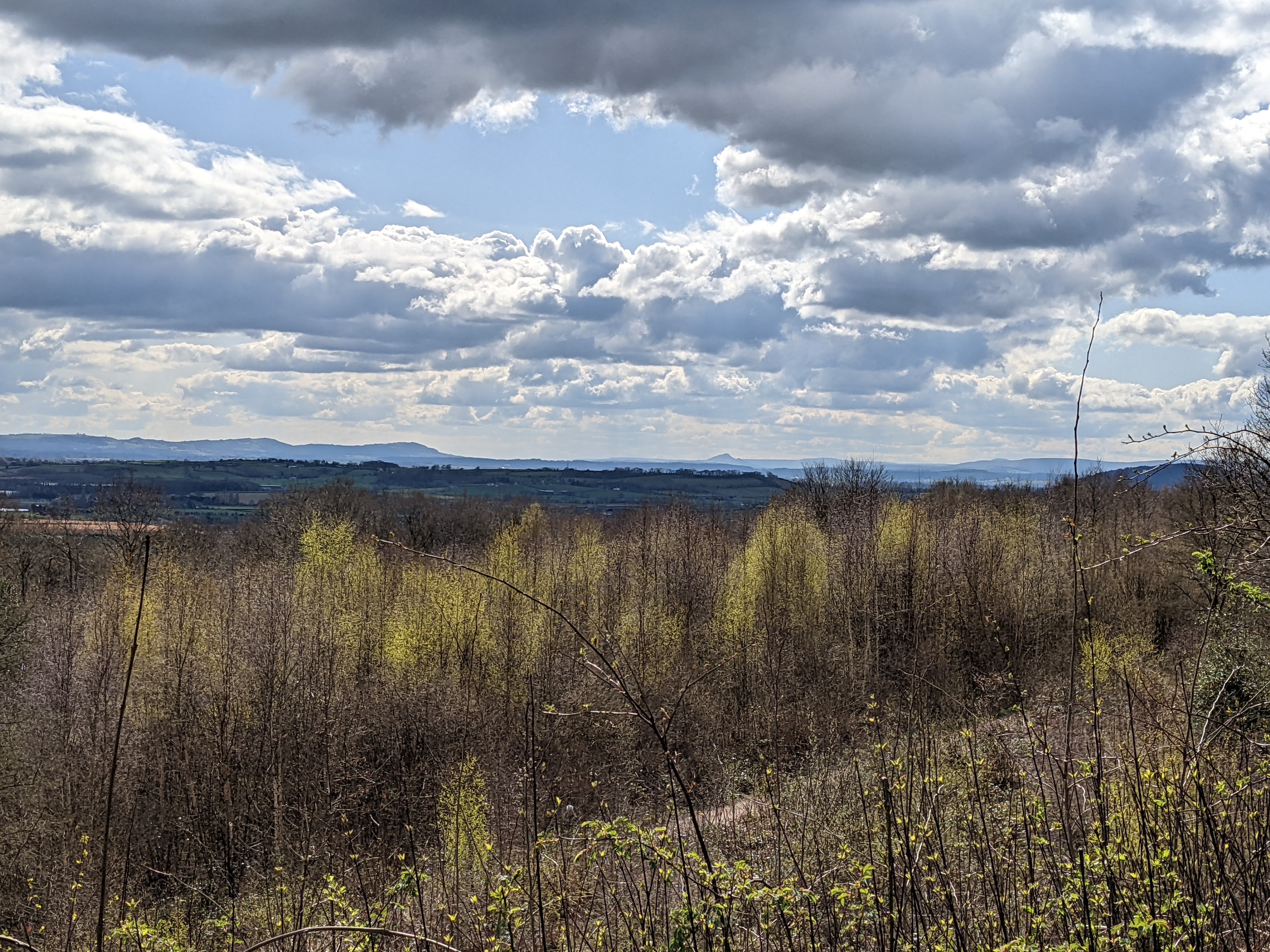
Queenswood is Herefordshire's only Country Park and a popular destination (over 500,000 visitors per year) for both locals and tourists. Lying between Hereford and Leominster, it comprises 123 acres of ancient native woodland (designated as a Site of Special Scientific Interest, SSSI) surrounding a 47-acre Arboretum with a collection of over 1200 rare and exotic trees. Although owned by Herefordshire Council, a 'community asset transfer' to Herefordshire Wildlife Trust and New Leaf Sustainable Development, on a 99-year lease, was made in 2016. There is an excellent cafe, well-equipped shop, toilets and a large childrens' playground to go with the many miles of tracks. Most people visit the viewpoint (below) which has a good vantage looking south and eastwards as far as Wales and Gloucestershire.

A toposcope points out the key landmarks. For example, the Skirrid can be 'clearly' seen in the far distance (25 miles?), instantaneously recognisable by its shape, just right of centre.

It was a bright, mostly sunny, day with a cool north breeze during our visit on April 1st 2022. There were only about 20 cars in the car park although quite a few of the visitors seemed to be enjoying the warmth of the cafe. There are a number of signposted walks such as the Gruffalo Trail...

...but we tend to just follow our noses and see where it leads. The cherry trees and magnolias were in blossom...


...but the stars of the show were the carpets of wood anemone...


...and primroses...


...and, near the viewpoint, a good display of common dog violets...


A local resident clearly enjoys daffodils, whilst also benefitting from a fine display of wood anemones...


A final visit to our favourite piece of wood art...


...before returning to the car park and paying for our stay. There was just enough time to meet someone complaining about the car parking charges - a much-discussed topic in the local newspaper. I guess in the olden days when Queenswood was operated by Herefordshire Council, car parking was free so I can understand why some people complain now that they have to pay when they didn't in the past. However, if they paused for a moment and thought about it, they would realise they have always paid for the car parking; just through local taxes rather than cash in hand.

Time to plan another visit when the bluebells are out and when the Acers are at their best.


Popular Posts

Blog Archive