River Surveys - Pollution Monitoring

The Belmont Testers are a group of citizen scientists (Alan, Maggie. Mary, and I) who test the waters twice weekly at our designated spots - marked by red dots on the map (Figure 1). On occasions, we perform additional testing upstream following the course of Newton Brook from the River Wye to its source (X). 

Figure 1: Map of Newton Brook 

We also include the unnamed tributary (Western Stream, source X) of Newton Brook in our surveys. Since this watercourse is, as far as we know, unnamed, we are trying to get it adopted as Maggie's Brook, in recognition of all the work she does.

Photo 1: Maggie's Brook (unadopted)

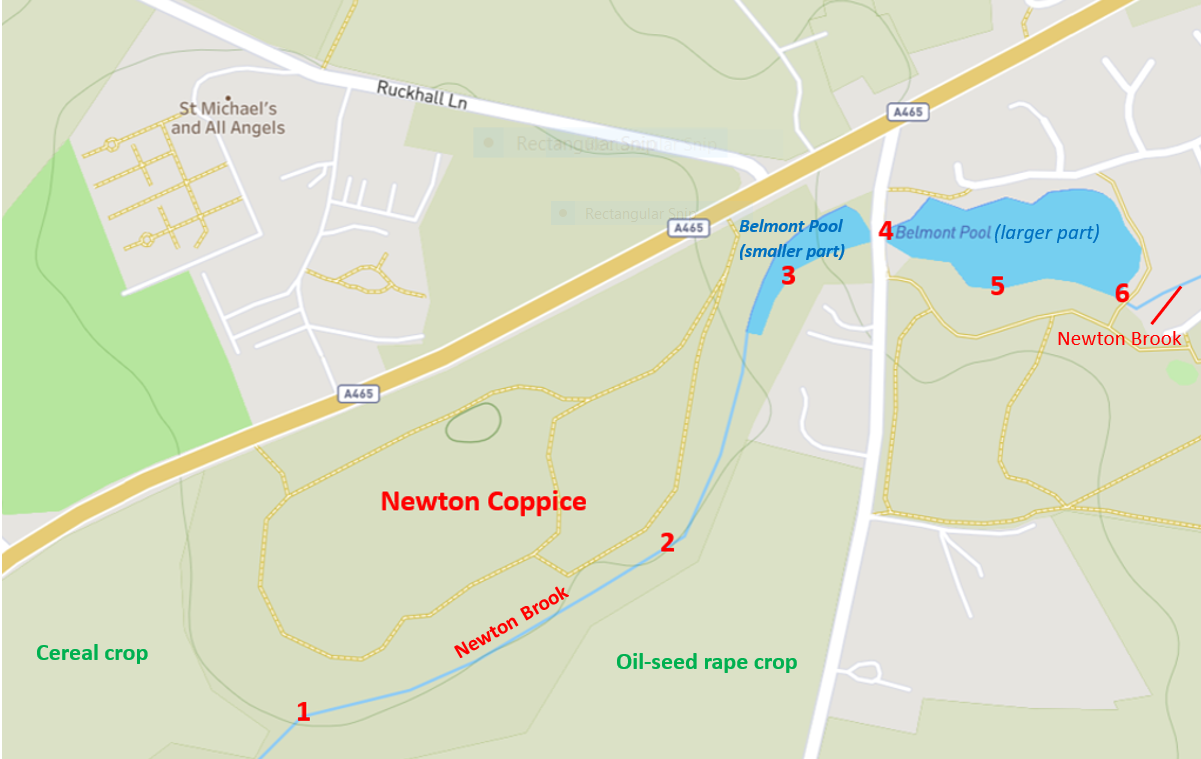
In April 2024, Alan & I surveyed the upper stretch of Newton Brook, Figure 2, sampling and testing at six different sites.

Figure 2: Six Sampling/Test Sites along Newton Brook (21/4/24)

The purpose of these surveys are two-fold. Firstly, to understand the layout of the land, identify potential sampling sites and pollution sources (agricultural, sewage, road drainage, etc), and note any unmarked water inputs (land drains, etc). Second, to establish seasonal pollutant levels and physical parameters for the entire watercourse. Deviations from baseline pollution levels can be used to identify point source pollution incidents (e.g. leaking septic tank or silage pit) and more general trends of increasing/decreasing pollution.

Table 1 presents a summary of the on-site chemical analyses performed during this particular survey.

Site

EC (µS/cm)

Temp

(°C)

Nitrate as N

(ppm)

Nitrite as N

(ppm)

Phosphate as P

(ppm)

TAN (ppm)

pH

Turbidity

(NTUs)

1

672

11.2

10

0

0.00

0.00

8.0

21

2

714

11.0

  5

0

0.05

0.02

7.9

12

3

714

10.8

10

0

0.03

0.05

7.9

40

4

696

12.5

  5

0

0.04

0.00

7.9

12

5

561

16.7

20

0.3

0.00

0.11

7.9

12

6

566

17.0

20

0.3

0.00

0.10

7.9

12

Table 1: Chemical Analysis (21/4/24) at Six Sample Sites. (EC = electrical conductivity, TAN = total ammoniacal nitrogen)

As noted in the schematic below, courtesy of Freshwater Habitats Trust, pollution levels are very low for phophate yet very high for nitrate.

Figure 3: Schematic of Relative Pollution Levels for Phosphat and Nitrate (h/t Clean Water for Wildlife)

At Site 3 (Figure 2 & Table 1), the water turbidity was high and there was a very obvious algal bloom event (Photo 2 & Photo 3).

Photo 2: Algal Bloom at Site 3

Photo 3: Closeup of Algal Bloom at Site 3

Fortunately, these are filamentous algae. Unsightly but not dangerous.


Mary's 70th Birthday

This year (2024) is birthday number 70 for Mary. I reached the same milestone a couple of years ago. It also happens to be our Golden Wedding Anniversary. We will be meeting up with all the family (5 children, 5 partners and 10 grandchildren) in the middle of August before travelling down to the Isle of Wight in September to celebrate with Mary's brother & sister (and their partners).

It just so happened that the day of her birthday fell on the same day we gather, as citizen scientists, to test the waters of Newton Brook, a tributary of the River Wye.

Photo 1: Maggie, Mary, Ian, Sandra & Alan

Mary decided to bring the birthday party to our testing site for an early morning celebration (10 am), after testing of course!

In the evening, Mary & I travelled out to Symonds Yat Rock for another picnic and the chance to take in the wonderful views from Symonds Yat Rock.

Photo 2: View from Symonds Yat Rock

Photo 3: View from Symonds Yat Rock

Photo 4: View from Symonds Yat Rock

Photo 5: View from Symonds Yat Rock

The rock faces visible in Photo 5 are where the peregrine falcons nest. No sign of them today, though. In Photo 4, you might just be able to pick out the herd of Hereford Cattle, a world famous breed. For those with less than 20/20 vision, like myself, here's a close-up ...

Photo 6: Hereford Cattle grazing below Symonds Yat Rock

Finally, here is a short panorama from Symonds Yat Rock showing the surrounding countryside ...

Video 1: Panorama from Symonds Yat Rock

There are plenty of waymarked walks through the surrounding forest - we had time for a 3 kilometre stroll before heading home. Car parking, toilets and refreshments are available on-site.

Celestron LCD Digital Microscope II

 For some time we have been hankering for a half-decent microscope - ideally one with a screen with the capability for taking photos and videos. We had an ancient school microscope, kindly donated by one of our citizen science friends, but the optical lenses were badly scratched and we could not find suitable replacements. So on April 11th this year, a package arrived ...

Photo 1: A Package Arrives ...

Mary was out so I had to wait on her return before opening it ...

Photo 2: Celestron LCD Digital Microscope II

Photo 3: Microscope and Accessories

You can find a fuller description of the microscope here. It comes with a number of accessories - some useful, some less so. This carrier bag (Photo 4) is certainly handy for transporting this microscope, capable of mains and battery operation.

Photo 4: Handy Carrier Bag

The three objective lenses (x4, x10, x40) combined with the camera sensor (x10) provide optical magnification of x40, x100 and x400. Digital magnification up to x1600 (using the built-in camera's zoom function) is available.

The 3.5" colour touchscreen is great for group views and certainly reduces eyestrain - especially for us oldies! I used a phone adaptor on our old optical microscope but it was a bit fiddly. Photos and videos are very easy on the Celestron microscope.

The Celestron microscope has light sources below (transmission) and above (reflection) the specimen to cater for both translucent and opaque samples.

I will give a fuller review once I have given the microscope a good work out. By way of a taster, here is a photo taken from a pond sample ...

Photo 5: Pondlife


Flower Power

I picked this up from our Ring doorbell. Two passers-by enjoying our garden wall display using three of the five senses: sight, smell and touch. (the touchy, feelie plant in the video is a red-flowered thyme). See Stop and Smell the Flowers for more plant appreciation.

Video 1: Passers-by Enjoying the Flowers in our Front 'Garden'

We always try to make an effort with our 'front garden', especially since no other residents on our road bother. The outlook from our front windows is most definitely utilitarian (see Video 1) though our neighbour across the road very kindly installed three water butts to facilitate watering the 'front garden'. In return, they get to enjoy our flower display (Photo 1).

Photo 1: The Front Garden (28th July 2024)
We had our front wall rebuilt some 20 years ago to contain a narrow (10 cm) cavity in which we could grow plants. Some years are better than others depending on the amount of summer rainfall - manual watering (and feeding) is somewhat irregular and appears to be predominantly a male occupation as far as I can tell. Mary chooses the plants and is in charge of all horticultural practices.

We are especially pleased with the hanging baskets this year because these are usually the first to suffer from irregular watering and feeding!!

Photo 2: Right-hand Hanging Basket

Photo 3: Left-hand Hanging Basket

There are a few potted plants on the inside of the wall including sunflowers (not yet flowering) on the far left and far right (Photo 1 and Photo 4) ...

Photo 4: Flora inside the Wall

Apart from the onerous task of watering during hot dry spells, maintenance is kept to a minimum by growing mainly perennials plus a few annuals to spruce things up. Cats, of course, treat any bare earth as their toilet, moss is constantly falling off the roof and every loose crisp packet seems to be blown into the front garden. We also find an inordinately large number of pigeon feathers (Photo 4) for some reason.

The Life Cycle of a Wood Pigeon?!

 At the bottom of the garden, there is a wisteria-laden archway (marked) leading to the kitchen garden ...

Photo 1: Wisteria Arch marking the entrance to the Kitchen Garden

For a few weeks I have heard a gentle cooing coming from the wisteria with the occasional rapid exit of a wood pigeon when passing through the archway leading to the Kitchen Garden. A pair of wood pigeons had tried, unsuccessfully, to nest in our winter-flowering cherry last year. This year they paid regular visits to the flowering cherry tree but only (with hindsight) to collect twigs to build their very rudimentary nest in the wisteria.

On exiting the kitchen garden today (22nd July), I noticed a motionless wood pigeon sitting on a nest no more than a foot above my head.

Photo 2: Wood Pigeon Nesting in the Wisteria

Photo 3: Wood Pigeon on its Nest

The pigeon remained motionless hoping I wouldn't spot it. I assume the fact that it did not immediately fly off meant that there were eggs in the nest.

While new life is in the offing at home, the short video below reports the untimely death of another wood pigeon at the claws of a sparrowhawk. This was recorded in Hereford by my son, and only about a mile or so from us.

Video 1: Death by Sparrowhawk

Pigeons are slow and, outwardly, rather stupid so are easy meat for predators like the sparrowhawk and peregrine falcon. As one pigeon leaves this world, possibly several new ones enter!

Common Brimstone Butterfly

 A couple of days ago, I mentioned an unexpected garden visitor in the form of the common brimstone butterfly. Whilst not an uncommon butterfly, especially in the south and east of England (Figure 1), its preferred habitat is scrubby grassland and woodland including roadside verges and hedgerows.

Figure 1: Brimstone Distribution in the UK (h/t Butterfly Conservation)

Well, I object to our garden being described as scrubby grassland!! Hence our surprise and delight in seeing this rare visitor enjoying our garden. In the past, we have observed brimstones at Common Hill (scrubby grassland) and the nearby Lea & Paget's Wood (woodland). In our experience, brimstone sightings are often on the wing and some distance away but their identity is given away by the distinctive yellow colour.

Our recent garden visitor was still rather flighty but at least it was possible to get reasonably close. Here are a couple of short videos recorded on the 19/7/24 in the kitchen garden.

Video 1: Common Brimstone in a Hereford Garden (19/7/24)

Video 2: Common Brimstone in a Hereford Garden (19/7/24)

For more information on the brimstone butterfly, see here, here, here, and here.

Big Butterfly Count 2024

This important Citizen Science project started on the 12th July and finishes on the 4th August. Further details can be found on the Butterfly Conservation website. From conversations with people in different parts of the UK, butterfly sightings have been very low this year. We have seen remarkably few in the garden; even the cabbage whites have been largely absent. It is imperative, therefore, that citizen scientists submit as many reports as possible to the 2024 Big Butterfly Count so we can understand what is happening. I suggest that, no matter where you are, if you spot an identifiable butterfly then please spend the next 15 minutes counting how many you see and what type. Report your findings on-line, here.

I took this photo of a common brimstone butterfly yesterday (17/7/24) in our garden ...

Photo 1: Common Brimstone in Our Back Garden

... though you might have some difficulty spotting it. Fortunately, it was the male butterfly with its distinctive butter yellow colour (possibly the reason for the butterfly name).

Photo 2: Enlarged Close-up of the Common Brimstone (extracted from Photo 1)

This is quite an unusual sighting both for our garden and for this time of the year (Figure 1)

Figure 1: Common Brimstone Lifecycle (h/t Butterfly Conservation)

Today (18/7/24) we visited Arthur's Stone (more on that in another blog) and, afterwards, walked on to Merbach Hill and Common. Mary was keen to see the harebells that had been plentiful on a previous visit in 2021. We were largely disappointed on that front with just these two specimens on show.

Photo 3: Harebells on Merbach Common/Hill (July 2024)

Fortunately, from a butterfly point of view there were a number of meadow brown and marbled white butterflies displaying their flying prowess. No photographs as the butterflies refused to stay still for long enough!


Popular Posts

Blog Archive