Oxlips and False Oxlips

In a previous post about a visit to Common Hill Nature Reserve in April, we mis-identified this plant...

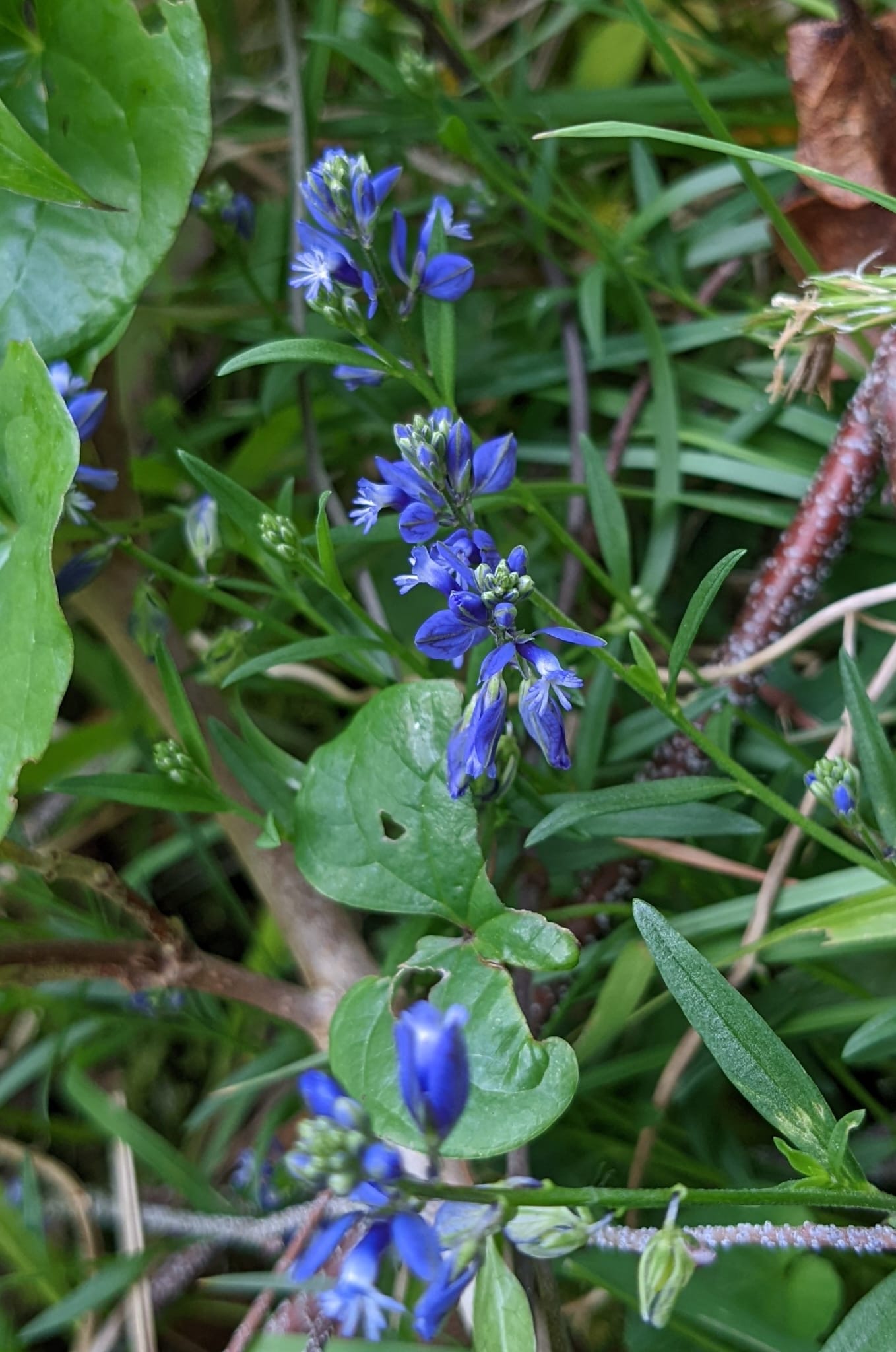
False Oxlips

...as oxlip when it should have been identified as false oxlip. In Mary's defence, she did not realise there was such a thing as a false oxlip, and oxlips themselves turn out to be quite rare in England. The warden at Common Hill checked earlier records and noted false oxlip had been recorded at Common Hill - but not oxlip. It did not take long to confirm these were false oxlips using several wildflower reference books.

The oxlip, or true oxlip (Primula elatior) is restricted to certain parts of East Anglia, specifically parts of Cambridgeshire, Essex and Suffolk - it is the county flower of Suffolk.

The False Oxlip (Primula veris x vulgaris) is a hybrid of the Cowslip (Primula veris) and Primrose (Primula vulgaris). So, if you're in East Anglia then you are probably looking at Oxlip unless there are cowslips and primroses also present. In all other places, assume False Oxlip. Just to confuse matters, hybrid crosses of Oxlip and Primrose also occur! But it is now getting far too complicated.


First Cucumber of 2022


First Cuke (7th June 2022)


I grow cucumbers in a polytunnel using the Quadgrow Self-Watering system. Cucumber seed (Passandra F1) was sown in coir seed compost (March 5th) for germination (about a week) in a heated propagator before growing on indoors under 'grow lights'. Mid-April, the plant was transferred to the polytunnel to 'harden off' before transplanting into the Quadgrow planter on the 5th May.

Cucumber (far right) plus 3 different tomato plants (5th May 2022)


The cool start to 2022 has resulted in slow growth in the vegetable garden generally and this cucumber plant was a little less robust than in previous years. Nevertheless, the root system looked fine so the signs were hopeful for some vigorous growth to come.

By June 7th, the plants had progressed well...

Quadgrow a month later (7/6/22)

...and, even though the cucumber plant was still quite small, it has produced its first edible fruit at about 4" (10 cm) long (see top photo). [Note: Passandra is a mini cuke]

Checking back on previous years' records, the first cucumbers were picked on 24th June in 2021 and 4th June in 2020. 2020 was a particularly good year for vegetables due to the warm spring and absence of frosts. Here is a picture taken on 4th June 2020 of the first salad harvest...

Cucumber & Salad Leaves (4/6/20)


Common Hill Nature Reserve - June Update

 On our previous visit to Common Hill on 24th April, the stars of the show were, undoubtedly, the cowslips and early purple orchids. For one reason or another, we didn't manage to visit in May despite the best of intentions. So a return visit in early June (3rd) was a must. We took a packed lunch and spent an enjoyable two hours just wandering around.

[Edit: We made a return visit a few days later (7th June) to confirm the ID of some of the flowers seen on the first visit. As a result, a few more examples of flora & fauna found at the Common Hill Nature Reserve have been added along with some corrections. I am reliably informed by Mary that some plants are difficult to identify!  Sometimes you need to see the plant at all its development stages (e.g. buds, flowers, seeds) to be absolutely sure of the ID. This is not possible on sporadic visits and without taking specimens (only digital photos are taken). This post was updated on 7th June 2022 with the latest information and the best IDs based on the available data] 

There were four highlights to this visit; starting with this pair of courting Wood Whites at Monument Hill - captured by Mary on her phone after exhibiting considerable stealthiness to get close enough. 

Wood Whites (Courtship)

We had seen plenty of males, with their characteristic slow & weak flight, but none had landed for that photo opportunity...

Wood White in flight!

...until this particular male spotted a female and the courtship began!

Wood Whites (Monument Hill)

As we enter North Meadow from the 'car park', we see a 'typical' meadow scene - something has already caught Mary's attention...

Entrance to North Meadow looking towards the Orchard

Buttercup and pignut form speckles of yellow and white in the greensward while at ground level the reddish-pink flowers of red clover can be seen. At the margins, close to the hedgerow, hogweed and oxeye daisies have established a small foothold...


Hidden amongst the green, white and yellow is another gem (Highlight #2)...

Common Spotted-Orchid

...the Common Spotted-Orchid which, as the name suggests, is the UK's least rare orchid. There can be quite a variation in colour but they are all Common-Spotted.

Common Spotted-Orchid (Common Hill)

Common Spotted-Orchid (Common Hill)

Looking back towards the car park entrance to North Meadow from the corner of the old orchard...

North Meadow looking westwards

...before reaching the bench, next to the exit onto the Wye Valley Way, where we enjoyed lunch and the view looking back from whence we came...

View from the picnic bench

Sufficiently fortified, we commenced our recording of flowering plants in North Meadow, Monument Hill and Round's Meadow - always keeping a lookout for any fauna that crossed our paths. This brings us to Highlight #3...

Bird's Nest Orchid (Common Hill Nature Reserve, June 2022)

The Bird's Nest Orchid derives its name from the tangled root system which is said to look like a badly-made bird's nest. A specimen of this orchid, just outside the reserve, has been observed for a number of years but there has been no sign of it this year.

The final Highlight (#4) was this difficult-to-spot (until you find the first one!) common milkwort. Lying low in the grass, this plant also comes in purple/pink/white forms.

Common Milkwort (Common Hill Nature Reserve, June 2022)

Common Milkwort (Common Hill Nature Reserve, June 2022)

Finally, before getting to the list of flora and fauna seen on this visit, a couple of photos of Monument Hill...

Looking up Monument Hill

Looking down Monument Hill

We visited Common Hill on 3rd June 2022 between 2 pm and 4 pm. It was warm, sunny and bright with a gentle breeze. Back home in Hereford, our weather station recorded temperatures of 23/24 ℃ over this 2-hour period though it was somewhat cooler at the reserve. 

Flora (flowering):
  • Bird's Nest Orchid
  • Black Bryony
  • Bramble
  • Broad-leaved Willowherb
  • Bulbous Buttercup
  • Bush Vetch
  • Changing Forget-me-not
  • Common Bird's-foot-trefoil
  • Common Milkwort
  • Common Mouse-ear
  • Common Nettle
  • Common Sorrel
  • Common Spotted-Orchid
  • Common Twayblade
  • Common Vetch
  • Cow Parsley
  • Dandelion
  • Dog-rose
  • Dog's Mercury
  • Early Purple Orchid
  • Field Forget-me-not
  • Germander Speedwell
  • Goosegrass
  • Herb Robert
  • Hogweed
  • Hop Trefoil
  • Lesser Stitchwort
  • Marsh Thistle
  • Meadow Buttercup
  • Narrow-leaved Bird's-Foot-Trefoil
  • Ox-eye Daisy
  • Pignut
  • Red Clover
  • Ribwort Plantain
  • Rough Hawkbit
  • Selfheal
  • Short-fruited Willowherb
  • Smooth Tare
  • Thyme-leaved Speedwell
  • Wood Avens
  • Wood Spurge
  • Yellow Pimpernel
  • Yellow Rattle
Fauna:
  • Wood White
  • Speckled Wood
  • Meadow Brown
  • Grass Rivulet Moth
  • Burnet Companion Moth
  • Chiff Chaff
  • Blackbird
  • Chaffinch
  • Crow
  • Great Tit
  • Blue Tit
  • Wood Pigeon
  • Song Thrush
  • Buzzard

Storing Onions

Back in August 2021, I harvested our maincrop of red (Red Baron) and white (Cupido) onions. The onions were 'cured' on wire racks in an outhouse. In November, before any frosts, the onions were transferred to the house cellar (temperature range 10-15 ℃) to store over winter. I tied bunches of four to six onions together and hung the bunches over a wooden batten slung between two shelves. This ensured a good airflow around the onions for long-term storage.

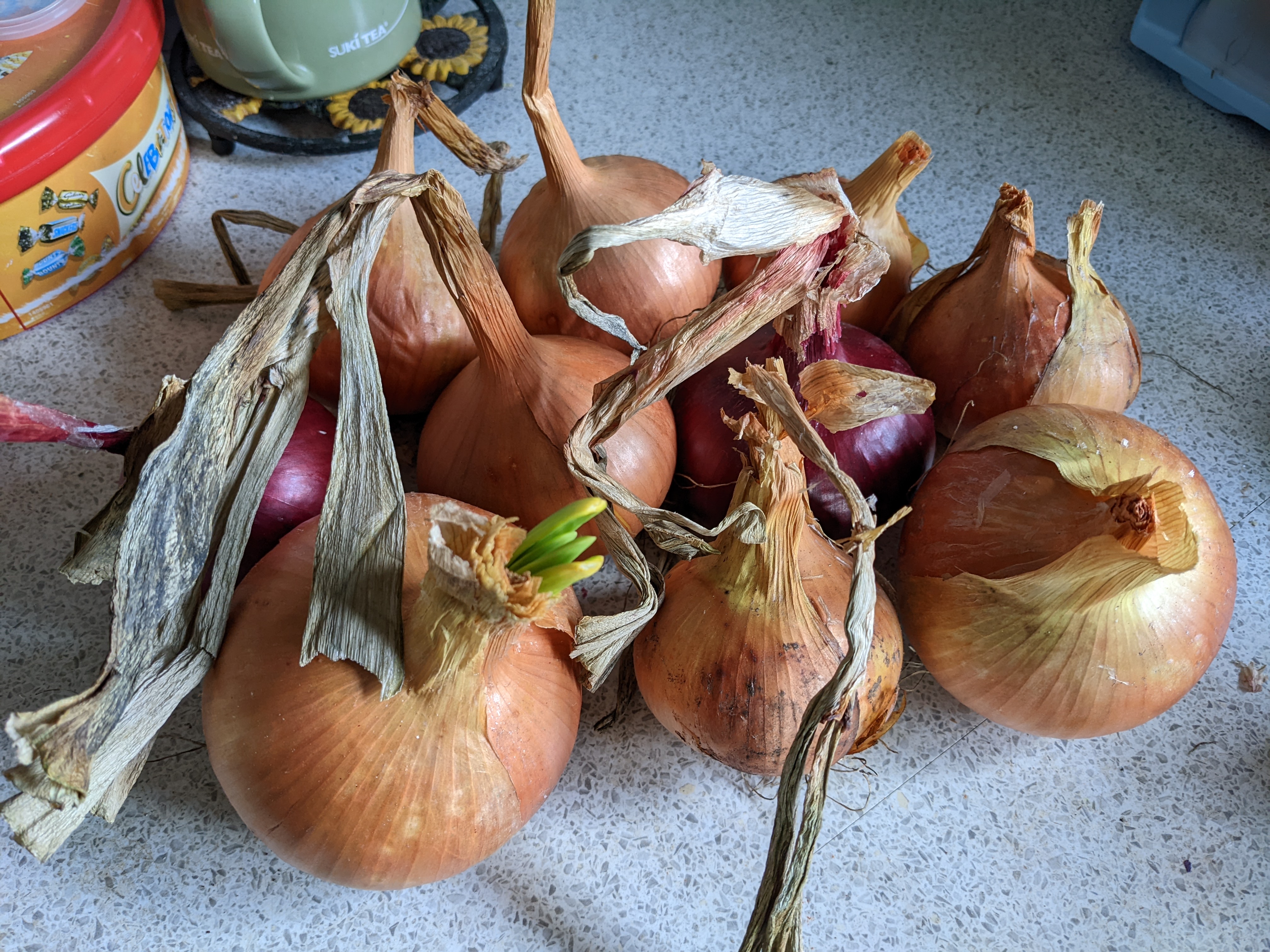
Nine months later, on the first of June 2022, I still had these onions left...

Onions after 9 Months of Storage

One or two onions had gone off (predominantly the red-type) and a few had sprouted but, overall, >95%  had stored well. Some onions were processed (peeled & chopped) and frozen for future use, while these remaining bulbs will see us through to the end of June at least. That means the onion crop from a 6 ㎡ plot (2 m by 3 m) provided nearly a full year's supply of these versatile vegetables.

This year's (2022) crop is coming along nicely...

2022 Onion Patch (Garlic in the background)

...such that, we may never have to buy an onion from the supermarket again!


A Slow Burner or Fiery End?

Queen Elizabeth II is celebrating her platinum jubilee this year - 70 years on the throne and Britain's longest-reigning monarch. All over the UK and in many Commonwealth countries, fire beacons were lit on the 2nd June 2022 in a time-honoured fashion.

Hereford lit their beacon at 7.30 pm on one of the highest points in the city - Churchill Gardens. There is a choice of two videos. The first video is nearly 4 minutes long for those with a little time on their hands! The second video is for those with less patience who just want to see the final outcome.


Enjoy!


European Garden Spiderlings

 Filling my watering can from a water butt next to a sarcococca bush, a movement caught my eye. Due to my slight longsightedness and the closeness of the perceived movement to my head, the video below is a pretty accurate view of what I saw. And it has nothing to do with the fact that my video-making skills need improving!


I did manage to get a slightly better-focussed picture though, admittedly, not that much better...

In any case, the picture was clear enough to identify European garden spiderlings (Araneus diadematus) just beginning to disperse from the cluster. The female lays 100-800 eggs (then dies) - after hatching, the spiderlings remain as a cluster for a day or so before dispersing to build their own small orb-shaped webs.

Wikipedia has a good page on these European garden spiders including a video of the female eating the male after mating. Spiders are fascinating creatures but they do tend to get a bad press. They work incredibly fast building their webs. In the mornings, I have to remember to wave a stick (or my arms) in front of me as I walk down the garden paths if I want to avoid a faceful of web and, sometimes, a persistent sense of crawling on my head for the next hour or so!

Here is a rather fine example of an orb web in the back garden on a sunny day in September 2021...

Orb web - Back garden, Autumn 2021


How Much Rubbish does Herefordshire Council send to Landfill

 A few weeks ago, I posted about a pet hate of mine often found across all media forms (social, mainstream, TV, radio, internet blogs, etc); i.e. data presented without context. As a result of that article, I sent in two Freedom of Information (FoI) requests to Herefordshire Council. I received answers to both requests fairly quickly.

The first FoI request asked for more up-to-date information on the rates of recycling. Not only did I get a reply to my question but my FoI request also triggered an update of the Council's website so everyone benefited.

The second FoI request concerned a statement that 3000 tonnes of stuff rejected in the recycling process, operated by Envirosort, was sent to landfill. I have visited this facility and it is an impressive, if somewhat smelly, operation that still requires significant human interaction in the sorting process.

I asked Herefordshire Council why the rejected recyclables were sent to landfill rather than the Energy from Waste (EfW) Incinerator built by Herefordshire and Worcestershire and in operation since 2017. I'm not a fan of incinerators but they are probably better than landfill for materials that cannot be reused or recycled. It would be better if the energy generated was used in a carbon capture process to reduce the environmental impact of the incinerator but that might destroy the economic feasibility of the incinerator.

The Council's response stated that in 2020-2021, 17.05% of the total waste went to landfill, 43.76% went to the incinerator and the remaining 39.19% was recycled. From April 2022, it is planned to send no more than 1% to landfill - this will be achieved by (i) re-routing the rejected recyclables away from landfill and towards the EfW facility, (ii) improving recycling rates, and (ii) sending more general waste to the incinerator.

For Herefordshire residents, just over 8% of council tax (ca £10 million) is spent on waste management. We can help reduce these costs by ensuring we recycle more and create less waste. I'll have more to say on this in another post.


Popular Posts

Blog Archive