At the end of August, I spotted these cabbage white butterflies (large whites, I think) participating in what appeared to be a mating dance. I took the video on my Pixel 4a phone so the quality is not great. See here for a higher-quality close-up video.
Cabbage White butterflies can see in the ultraviolet (UV) range of the electromagnetic spectrum which helps the male identify females from the UV reflections on the female's wings. Hence the fluttering display of the butterflies. According to this 1970 research paper, this ultraviolet communication system enables the identification of suitable mates and the initiation of courtship leading to acceptance or refusal of mating behaviour by either sex.
I thought it interesting the butterflies kept landing on the patches of homemade sieved compost rather than the natural soil. Whether there is some attractant in the compost or it is the broad bean seedling germinating under the compost, I haven't the foggiest.
Cabbage Whites are the dominant butterflies at the present time - late summer to early autumn.
Picked and enjoyed our first sweetcorn cobs of 2022 on 16th September. I grow sweetcorn every year but cannot find any records of first pickings from previous years.
This is the first time I have grown this variety (Incredible F1):
A very reliable Sugar enhanced variety “Incredible” delivers large 22cm (9in) cobs with excellent flavour on tall 8ft high plants. Good tolerance to rust and crops well even in wetter British summers.
With the hot dry summer we have just experienced, I cannot vouch as to whether it crops well 'even in wetter British summers'. However, I can vouch for the plants being 8ft tall...
This Year's Sweetcorn Crop (Incredible F1)
There are lots of sweetcorn varieties to pick from including early, mid-season, and late cultivars. I always sow, and therefore recommend, modern F1 varieties that have sugar-enhanced, supersweet or extra tendersweet in their description. As the name suggests, these cultivars are much sweeter than heritage and non-F1 varieties - so you can skip that knob of butter for a healthier meal.
They also keep their sweetness even after freezing. We just strip off the outer leaves (husk/shucks) and silks, pop into a plastic bag and freeze.
In mid-May, I sow seeds under cover (9 cm pots containing Fertile Fibre Seed Compost). Later sowings, from the beginning of June, can be sown directly outdoors. Even so, I prefer to sow into 9 cm pots, filled with seed compost, rather than directly into the soil...
Young sweetcorn plants
...as this allows more targetted (and hence economical) watering and offers some protection against mice. The hosta rings protect against slug attacks until the plants are strong enough to look after themselves. Once the plants have germinated and developed a strong root system...
Strong, healthy root system (Incredible F1 Sweetcorn)
...they can be planted into the ground - still with some protection from slugs - in a block formation...
Block planting (Sweetcorn)
In hindsight, I got the positions of the sweetcorn and potatoes the wrong way round because the potatoes overshadowed the later-sown sweetcorn. I had to restrain the potatoes nearest the sweetcorn by trimming a few leaves and using poles and string. I shall try not to make the same mistake next year!
Once the plants were established, I removed the hosta rings and kept the patch weed-free. Because of the hot dry weather in August, I gave the soil around each plant a one-time thorough soak followed by a feed/mulch with my sieved homemade compost. Otherwise, the plants were left to get on as best they could. The only things to remember with growing sweetcorn is: (i) they like hot sunny weather so don't plant out too early (from the beginning of June in Hereford), (ii) always plant in blocks, not rows, because they are wind-pollinated - anything bigger than a 3 x 3 block should be fine, and (iii) only plant one variety to ensure a tasty crop of divine sweetness - cross-pollination with another variety may lose all the advantages, including taste, of your F1 hybrid.
Depending on the variety and the size of your plot, one packet of seed may last for two years. Then you can try a different variety! Using raised beds, I can plant my corn closer together than the distances typically recommended on the seed packets.
Once the corn has been harvested, the stalks and leaves are composted in my hot composting systems. The bare ground is covered with a layer of homemade compost (non-sieved) and either covered with black plastic (to suppress weeds and stop the local cat population using the plot as a toilet) or sown with green manure.
Mary & I have just got back from a family visit which was to include a day at The Kia Oval (father, son, and father-in-law) watching England play South Africa at cricket. Tickets had been booked many months ago for the second day of this test match on Friday 9th September. The first day (Thursday) was rained off without a bowl being bowled; somewhat ironic in a year of well below average rainfall! The weather forecast for the second day looked more promising but, late Thursday afternoon, news broke that Queen Elizabeth II had died and most sporting fixtures for the following day were cancelled. Disappointing but it was only a game.
My son and grandson had tickets booked for the third day (Saturday) and enjoyed an exciting day's play. We consoled ourselves by watching the game on television.
We broke the car journey home with overnight pub stays in Holybourne and Marlborough; definitely recommend The White Hart in Holybourne for accommodation, food, beer and the friendliness of the staff!
Not far from Holybourne, is Jane Austen's House at Chawton which we visited the following day...
Jane Austen's House, Chawton
...and spent a very pleasant couple of hours wandering around the house and gardens. We met quite a few characters dressed like this...
Chawton as it might have looked in the early 19th Century?
Initially, we thought there were 'extras' for the Jane Austen's House. However, we were told they were just Jane Austen fans who liked to dress up and mix socially. It was a warm sunny day (27 ℃ maximum back in Hereford) so the man in black must have, at least, taken his hat and coat off later.
Is there a link between cricket and Jane Austen, I hear you say? Well, of course there is otherwise what would be the point of this post?
The origins of cricket are a little fuzzy but it is believed some form of the game was played in Anglo-Saxon times. There are written references to cricket at the end of the 16th/beginning of the 17th centuries. Cricket was already well-established in the 18th century - Marylebone Cricket Club (MCC) was founded in 1787 with responsibility for establishing the rules or laws of cricket.
That Jane Austen (1775 - 1817) was aware of the game is clear from this passage taken from her book, Northanger Abbey:
She was fond of all boys’ plays, and greatly preferred cricket not merely to dolls, but to the more heroic enjoyments of infancy, nursing a dormouse, feeding a canary-bird or watering a rose bush.
Since Jane Austen based many of her characters on people she knew, including family members, we may assume she either knew someone who played cricket or watched a game - though not at Chawton Cricket Club which started in 1883.
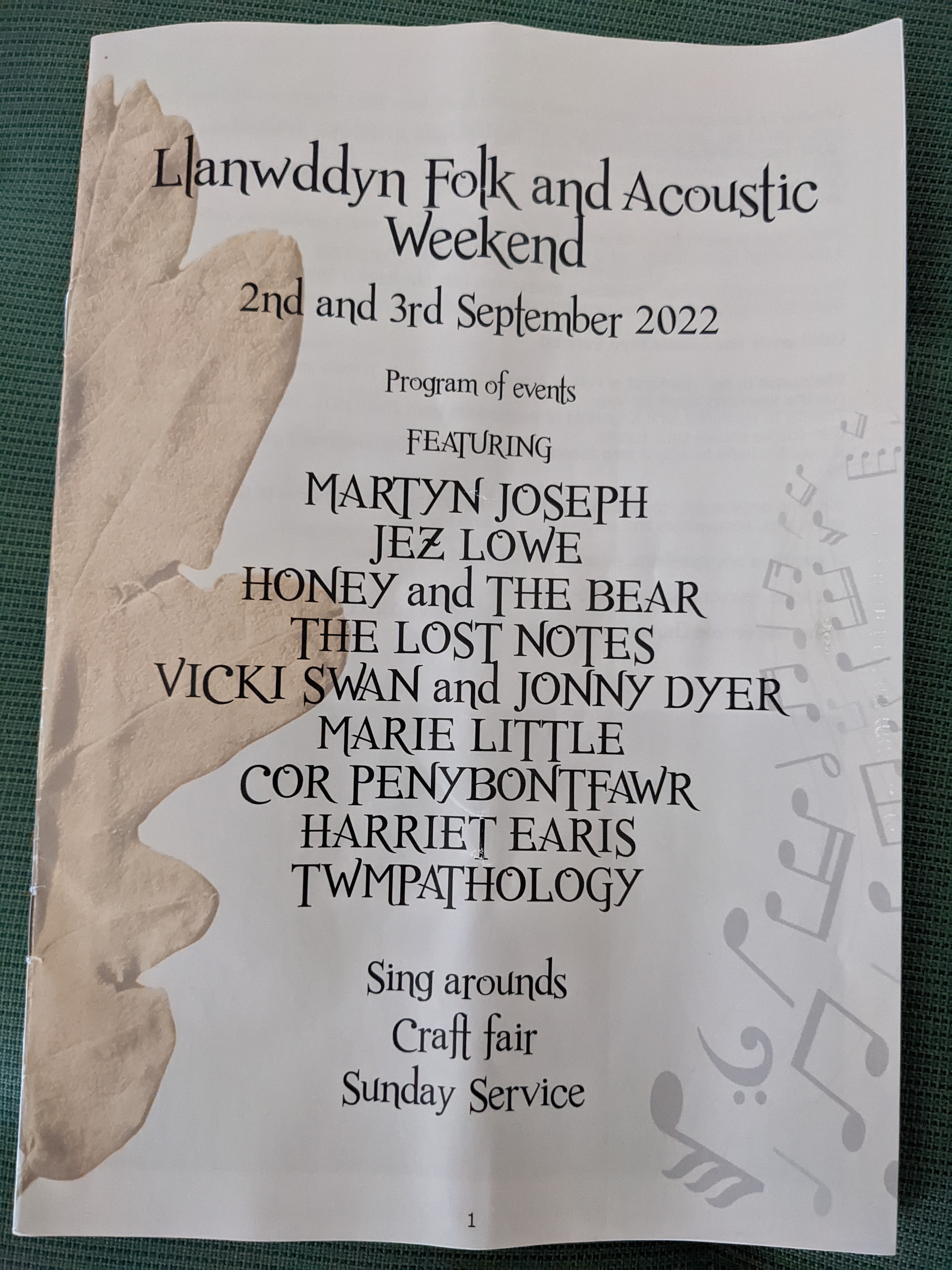
Mary & I have just returned from the Llanwddyn Folk & Acoustic Weekend (2022) - an annual festival in the village/community hall. Llanwddyn (pronounced Clanuthin or something like that!) is a small village near Lake Vyrnwy (pronounced Vernwee or something like that!). The original village lies below the waters of Lake Vyrnwy behind a dam built by the Victorians to supply Liverpool with fresh water.
Lake Vyrnwy Dam
The residents of the original village of Llanwddyn - comprising a church, two chapels, three inns, ten farmhouses and 37 houses - were not consulted about the dam and, unsuccessfully, raised a petition against it being built. The current village has no pubs or chapels but gained a school (now closed and part-used as the village hall), a shop and small petrol station.
During past visits, water could often be seen cascading over the top of the dam but the recent hot & dry weather certainly put paid to that. Indeed, there were local news reports that parts of the old village were visible as water levels in the reservoir dropped this summer. Levels were certainly low when we arrived for the folk festival...
Panoramic view of Lake Vyrnwy from the dam looking NW
...but not as bad as I had expected. We did not see any remains of the original village which is located at the far end of the reservoir.
We arrived on the Friday and set up camp...
Vacanza Campervan
For longer stays, we take our Airbeam awning but it does take up a lot of space in the back of the campervan. For shorter trips, Mary has made this simple awning out of ripstop nylon which packs away to nothing. This was its first outing and proved a success - minor modifications were made on site and it perfomed admirably in wind and rain.
We had some free time on Saturday morning so took the opportunity to visit Lake Vyrnwy via a short walk along part of Glyndwr's Way. The flowering season is noticeably later in the Welsh Hills compared with Herefordshire. Meadowsweet was still out and harebells lined the path...
Harebells along Glyndwr's Way
...while a lone bee collects nectar from late-flowering field scabious.
Adjacent to Artisans cafe is a RSPB hide which offers great viewing of woodland birds such as this siskin...
Siskin on feeder (Lake Vyrnwy RSPB Hide)
Great tits, coal tits and blue tits...
Blue Tit on feeder (Lake Vyrnwy RSPB Hide)
A female chaffinch is feeding before being rudely interrupted by a blue tit...
And a nuthatch adopts its familiar upside pose while eating...
Note: Bird photos and videos taken with Pixel 4a phone through the glass window of the Lake Vyrnwy RSPB hide
As we made our way back to the campsite for lunch, a quick look back at the dam through the trees...
River Vyrnwy looking back towards the weir and dam
After a quick lunch, it was off to the Saturday concerts.
Marie Little - unfortunately, due to a failed clutch on her motorhome, Marie was on the back of a recovery lorry heading back home when she should have been performing. Fortunately, our hosts (Ruth and Ken Powell) stepped in and saved the day!
Harriet Earis - brilliant harpist doing old and new music. Bought the CD
The Lost Notes - a five-piece folk band from Birmingham who appeared as a four-piece because their double bassist got lost somewhere in South Wales when he should have been much much further north in Llanwddyn! Good fun though a tendency for the vocals to get drowned out. The main guitarist (Oli Jobes) was exceptional.
Honey and the Bear - Harmonious duo from East Anglia joined by a fiddle/whistle and a percussionist. Lovely songs and clear vocals. Expect to see and hear more from them.
Jez Lowe - brilliant and well-known singer-songwriter from County Durham. Go see if you get the chance. Funny and poignant songs. Jez had his car, containing all his instruments, stolen in Walsall a few days earlier and had to borrow one of Ken Powell's hand-made guitars for the concert. I expect there will be a song about it soon!
Martyn Joseph - they don't come any more intense than Martyn. His protest songs have a lament that cannot help but tug at your heartstrings. A music journalist once suggested Martyn made Leonard Cohen sound like Julie Andrews. At times you could close your eyes and think you were listening to 'The Boss' which is why Martyn is sometimes dubbed the 'Welsh Springsteen'
On Sunday, we packed up early and headed off home, stopping for a while in Newtown where the annual Food Festival was happening...
Newtown Food Festival 2022
And still time to pop into a few venues taking part in the Herefordshire Art Week before arriving exhausted at our final destination - HOME.
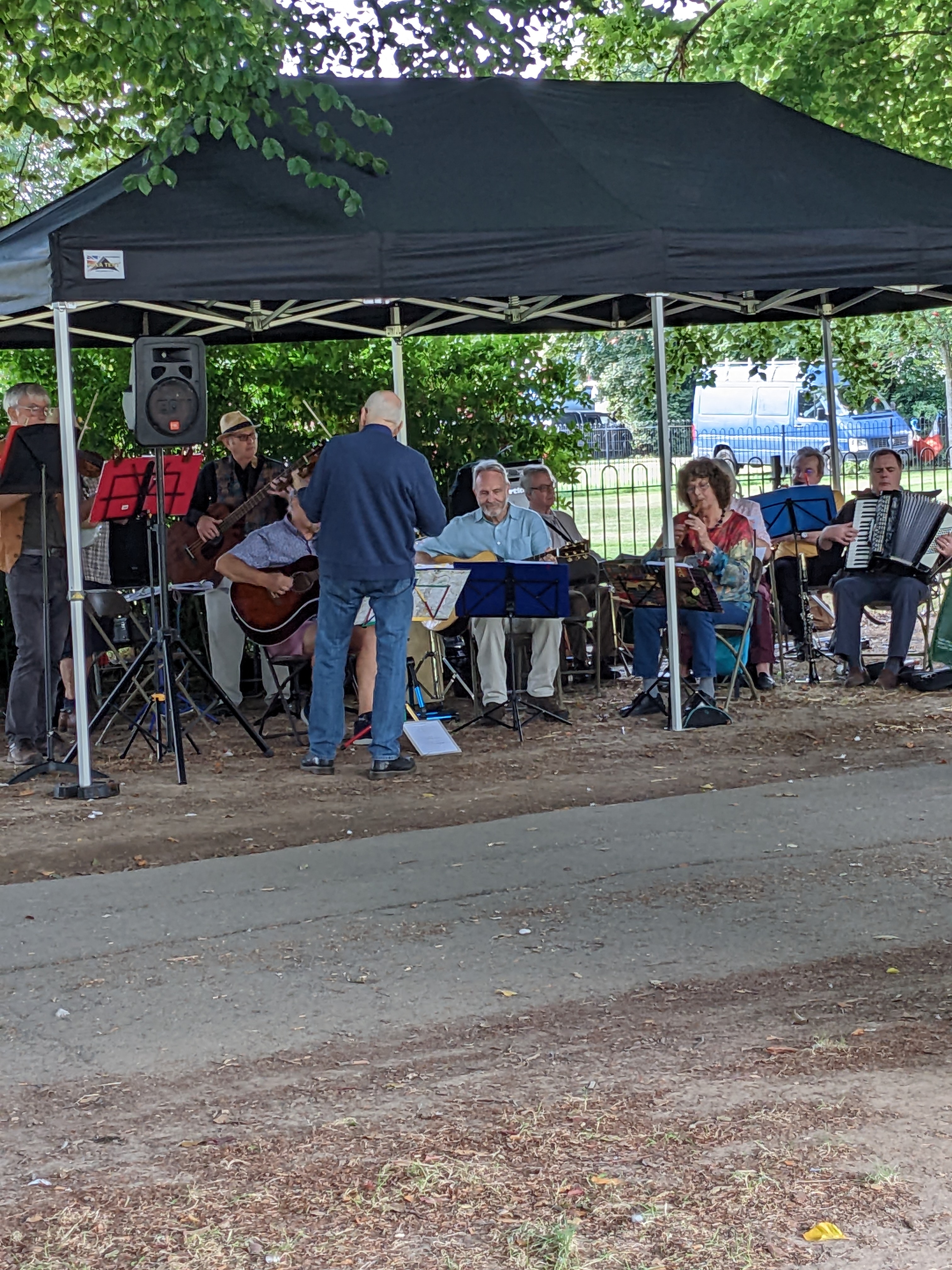
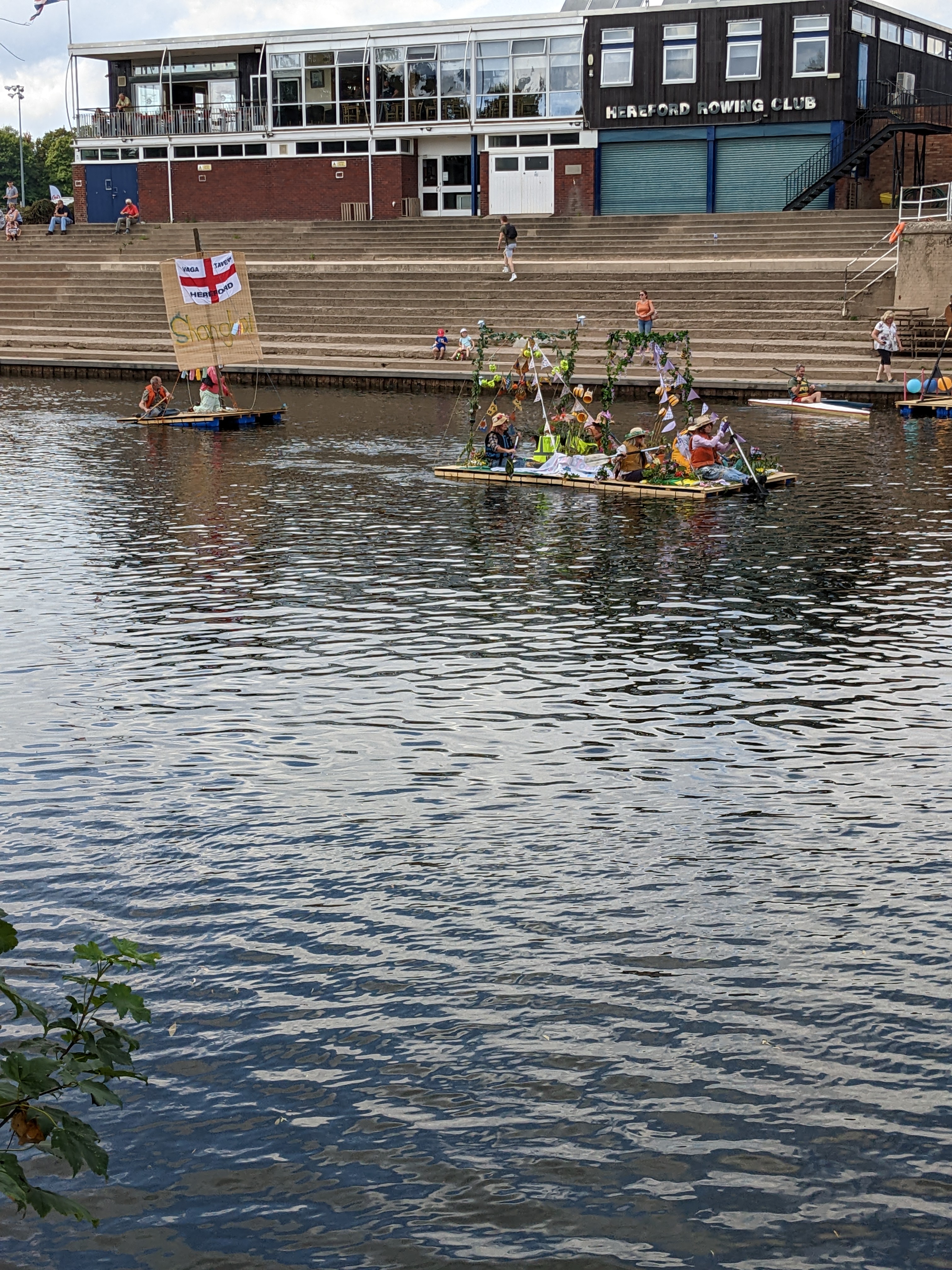
Last weekend (26-27/8/22) was the Hereford River Carnival. A relatively recent innovation held somewhat sporadically - though the pandemic did not help matters. Mary was playing with Bandemonium on Saturday...
...and, finally, the last float getting an assist from a passing kayaker...
Novel Propulsion Method
The event was split between Castle Green and the King George V Playing Fields and included a fair, lots of stalls, food and drink, a craft tent and three music stages. A warm (27 ℃) & sunny day and an excellent turnout.
The Doward, near Whitchurch in Herefordshire, comprises two hills - Little Doward and Great Doward - and lies close to the Welsh border. It has a fascinating cultural, industrial and agricultural history. This post, however, is concerned with our visit to four of the six nature reserves: Miners Rest, Woodside, White Rocks, and Leeping Stocks (locally pronounced as lepping though accessed via Leaping Stocks Road?!).
We parked the campervan in the small car park at Miners Rest (access through the five-bar gate). At this time of year, there are relatively few blooming wildflowers. Nevertheless, we did spot this Meadow Saffron near the entrance...
Meadow Saffron
It is also known as Autumn Crocus - it is a native British bloom and not a crocus although it is poisonous!
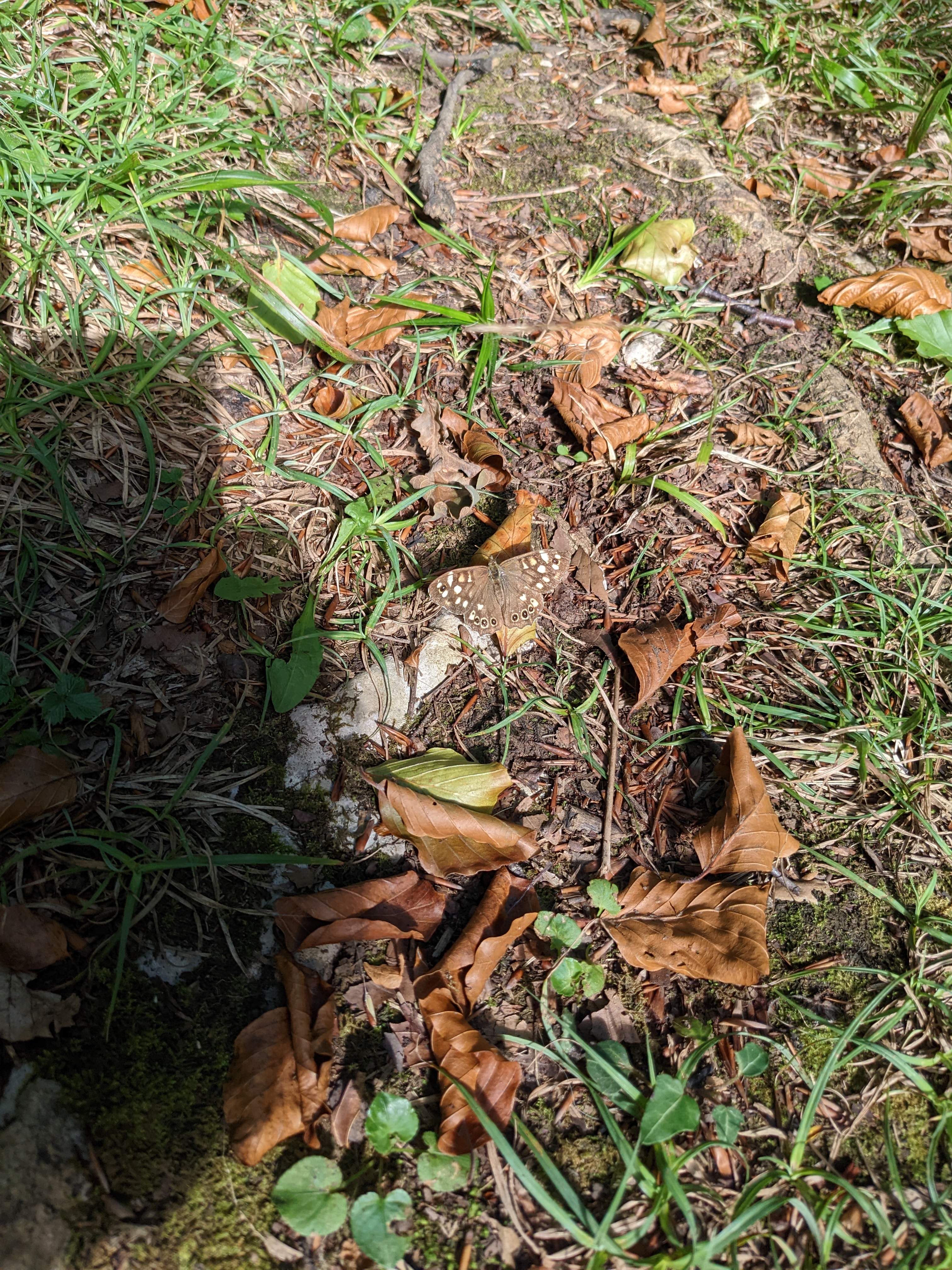
Apart from Speckled Wood, there was also a shortage of butterflies...
Speckled Wood - Miners Rest Nature Reserve
Miners Rest NR merges into Woodside NR. In the wooded area, we spotted a group (family?) of fallow deer including one youngster. Too quick and too far away to photograph using our camera phones. We did come across this small fenced-off enclosure...
Deer-free Experiment
The Herefordshire Wildlife Trust are monitoring plant growth in the absence of deer (inside the enclosure) in order to see what effect restricting deer access would have on biodiversity, especially plant life.
In the grassland area of Woodside, grasshoppers abound...
Common Field Grasshopper - Woodside Nature Reserve
...along with this European Hornet...
European Hornet - Woodside Nature Reserve
From Woodside, a short roadwalk led us to White Rocks Nature Reserve where we spotted these giant woodlice, helpfully magnified...
Woodlice/Magnifying Glass Sculpture - White Rocks NR
Miners Rest and White Rocks have plenty of examples of tumbledown limestone walls surmounted by multi-stemmed and twisted beech trees, remnants of the original beech hedges.
We arrived at Leeping Stock Nature Reserve after a further short roadwalk. Lords-and-Ladies were widespread throughout all the reserves. The fruits of this specimen in Leeping Stocks had been part-eaten by birds although they are poisonous to many animals, including humans...
Lords-and-Ladies - White Rocks NR
Surprisingly, we came acroos some deer droppings in this reserve even though the area is fenced off to exclude them...
Deer Poop - Leeping Stocks NR
Wild basil was found throughout the reserves...
Wild Basil - Miners Rest NR
Despite the time of year, there was still plenty to see. We plan to return next year when the wildflowers are abloom and the butterflies are on the wing.
It is traditional to have a day out on August Bank Holiday Monday. While there are no guarantees regarding the English weather, you can usually count on it being warm if not always dry. Many people head to the seaside for the last summer fling before the kids go back to school in September.
Today, we are in luck and it is warm (20 ℃ or above between 11 am and 7 pm), dry, and sunny with just a few fairweather clouds. So, picnic packed and off to Goodrich Castle which, as members of English Heritage, includes free entry. There were lots of families though it wasn't overcrowded.
Solar Block at Goodrich Castle
For more information on this 11th Century castle ruin look here, here, and here. There are scenic views from the battlements...
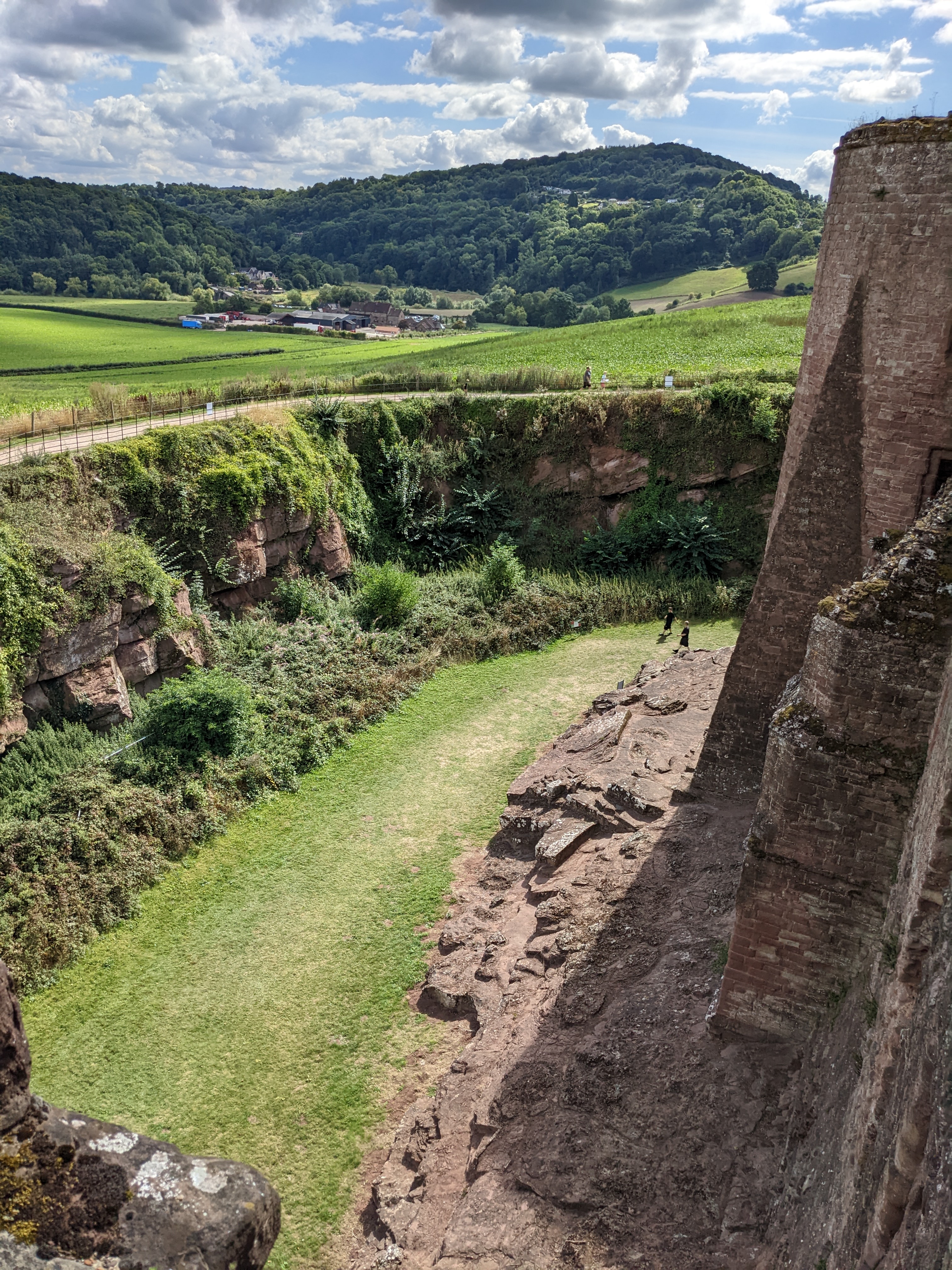
Goodrich Castle - looking down on the moat
View from the battlements - Goodrich Castle
Goodrich Castle - view from the battlements
It is a 400-metre walk from the car park and visitor centre (information, cafe, toilets, shop, reception) to the castle. There are no facilities at the castle. It is a great place for kids to explore but there are quite a few steps to negotiate if you want to see it all. Roaring Meg is a mortar/cannon built locally in the Forest of Dean. It was used in the English Civil War by the Parliamentarians/Roundheads to capture Goodrich Castle from the Royalists/Cavaliers.
Roaring Meg at Goodrich Castle
Not far from Goodrich Castle is an area known as The Doward which includes a number of nature reserves managed by the Herefordshire Wildlife Trust. Our first-ever visit is described in the next post...


.jpg)



.jpg)


.jpg)






.jpg)


.jpg)




 Posts
Posts

