For Part I of View from the Rear Window - February 2024, see here. Blogger has been playing up recently and this seemed the quickest workaround. At the end of each monthly report, I add a few photos from the garden. So here goes:
Photo 1: Snowdrops in our Mini-Wood (3rd February)
Photo 2: Primrose with Auricula in the background (5th February))
Photo 3: Primroses (5th February)
Photo 4: Auricula (7th February)
Photo 5: Pitcher Plant (7th February)
Photo 6: Crocus (9th February)
Photo 7: Daffodil (10th February)
Photo 8: Crocus (10th February)
Photo 9: A Clump of Crocuses (16th February) with Daffodil Interloper
Photo 10: A Clump of Crocuses (20th February) with Daffodil Interloper
The warmest day of the year (so far) in Hereford occurred on the 12th April (Figure 1) with temperatures reaching 21 ℃ between 3.30 pm and 4.30 pm (Figure 2). This daily high comfortably beat the previous record of 19 ℃ that occurred the day before (11th April). [Note: the following day (13th April) turned out to be the UK's warmest, so far, of 2024 with the mercury hitting 21.8 ℃ at Writtle in Essex].
Figure 1: Daily Maximum Temperatures (1st January 2024 to 12th April 2024)
Figure 2: Maximum Temperatures (15-minute periods) for 12/4/24 in Hereford
The Met Office gave a high probability to the 12th April being the hottest day so far.
We have seen hotter days in Hereford even earlier in the year: for example, 23 ℃ on the 30th March (2021) and 22 ℃ on the 5th April (2020). For the past two years, we have had to wait until 15th April (2022) and the 29th April (2023) for our first 'heatwave'!
When the weather gets warmer, it is time to start thinking of the birds and the bees. The local wood pigeons (well, perhaps only the males) have been feeling frisky for awhile now. The females seem to be, in the main, largely disinterested. I was looking out of the window this morning when I spotted a pair sitting on the trellis of the Paradise Garden. By the time I managed to get my camera ready, I had missed the very brief courtship routine of the male and the mutual preening and only caught the 'not today, darling' moment (Video 1).
Video 1: Wood Pigeon's Pairing Up?
Here is someone else's video showing the wood pigeon's courtship ritual ...
There were five days with heavy rain (> 5 mm) and no rain on nearly half (13/29) of the days. Sunny days were at a premium but at least the cloudy nights kept the frosts away.
February temperature data for the last 5 years are summarised in Figure 3. While five years is too short a period to confirm any trends in weather parameters, the data suggests the daily means, daytime maximums and night-time minimums are all getting warmer.
Figure 3: February Temperature Data for the 2020 - 2024 Period
This warming trend can also be seen in the mean February temperatures for the whole of the UK courtesy of the Met Office - the 2020 - 2024 period is indicated by the red crosses on the rhs of the plot.
Figure 4: Met Office Graph Showing Mean UK Temperatures for February
In Figure 5, monthly rainfall and sunshine data for the last five Januarys are displayed. According to the nearby Credenhill Met Office weather station, rainfall in Hereford is around 51 mm for the month of February (based on the 1991-2020 average). So, February 2024 has definitely seen above average rain in these parts. Sunshine is below par, possibly part of a trend. It may not be a coincidence that the two warmest Februarys in Hereford over the last five years have seen above average rain and below average sunshine.
Figure 5: February Rain/Sun/Wind Data for the 2020 - 2024 Period
The following figures come from the UK Met Office's February 2024 Report. I've marked the location of Herefordshire on all three maps. Herefordshire, along with most of England below a line drawn from Middlesborough to Llanelli, was very warm. The rest of the UK was just warm!
Figure 6: UK Mean Temperature Anomalies (February 2024)
The bits of the country that were very warm (Figure 6) were also rather wet (Figure 7), including Hereford, ...
Figure 7: UK Rainfall Distribution for February 2024
... and with a distinct lack of sunshine (Figure 8).
Figure 8: UK Sunshine Distribution (February 2024)
Jobs in the Garden
Another quiet month
Hot composting ad infinitum
Picked the last celeriac (about 1 kg) from 2023 season - made soup
Pruned the Rev Wilks and Golden Delicious apple trees, the Nottingham medlar tree, the Concorde pear tree and the Whinham's Industry gooseberry bush
Photo 2: From L to R, Medlar, Rev Wilks and Golden Delicious before pruning
Photo 3: After Pruning
Flora & Fauna (in the Garden)
2 x Blackbirds (male & female)
Photo 4: Blackbird
4 x Blue Tits
2 x Collared Doves
1 x Crow
1 x Great Tit
11 x House Sparrows
1 x Herring Gull
2 x Magpie
1 x Robin
15 x Starlings
Photo 5: Starling on Feeder
5 x Wood Pigeons
Buff-tailed Bumblebees (numerous)
Photo 4: Buff-tailed Bumblebee on South Facing Wall
This is where I usually add some photographs of the garden. Unfortunately, Blogger is being a bit of a bleggar so I'll post the photos in the next article.
Overnight, the rain was quite heavy but we awoke to blue skies and intermittent sunshine. Here are the views from the pod looking east (Photo 1) and south (Photo 2). A somewhat industrial outlook but we are, after all, on the site of a former colliery.
Photo 1: View from the Glamping Pod looking East (1/4/24)
Photo 2: Looking South Down the Rhondda Fawr Valley (1/4/24)
Today is April Fools' Day but we're not expecting any pranks or jokes here in the Brecon Beacons. We plan to visit three waterfalls in and around Pontneddfechan: Sgydau Sychryo, Pwll Berw and Sgwd Gwladus (see Map 1). See here for the previous day's waterfall visits.
As we arrived in Pontneddfechan, we were a little concerned that we would have the previous day's problem of nowhere to park. Fortunately, the car park at Dinas Rock (Craig y Ddinas) was only half full.
Map 1
Just a short walk from the car park along the river bank is the first waterfall: Sgydau Sychryd. Sgydau is the plural form of Sgwd which is why this particular waterfall is often described as a cascade or a series of waterfalls.
Photo 3: Sgydau Sychryd (1/4/24)
Video 1: Sgydau Sychryd Cascade (1/4/24)
We retraced our steps back to the Car Park to pick up the Gunpowder Trail (yellow dots). There was a bit of a steep climb up (handrails provided) before taking a right-hand turn down to Pwll Berw (or Pwll y Berw).
Photo 4: Pwll y Berw
As waterfalls go, this is a small one which may explain why its name - 'the boiling pool' - describes the plunge pool at the bottom rather than the waterfall itself.
Video 2: Pwll y Berw - the boiling pool (looking upstream)
Video 3: Pwll y Berw from the footbridge (looking downstream)
Time to retrace our steps again back to the Car Park before taking the riverside path towards Pontneddfechan and crossing the bridge onto the road leading into the village. Pontneddfechan (also known as Pontneathvaughan) has public toilets, a cafe (Sgwd Gwladys), and a couple of pubs (The Angel Inn and the Old White Horse Inn). A third pub (The Dinas Inn) was closed (temporarily it says).
The start of the Waterfalls Walk to Sgwd Gwladus (Lady Falls) is adjacent to The Angel Inn and opposite the public toilets. The path is generally good though muddy in places. The round trip to the waterfall and back is approximately 2½ miles (4 km) and takes about an hour and a half to two hours.
Photo 5: Sgwd Gwladus (Lady Falls)
Video 4: Sgwd Gwladus near Pontneddfechan
Video 5: Sgwd Gwladus near Pontneddfechan (slo-mo)
Before turning back and returning to our campervan, we spotted a lonely dipper enjoying the waters ...
Photo 6: Dipper at Sgwd Gwladus
We took the A4061 (Rhigos Road) over Rhigos Mountain back to the glamping pod taking in the views from the designated Rhigos viewpoint ...
Photo 7: Rhigos Viewpoint (A4061) looking north to the Brecon Beacons
Here is a video from the same spot ...
Video 6: Looking North to the Brecon Beacons from Rhigos Viewpoint on the A4061
For a second day we had been lucky with the weather. Tomorrow it was time to head home with happy memories from Waterfall Country.
Storm Kathleen hit the United Kingdom and Ireland today (6th April 2024) bringing strong winds and warm sunshine. It was the warmest day of the year with parts of East Anglia reaching 21 ℃. Not quite so warm in Hereford but a very pleasant 18 ℃ with plenty of sunshine and the odd shower.
Photo 1: Concorde Pear Tree and Blue Skies (6/4/24)
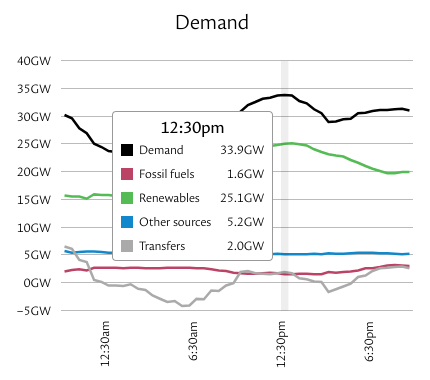
Windy, sunny days are ideal conditions for producing lots of renewable low-carbon electricity. The peak demand for electricity occurred at 12:30 hours (Figure 1).
Figure 1: Electricity Demand for Great Britain on 6th April 2024 (grid.iamkate.com)
As Figure 2 shows, the peak demand at 12:30 hours was largely met by wind (55.0 %) and solar (18.3 %). If we include nuclear power (13.5 %) and interconnector transfers from (mainly nuclear) France (7.5 %), then 94.3 % of the electricity generated at that time was low carbon. [Note: Biomass, i.e. Drax, is most certainly not a low-carbon energy source and so is not included]
Figure 2: Electricity Generation for Great Britain on 6th April 2024 (grid.iamkate.com)
The carbon emissions produced by Great Britain's electricity generation on 6th April 2024 have, in fact, been very low all day. [Note: for the 2019 - 2023 period, average emissions per kWh were 175 g]
Figure 3: A Low-Carbon Emissions Day (6/4/24)
On a personal note, our solar PV panels generated about 12 kWh on 6th April, of which 5kWh were uploaded to the National Grid. Every little helps!
Over the Easter holiday, we spent a few days exploring waterfall country in the Brecon Beacons (Bannau Brycheiniog) while staying in a Glamping Pod in the upper reaches of the Rhondda Fawr Valley. We started out from Hereford around 11.30 am (after completing our Citizen Science testing) and arrived at Pontneddfechan around 1.00 pm. The place was absolutely heaving and there was no parking to be found for love nor money. In hindsight, we shouldn't have been surprised that good weather on an Easter Sunday had brought everyone out.
Video 1: Sgwd Isaf Clun-gwyn (includes slo-mo) - 31/3/24
We finally managed to park the campervan at the small Clun-gwyn car park around 2.30 pm, having almost given up and nearly decided to leave the waterfall walk until the next day.
After a 10-15 minute walk, we came upon our first waterfall - Sgwd Clun-gwyn (Photo 1 and Video 2)
Photo 1: Sgwd Clun-gwyn (31/3/24)
Video 2:Sgwd Clun-gwyn (31/3/24)
The next waterfall, Sgwd y Pannwr, was a gentle 1.5 km walk before a fairly steep, sometimes muddy, 0.5 km descent (with steps). We met a couple of Spanish visitors (three, if you include their baby in a sling) who assured us the descent was not too bad and the effort was worth it; especially considering there were two waterfalls to see. So down we went at a leisurely pace to view Sgwd y Pannwr ...
Photo 2: Sgwd y Pannwr (31/3/24)
Video 3: Sgwd y Pannwr (31/3/24)
We then followed the river upstream, for another 0.5 km, to arrive at the third waterfall of the day: Sgwd Isaf Clun-gwyn. You had to peer around the corner to experience this waterfall in its full glory ...
Photo 3: Sgwd Isaf Clun-gwyn (31/3/24)
Video 4: Sgwd Isaf Clun-gwyn (31/3/24)
... or scramble up a rocky incline to get a better view of the upper reaches of Sgwd Isaf Clun-gwyn ...
Photo 4: Sgwd Isaf Clun-gwyn (31/3/24)
Retracing our steps back up to the main path required a few rest periods on the way but we still had enough energy to set off for the fourth and final waterfall of the day: Sgwd yr Eira. Mary decided she couldn't face the climb downto the base of the waterfall (and, more importantly, the climb back up) - a total of 170 steps, apparently, though I didn't count them. I did, however, summon the effort to descend/ascend in order to take this picture and complete the 'four waterfalls' set ...
Photo 5: Sgwd yr Eira (31/3/24)
Video 5: Sgwd yr Eira (31/3/24)
It is possible to walk behind the curtain of water at Sgwd yr Eira but you shouldn't try it without being properly kitted out (waterproofs and a good pair of walking boots) as it can be both wet and slippy. I had the boots but not the waterproofs so maybe next time. Time to rejoin Mary at the top of the steps and head back to our glamping pod for dinner and recuperation.
Photo 6: Glamping Pod, Fernhill Valley Farm
The map below shows the route we took:
Starting at the Clun-gwyn Car Park, followed the grey route to Sgwd Clun-gwyn waterfall
Follow the red route to Fingerpost 25
Follow the green route to Fingerpost 32, taking in Sgwd y Pannwr and Sgwd Isaf Clun-gwyn waterfalls
Back up the green route to rejoin the red path at Fingerpost 25
Continue along the red path to Fingerpost 35
Down the 170 steps (green route) to Sgwd yr Eira waterfall & return to Fingerpost 35
Retrace steps (red and grey routes) back to the Car Park
Total distance between 8 - 10 kilometres (5 - 6 miles); duration 3 - 4 hours including stops at the waterfalls.
Map 1: Our Walking Route
In summary, we had a great day out and the weather was kind. Plenty of rain before we arrived to ensure the waterfalls were gushing and some sunshine during the walk to keep our spirits up.
Finally, a word to the wise: bring your own bananas and brown bread because we tried three local convenience stores - none of them had bananas and only one had brown (Hovis) bread. It seems fruit and fibre don't go down in the Rhondda Valley.






 Posts
Posts

