Picking This Season's First Cukes (27/05/2025)

 The first cucumbers of the season were picked on 27th May 2025. These prolific mini-cucumbers (Passandra F1) can be picked when they are 10-15 cm long (Photo 1). 

Photo 1: First Cukes of 2025

I grow this vegetable in my polytunnel using the Quadgrow planters. Once established in the Quadgrow, they put on rapid growth provided it doesn't get too cold overnight. Fortunately, April and May have both been frost-free this year. Just two weeks ago (15/05/25), these cucumbers were tiny (Photo 2).

Photo 2: Cucumber Plant (15/05/25)

These F1 hybrid seeds are relatively expensive (approximately 50p per seed) but I expect 100+ cucumbers from the four plants I cultivate. Enough to enjoy raw in salads or with dips or turned into cucumber relish. 

Sometimes You're The Pigeon And Sometimes You're The Statue!

Last year, a pair of wood pigeons nested in our wisteria arch, producing a couple of 'ugly ducklings' ...

Photo 1: Two Ugly Nestlings (August 2024)

Although not a direct consequence of this, we are now overrun with the damn things. Presumably we got a good review on Airbnb!  They are always hanging round the bird feeder hoping to pick up the scraps discarded by the other birds or perched on local vantage points such as the roof, flowering cherry tree, etc. You can almost always guarantee that on stepping onto the patio (either from the house, the outside gate or returning from the kitchen garden) there will be that loud flapping noise as the wood pigeon takes flight.

We have only ourselves to blame, of course and we could stop it instantly by not putting bird food out. But then we would not be able to enjoy our other feathered friends or help their survival. Mary is, however, keen to deter the pigeons because of the significant mess they make from their rear ends. Their only redeeming feature is hoovering up waste bird food that has fallen on the ground, thus deterring other vermin.

We have amended the way we feed the birds which has significantly reduced the amount of waste created by the other bird visitors. But still the wood pigeons come; sometimes as many as seven at a time. Having always considered the wood pigeon as a slow, clumsy and none too bright member of the avian family, I may have cause to change my mind.

Having seen their easy source of food disappear, at least some of the pigeons are exploring alternatives. This does involve some additional balancing skills, not easy for such a cumbersome bird, in order to extract food from the aerial bird feeders (Photo 2)

Photo 2: Wood Pigeon Trying to Access the Seed Feeder

At least one of the wood pigeons is now 'skilled in the art' of accessing the bird seed on offer at the bird feeder despite a little swaying on its perch (Video 1). The other wood pigeon looks on in admiration at the new found expertise of his companion ...

Video 1: Balancing Wood Pigeon and the Bird Feeder

This behaviour was unacceptable to Mary so we put an immediate stop to it by moving the seed holder to a lower position where there isn't a suitable perch.

Unfortunately, it hasn't stopped the wood pigeon visits ...

View from the Rear Window - January 2025

 Life imitates art far more than art imitates life - Oscar Wilde

This month's garden photo (Photo 1) was taken on the 5th January 2025 when we experienced a brief period of snowfall. When it wasn't snowing, we enjoyed the weak January sunshine despite the cold temperatures.

Photo 1: Snow on the 5th January 2025

The daily garden photos in January 2025 are collated in Video 1 ...

Video 1: Daily Photos of the Rear Garden in January 2025

Whereas the previous month (December 2024) was mild yet dull, January 2025 was cold yet sunny. January's weather stats from our Davis Weather Station are summarised in the table below ...

January 2025

Weather Parameter

Value

Dates

Average Monthly Temperature 

4 oC


Maximum Monthly Temperature

13 oC

14th

Minimum Monthly Temperature

-5 oC

9th, 10th,11th

Number of Air Frost Days

13


Number of Hot Days (> 25 oC)

0


Monthly Precipitation

79.0 mm


Greatest 24 h Precipitation

24.2 mm

5th - 6th

Number of Dry Days

18


Monthly Sunshine Hours (estimated)

49


Highest Wind Speed

51 km/h

24th

Heating Degree Days

455.9


Cooling Degree Days

0


In contrast to frost-free December, we experienced subzero temperatures on more than 40% of the days in January (Figure 1). If daytime temperatures hadn't picked up towards the end of the month, we would have been in for a very cold month.


Figure 1: Min/Max Daily Temperatures for January 2025

On the bright side, we did see the sun this month (about 20% more than in December) which always heightens the spirits. Rain was largely restricted to the beginning and end of the month (Figure 2) and close to the average for this time of the year. Precipitation on the 5th/6th January fell as snow.

Figure 2: Daily Rainfall & Sunshine Data for January 2025

With six complete years of weather data from the Davis Weather Station, we can start looking for trends. It is still very messy data because of the short period of time but minimum and maximum daily temperatures both seem to be trending downwards albeit the effect on the mean daily temperature is less clear. Interestingly, 2022 had the highest daily mean and maximum temperatures as well as the most air frost (sub zero) days (Figure 3).

Figure 3: January Temperature Data (2020 - 2025)

January's rainfall was close to the long-term mean following three dry Januarys (2022 - 2024). Sunshine levels have been very constant over the past 6 years with just a little more during this January. Stormwise, January was quiet though we did catch the edge of Storm Eowyn on the 24th of the month (see Table above).
Figure 4: January Rain, Wind & Sunshine Trends (2020 - 2025)

The following three figures are taken from the UK Met Office's Monthly Report for January 2025. December 2024's mean temperature anomaly map for the UK was all red/pink (hot) in complete contrast to this month which is all blue (cold). Herefordshire is marked by the black circle with the city of Hereford falling within the darker blue (colder) region (Figure 5).

Figure 5: UK Mean Temperature Anomalies for January 2025

Precipitation was close to, or slightly above, the long-term average (1991 - 2020) - see Figure 6. Credenhill Weather Station, located less than five miles away, reports the 1991-2020 mean January rainfall at 67.3 mm; this makes the recorded precipitation in our back garden 117% of this long-term average.

Figure 6: UK Rainfall (relative) for January 2025

Finally, UK sunshine hours are mapped out in Figure 7 with the city of Hereford falling within the 130-150% band. Our Davis Weather Station recorded the highest January sunshine hours for the last 6 years (110%); close but no cigar! Maybe, January has been getting sunnier over the last 30 years.

Figure 7: UK Sunshine Hours (relative) for January 2025

Jobs in the Garden
  • Dug up last 6 kg potatoes along with last few beetroot and parsnip roots
  • Ordered seed potatoes, onion sets, vegetable seeds, strawberry plants
  • Continued hot composting through the cold weather
Video 2: HotBin Composter on a Cold January Day (2025)

Flora & Fauna in the Garden
  • Blackbird (x2)
Photo 2: Blackbird on the Patio (10th January 2025)
  • Blue Tit (x2)
  • Collared Dove (x2)
  • Crow (x3)
  • House Sparrow (x15)
  • Jackdaw (x30)
  • Magpie (x1)
  • Robin (x1)
Photo 3: Robin on Bird Feeder (16th January 2025)
  • Starling (x10)
  • Wood Pigeon (x7)
  • Wren (x1)
And, finally, some garden photos ...

Photo 4: Early Rhubarb (1st January 2025)

Photo 5: Ice Crystals on Grapevine (11th January 2025)

Photo 6: Snowdrop (14th January 2025)

Photo 7: Snowdrops and Raindrops (23rd January 2025)

Photo 8: Storm Damage (Storm Eowyn, 24th January 2025)

First Strawberry of the Season

 The wall of strawberries I installed a at the beginning of May is now producing edible fruit ...

Photo 1: First Strawberry of the Season (15th May 2025)

We picked eleven Malling Champion strawberries on the 19th May. They were sweet & delicious. The wall feature also looks good with the double flowers of the Summer Breeze strawberries ...

Photo 2: Wall of Strawberries (23rd May 2025)

I haven't had time to set up the solar-powered watering system yet so I'm still watering by hand. And, as is clear from the above picture, I haven't had time to put up any netting to protect the fruit from birds. Where does time go? Fortunately, either the birds haven't discovered the ripe strawberries yet or they find access to the ripe fruit too difficult.


A Very Dry Spring

 It was 8 pm on Tuesday the 20th May and I had just finished planting out some brassica plants (cauliflower and red cabbage, Photo 1) when I felt an unusual sensation on my cheek. It was raining?! Not a lot (0.4 mm) and not for long (less than five minutes). Although light rain had been forecast (30% probability), it was unusual because this Spring has been the driest on record

Photo 1: Brassica Plants Under Netting

More light rain is forecast over the next few days so it is fortunate that I have triple-protected the brassica plants from slugs (nematodes, hosta halos and organic slug pellets).

I can definitely state that this has been the driest spring for our back garden, although records only go back to 2020! As I write this post, the data for May 2025 is up to and including the 21st May. We are forecast to have a little more rain this month but not much.

Figure 1: Rainfall for March, April, May and Spring (MAM): 2020-2025

As Figure 1 illustrates, Spring 2025 has been extraordinarily dry with rainfall only 25% that of the most recent five years. March, April & May were, respectively, the driest, third driest and second driest Spring months in Hereford for the past six years.

The nearest Met Office weather station is at Credenhill, just a few miles away. For the climate period 1991-2020, Spring rainfall at Credenhill averaged 152.41 mm, nearly five times this year's Spring rainfall in our back garden! Naturally, the garden water butts are running dry and we have had to do irrigate the garden more frequently. Having a bowl in the kitchen sink is a useful and simple way to re-use grey water in the garden.


BTO Breeding Bird Survey - 2025

 On the 16th May, we left the house at 7 o'clock in the morning and headed for Preston Wynne equipped with binoculars, food & drink. We were about to start the second part of the BTO Breeding Bird Survey. The first part was a recce visit two weeks earlier to check out the lay of the land; e.g. woodland, pasture, industrial, crop fields, river, ponds, hedgerows. The second and third visits were to observe, identify, and count the adult birds in each habitat. The third and final visit has to be no more than four weeks after the second visit.

Last year was our first attempt at the BTO survey and we are fortunate to see hares on every visit we have made to this area.

Photo 1: Hare, Preston Wynne (16th May 2025)

With the help of the Merlin bird identification app, we were able to identify 28 species in total during the 90 minute observation period:

  • Blackbird
  • Blackcap
  • Blue Tit
  • Buzzard
  • Canada Goose
  • Carrion Crow
  • Chaffinch
  • Chiffchaff
  • Collared Dove
  • Dunnock
  • Great Spotted Woodpecker
  • Greylag Goose
  • House Martin
  • House Sparrow
  • Jackdaw
  • Long-tailed Tit
  • Magpie
  • Mallard
  • Robin
  • Pheasant
  • Skylark
  • Song Thrush
  • Stock Dove
  • Swallow
  • Swift
  • Tufted Duck
  • Wood Pigeon
  • Wren
Wrens, robins, blackcaps, chiffchaffs, chaffinches, and house sparrows were especially abundant. There were quite a few birds that didn't put in an appearance this time but which have been seen at this location in the past (e.g. Goldfinch, Starling, Red Kite, Rook, Blue Tit, Jay). We also met a man with a dog who said there were kestrels and sparrowhawks in the vicinity.

For what I presume are very good scientific reasons, the BTO ask that both survey visits are carried out in the morning between about 7 and 9 o'clock. If the intention is to observe the maximum number of species, then this seems somewhat counterproductive. In our experience, the type & number of birds seen at this site in the morning is different to that seen in the afternoon (albeit there is a lot of overlap). Hence a greater number of species would be observed by splitting the monitoring periods between morning and afternoon.

Overall, we were reasonably happy with our species list though, overall, bird numbers seemed fewer than last year.


Hot Composting - Increasing Throughput

 My current hot composting facilities comprise:

  • an early version of the 200L HotBin bought from its inventor (Tony Callaghan) - at least 10 years old
  • a current 200L Hotbin bought in last year's Black Friday sale and used for the first time in 2025
  • two prototype Supercomposter Bins developed by Tony Callaghan after he sold his HotBin company in 2015
  • 4 x 200L plastic maturation bins for storing and finishing the HotBin output
  • a Bosch AXT Rapid 220 Garden Shredder
Photo 1: From l to r, Supercomposter, Current HotBin, Original HotBin, Maturation bins

In the busy gardening seasons (Spring, Summer & Autumn), I will have two (occasionally three) hot composters running. During Winter, I will just maintain one active HotBin. In addition to my own garden waste, I also accept waste from up to six other neighbours. Every autumn, I receive a large amount (about 2 cubic metres) of hedge cuttings from one particular neighbour. More generally, neighbours drop off their garden waste intermittently in quantities of two or three 60L bags (Photo 2).

Photo 2: Large & Small Bags of Garden Waste 

A few days ago, I took delivery of a large quantity of garden waste when the ivy/privet hedge belonging to a neighbour at the rear of our garden was heavily trimmed. The rear bag in Photo 2 is what remains of that delivery after I had shredded and fed some into my hot composters. A day later, the contractor who cut the hedge (Paul) popped round and asked if I was interested in taking more garden waste (lawn mowings and hedge trimmings in the main). I had, perhaps mistakenly, mentioned that I used hot composters to speed up the process. I agreed, on the basis that I could turn down future supplies if the amounts involved became too much, and immediately took delivery of another 400L of grass cutting and hedge trimmings (Photo 2, front bag). The next day, a further 200L of ivy cuttings arrived but I'm not expecting anything else for another week. Photo 3 is my current stock of garden waste but, at least, the 3 x 60L bags have been shredded and are composting away at 60 ℃.

Photo 3: Garden Waste Awaiting Shredding (18th May 2025)

With so much garden waste to process, I have had to change my modus operandi. In the past, my standard procedure was to half fill a hot composting bin with shredded waste/grass cuttings (50/50) using a minimum of 20L hot (50-60 ℃) partially-composted waste from an operating bin to kick start the process. Adding a couple of 2.5L bottles filled with hot water is an alternative way to kick start the composting process. As soon as the bin is up to temperature (50-60 ℃), usually the next day, continue to add shredded/kitchen/grass at the rate of 6-10L per day. At this rate it takes between 20-30 days to fill a bin.

To process the extra quantities of garden waste now available, I will be looking to fill the bins at a much faster rate as well as bringing my two Supercomposter bins back into action (Photo 4). The two Supercomposter bins are currently being used as (i) a store for shredded garden waste, and (ii) a maturation bin.

Photo 4: Supercomposter Bin in Use as a Maturation Bin

One of the Supercomposter bins is already in use and operating at over 60 ℃ after just 24 hours. So far, approximately 250L of shredded garden material is undergoing hot composting! I am also trialling  the use of heat reflective coverings laid on top of the compost to retain and re-use the heat generated by the composting process. Currently, I'm using extra wide (450 mm) catering aluminium foil which is working well. The covering should only loosely cover the compost to allow for ventilation and easy egress of water vapour/steam (Photo 5). Early indications are that the reflective shield increases the rate of initial warming, maintains a greater depth of warming, and reduces the rate of cooling towards the cool-warm (<40 ℃) composting phase.

Photo 5: Reflective Heat Shield (Aluminium Foil)

At a later date, I will report in more detail on the benefits or otherwise of using a heat-reflective covering when hot composting.

Living on the (H)edge

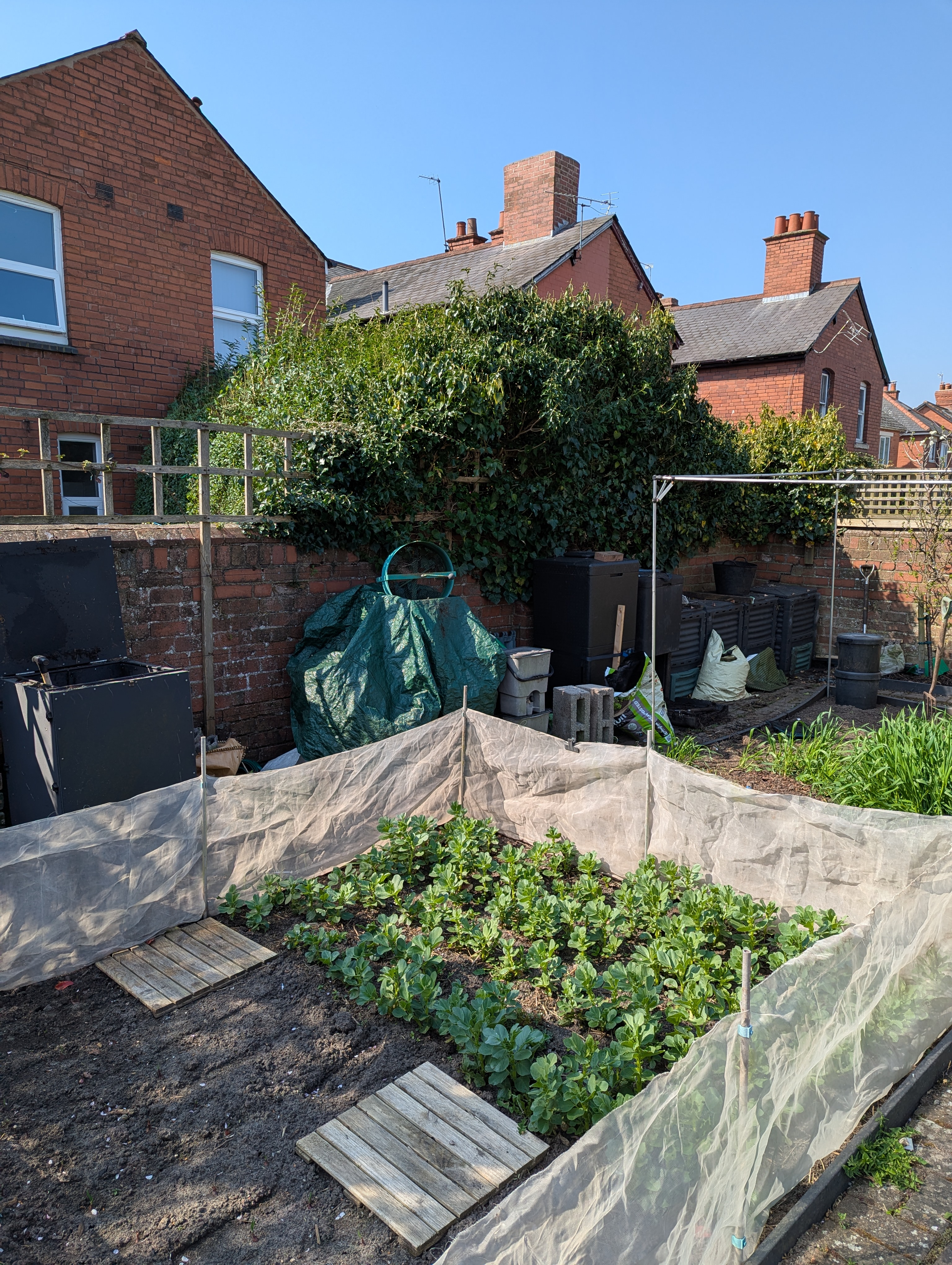
The kitchen garden backs onto a row of terraced houses. Along this southern boundary, there is a giant hedge (Photo 1). Ivy dominates the hedge which overhangs our boundary. Occasionally, I will trim the overhanging vegetation, shred it and put it through my hot composting system.

Photo 1: The Walled Kitchen Garden

House sparrows nest and roost in this giant hedge. A cacophony of sound often greets me when I visit my composting corner but soon changes to an eerie silence apart from the odd chirp from a young house sparrow.

I got a bit of a shock the other day on my way to tend to the hot compost bins. One side of the hedge was much reduced in height. I could hear noises on the other side of the wall so called out and received a reply.

Photo 2: The much-reduced Ivy Hedge

I almost said that it wasn't the best time of year to be cutting down hedges due to nesting birds but I would have been wasting my breadth as the job had already been finished. My neighbour would have happily hacked down all the hedge if he had been able to access it.

Photo 3: Close-up of the Much-Reduced Hedge

Being neighbourly, I offered to take all the cuttings for my hot compost bins. I probably should have checked how much stuff there was before making the offer because he started chucking it over the wall (I had agreed to this).

Photo 4: Hedge Cuttings Covering the Maturation Compost Bins

Photo 5: Side View of the Cuttings Pile

It took me about 6 - 8 hours to cut up the hedge trimmings into 3" to 4" pieces ready for shredding. In all, I ended up filling the equivalent of 11 x 80L bins (approx one cubic metre) before the kitchen garden returned to normal. You can see in Photo 6 how much the height of the hedge had been reduced.

Photo 6: All Tidied Up

There were a couple of house sparrow nests in the hedge debris ...

Photo 7: House Sparrow Nest

... and, fortunately, no eggs or young. There is still quite a lot of the original hedge still standing so hopefully the sparrows will continue to breed and raise their young here. For the moment they are still visiting our bird feeders in good numbers.

In an earlier blog, I made reference to man's urge (it is usually men!) to tidy up nature and this is another example. I suppose the neighbour's garden lets in a bit more light and I've gained lots of greenery for composting but that doesn't, in any way, make up for the fact that some house sparrows are now homeless. 


May Blossom

 You can guess what month Hawthorn flowers from its common moniker, May Blossom. This year's display of flowers has been spectacular, especially in hedgerows where hawthorn is a dominant species.

I took these pictures on my way home from a citizen science outing after testing the Yazor Brook adjacent to the Environmental Gauging Station mentioned at the start of this guided walk. This popular and well-used walking/cycling route has benefited from ongoing improvements to the area in the form of the Yazor Brooks Restoration Project.

Photo 1: May Blossom near Bulmers, Hereford (9th May 2025)

Cow parsley is also in full flower at this time of the year, often seen along the verges of country lanes.

Photo 2: Cow Parsley along the Cycle Path 

Along this particular route, however, there are fields of it covering the floodplain of the Yazor Brook ...

Photo 3: Fields of Cow Parsley on the Yazor Brook Floodplain

It has been allowed to spread in an urban environment as the floodplain is unsuitable for building. No doubt its existence will be threatened someday by the inexorable desire of humankind to tidy up nature. 

Photo 4: Pathway to Cow Parsley Heaven?

On a perfect Spring day, nature has crafted a beautiful urban landscape ...

Photo 5: Hawthorn and Cow Parsley, Yazor Brook, Hereford (9th May 2025)

Only a couple of hundred metres away from this nature idyll is the sprawling industrial complex that includes Avara Foods and Heineken (formerly Bulmers Cider). Avara Foods (purveyors of chicken, turkey and duck products to supermarkets/restaurants) are considered one of the 'bad guys' with regards to the pollution of the River Wye and one of the reasons we need citizen scientists to monitor river quality. Unfortunately, Avara is part of the Cargill US conglomerate and they do not have a good record of environmental protection in their home country. There is no getting away from the fact that Avara is a major employer in Herefordshire and that it produces cheap protein-rich food (an important consideration in a cost-of-living crisis). The main issue is with the intensive poultry farms and how they dispose of the high phosphorus waste. Avara have stated that none of their poultry waste will be spread on land in Herefordshire which is a good start. Unfortunately, their preferred disposal route is via anaerobic digestion and there are environmental issues with this process.

Popular Posts

Blog Archive