There are only two tragedies in life: one is not getting what one wants, and the other is getting it - Oscar Wilde
This month's garden photo was taken on the 26th of the month and was a typical day for February 2025: i.e. devoid of sunshine!
Photo 1: View from the Rear Window (26th February 2025)
The daily garden photos for February 2025 are collated in Video 1 ...
Video 1: Daily Photos of the Rear Garden (February 2025)
The overall impression for February 2025 was dry, dull with periods of cold and warmth. Weather stats from our Davis Weather Station are summarised in the table below.
The final week of February was warm, wet and reasonably sunny in contrast to the cold dull & dry conditions in the middle of the month (Figure 1 and Figure 2).
Figure 1: Min/Max Daily Temperatures for February 2025
The 23rd day of February was the wettest (10.6 mm) and also the windiest (56 km/h) day in Hereford (Table & Figure 2). This caused some local flooding though, surprisingly, it was not a named storm.
Figure 2: Daily Rainfall & Sunshine Data for February 2025
General weather parameters for the last six Februarys (2020 - 2026) are summarised in Figure 3 & Figure 4. This February was cold when compared to the last six Februarys. Average monthly temperatures (Figure 1) alternate between warm and cold, driven largely by the same trend in minimum temperatures and the number of air frosts. Meanwhile, warm days in February appear to be getting warmer.
Figure 3: February Temperature Data (2020 - 2025)
Precipitation in February is highly variable with February 2025 drier than normal. There is a slight downward trend in sunshine levels (Figure 4) and a small upward trend in the number of dry days (i.e. days with no rain) which suggests the days of February are becoming duller and drier overall.
Figure 4: February Rain, Wind & Sunshine Data (2020 - 2025)
The following three figures are taken from the Met Office's monthly report for February 2025. The mean (average) temperature anomaly map for the UK (Figure 5) agrees with my Davis Weather Station that this February's average temperature was colder than usual.
Figure 5: UK Mean Temperature Anomalies for February 2025
Meanwhile, this February's rainfall was also lower then normal (Figure 4 & Figure 6) in Hereford and Herefordshire.
Figure 6: UK Rainfall (relative) for February 2025
And sunshine levels were also down compared to the long-term (1991 - 2020) average (Figure 4 & Figure 7).
Figure 7: UK Sunshine Hours for February 2025
Jobs in the Garden
General tidying up including hedge cutting
Hot composting
Chit potatoes in preparation for planting out in late March
A reminder that this year's Big Butterfly Count takes place between the 18th July and the 10th August 2025. Sightings this year have been disappointingly low and follow a disastrous 2024.
I had the pleasure of watching two Comma butterflies recently on our 'butterfly bush (buddleia) ...
Photo 1: Comma Butterfly (26th June 2025)
Photo 2: Comma Butterfly with Second One in the Background (26th June 2025)
... in what has been a disappointing year so far both in the garden and further afield. There have been a few cabbage whites (both Small and Large Whites) in the garden hovering around my netted brassicas. This Speckled Wood was also a recent garden visitor ...
Photo 3: Speckled Wood Butterfly with Ladybird Pupa (25th June 2025)
Earlier in the season we've seen Holly Blue, Orange Tip and this Peacock Butterfly ...
Photo 4: Peacock Butterfly on Currant Bush (3rd April 2025)
I sincerely hope that the relatively few observations so far this year is not a prelude for another catastrophic year for butterflies in Herefordshire and beyond.
Update: lots of Comma butterfly sightings at the moment (Photo 5) along with Small Tortoiseshell butterflies. Mostly singles apart from the Commas and Cabbage White butterflies.
In a previous post, I reported on the use of field beans as a green manure.
Photo 1: Podded Field Beans
We have now gathered in the crop, eaten some and blanched/frozen the rest. I will be growing beetroot, parsnip and turnip in their place.
Green manures serve a number of purposes including retaining and adding nutrients, minimising soil erosion, increasing organic carbon content and weed suppression. Field beans achieved all these objectives and, in addition, provided an edible crop. They also kept the plot free of cat muck which is definitely a plus!
I planted the beans approximately 10 cm apart in rows 10 cm apart in a plot measuring approximately 1.6 metres by 2.2 metres. For an outlay of about £2.50 (500g field beans from SowSeeds cost £5.55 and I used about half of them). I did not irrigate or fertilize the crop. This small plot of 3.5 m² yielded 4.8 kg of podded beans.
Frozen broad beans are currently on sale at £2.60/kg, so the nominal value of my crop is £12.50; an investment return of 500% over six months ((I've ignored my labour costs but then I've also ignored the other benefits such as soil improvement, reduced weeding time and less cat muck to dispose of).
Since my 3.5 m² plot equates to 0.00035 hectares or 0.00086 acres, I can reformulate my crop yields as either 13.7 tonnes/hectare or 5.5 tonnes/acre (note: 1 tonne = 1000 kg).
Field beans grown commercially have yields of 2 - 4 tonnes per hectare, with autumn-sown beans at the lower end and spring-sown beans at the upper end. Field bean yields are double those of broad beans. The Bean Yield Challenge is aiming to produce yields of 10 tonne/hectare or more - the current record is 8.32 tonne/hectare.
Not wanting to brag but my 13.7 tonne/hectare is presumably a world record and I claim my prize! OK, maybe there is a minimum field size and I do not qualify. However, it does demonstrate the yield advantage that small market gardens have over large-scale commercial farms.
It was a pleasing June day, pleasantly warm with a mix of blue skies and cotton wool clouds. Mary had just come back from Leominster where she had helped set up an exhibition in the Priory Church as it celebrates its 900th anniversary. She was hungry and the cupboards were bare. So I suggested going out for lunch to Brobury House Gardens. We had visited this delightful eight acre garden many years ago but could not recall any particular features. And it has a cafe!!
Figure 1: Layout of the Gardens (Brobury House & Gardens, June 2025)
The house itself is nothing special, built in the late 19th Century and typical of the Victorian era. There is no access to the house apart from the more recently added conservatory.
Photo 1: Brobury House (June 2025)
Photo 2: Conservatory (June 2025)
First port of call was the cafe. We both had the salad of the day (feta & walnut) which was delicious if a little pricey ...
Photo 3: Eating our Greens
... before paying our £9 per person to view the gardens. We spent three and a quarter hours (including lunch) enjoying the gardens.
Lots of 'garden rooms' and plenty of trees against some hard landscaping (ponds, wall, bridges, etc). The gardens overlook the River Wye near Bredwardine Brodge and there are views across the river to the rectory where Francis Kilvert, the famous diarist, spent the last two years of his life as vicar of Bredwardine.
Photo 4: Kilvert's Rectory, Bredwardine
Here are a few photos to show off the garden ...
Photo 5: The Season of Roses (Brobury Gardens, June 2025)
Photo 6: One of Several Ponds in a Tree-Lined Landscape
Photo 7: Veteran Mulberry Tree
Photo 8: A stand of Paper Birch Trees
Photo 9: Hard Landscaping & Sensitive Planting
Photo 10: Another Pool
The Caucasian Wingnut Tree (Photo 11) drew many admiring glances with its small green flowers in drooping racemes.
Photo 11: Caucasian Wingnut Tree
But for me, this Dogwood tree (Photo 12), being admired by Mary, beat everything else hands down ...
Photo 12: Eye-catching Dogwood
Just covered in flowers ...
Photo 13: Dogwood in Bloom
Photo 14: A Mass of Dogwood Flowers
A small stream runs through the gardens before joining the River Wye and includes an artificial waterfall:
Photo 15: Waterfall, Brobury Gardens (June 2025)
And, of course, I had to make a short video of the waterfall to add to my collection ...
Video 1: Waterfall, Brobury Gardens, Herefordshire (June 2025)
So, all-in-all, a very pleasant day's outing. Is the £9 entry fee to the garden expensive. Not really when you consider it costs £12 to watch Hereford FC play at Edgar Street. The salad platter was rather expensive and not very filling but it did leave room for tea and cakes after we had finished our walk around the garden!
You can use the cafe without paying an entrance fee although you would be missing out on the best part. An annual pass was about £35 which would be a good investment if you lived nearby and planned a number of visits throughout the seasons.
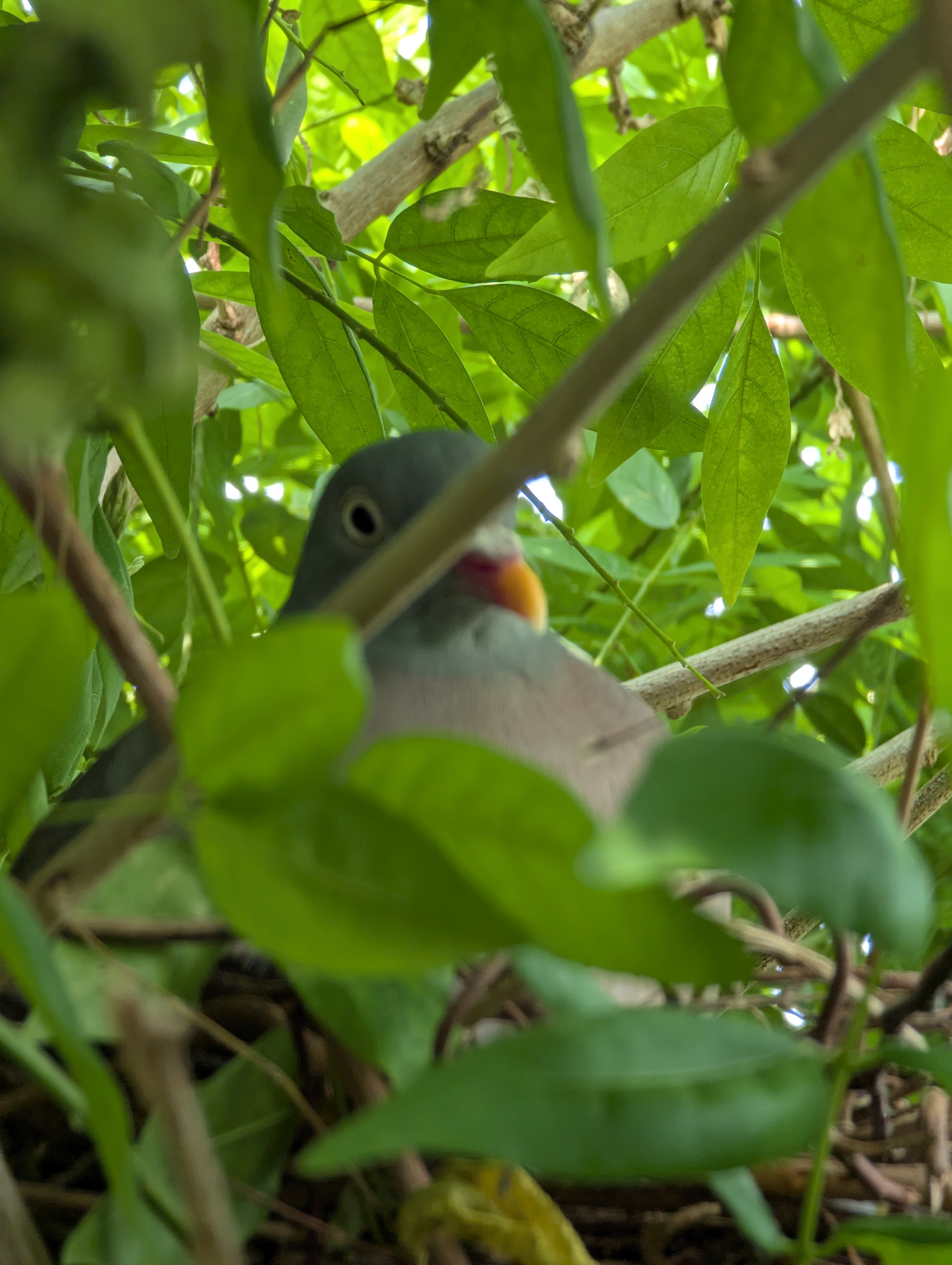
It seems that once you have a pigeon, you have them for life. Once again, we have wood pigeons nesting in the wisteria. No idea whether they are last year's pair returning; somehow I suspect not as pigeons seem to be very promiscuous. It is also much earlier than last year.
Photo 1: Wood Pigeon on Nest (June 2025)
The position of the nest has shifted to the right so I no longer have to walk directly underneath it when visiting the kitchen garden. The nest is the usual jumble of twigs and you always get that pigeon stare when you look at it. I don't know whether they think I cannot see it if they don't move? Mary did see the changeover from female to male (or vice versa) so both parents help out with sitting on the eggs.
Photo 2: Wood Pigeon on Nest (June 2025)
I guess the wood pigeons reckon they've hit the jackpot with a ready made nesting site and nearby eat-all-you-can outlet only 30 feet away!
I do keep moving the attachments on the bird feeder to try and stop the woodies feeding from it. I don't mind them hoovering up the bits that fall to the ground but I don't want them creating the mess in the first place.
Video 1: Wood Pigeon Balancing on the Bird Feeder
No doubt in a few weeks, we'll have a couple of ugly duckling staring at us every time we go through the wisteria arch.
Great Tew is a picturesque village in Oxfordshire, not far from Chipping Norton and only a few miles from where we were staying. So we paid an afternoon visit after unpacking. There was a lot of building work going on so the village wasn't looking its best. The pub (Falkland Arms) and next door cafe (Quince & Clover) looked inviting but we were heading up towards the Norman church of St Michael's and All Angels.
From the road, you pass through this 17th Century gateway with just a short walk up to the church ...
Photo 1: !7th Century Gateway
... which suddenly comes into view on your left ...
Photo 2: St Michael & All Angels, Great Tew
The church has some original Norman features but was largely rebuilt in the 13th & 14th Centuries.
Photo 3: Inside St Michael & All Angels, Great Tew
Two flower arrangers were getting the church ready for a wedding on the Saturday (7th June) and were able to assist in moving a couple of large urns. We were also told that another wedding that summer was planned where the church would be decorated with 80,000 roses!! Names were not mentioned but perhaps it is Steve Jobs daughter?? Whoever it is, we wish them luck although that many roses seems a tad excessive.
As we were walking back to the car, this somewhat unexpected chimney came into view ...
Photo 4: Chimney for Sawmill Beam Engine, Great Tew
Apparently, part of a sawmill complex and built for a beam engine which has since disappeared.
The following day we visited Blenheim Palace (here and here) which left Saturday to fill before we departed early on the Sunday.
I forgot to take a picture of the Whispering Knights which is the oldest part of this ancient monument and 5000 years old (similar age to Stonehenge). Perhaps we were feeling a little peckish so we retired to a nearby garden centre for some refreshments. We also came away with a few plants!
Did I mention the great views from the Rollright Stones?
Photo 7: View from the King Stone
After partaking of refreshments, four of us went to Chastleton House while the other pair headed for Chipping Norton. Mary & I visited Chastleton House & Garden last October but it's always nice to revisit in a different season. It was a quick visit because we had to get back to our holiday accommodation to welcome some visitors at 4.30 pm. There was still time to pop into the church for refreshments (Angela's Legendary Brownie) raising funds for a local school.
Photo 8: Chastleton House
Photo 9: Chastleton House Gardens
Photo 10: Chastleton House Gardens
On Sunday, we left our excellent holiday accommodation and headed for Burford - gateway to the Cotswolds - before our three parties headed off in different directions (Isle of Wight, North Devon and Hereford) for home.
Despite this area being a magnet for celebrities (the Chipping Norton Set) and Sir David Beckham living near Great Tew, we had a quiet and relaxed break with just the right amount of excitement.




 Posts
Posts

